The history of knives and other edged instruments is tied to the history of people in general. As humankind’s oldest tool, unraveling knife history can lead to even more surprising and enriching information to better understand the world.
If he were in his prime today, Jim’s EDCs would run the gamut.
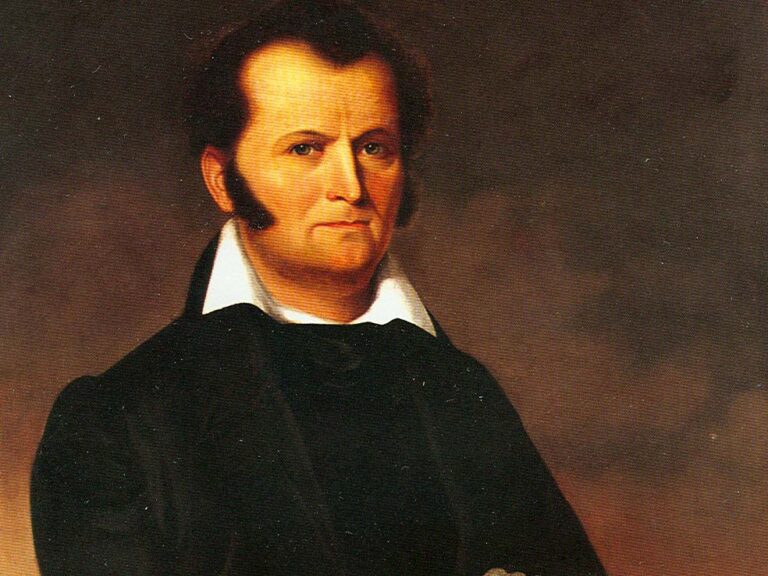
Jim Bowie is known for more than a few things, among others the Sandbar Fight, the Battle of the Alamo and the knife called by his surname for nearly 200 years. A member of the BLADE Magazine Cutlery Hall of Fame®, he was a businessman, soldier, pioneer and frontiersman, and a gentleman of means. While he gave his life at the Alamo 190 years ago this March 6, if he were as immortal as his namesake knife, what would be his EDC today?
BLADE® field editor Reuben Bolieu knows knives, the outdoors and bushcraft.
“If Jim Bowie were around today, he’d do as I’m sure he did back in his time—use the best materials on hand up to his standards,” Reuben observed. “I believe his everyday carry would reflect both tradition and modern utility. Two blades from Bear Forest Knives stand out: the GT-EDC and the Thunder. Each offers distinct advantages and together capture the essence of Bowie’s legacy.”
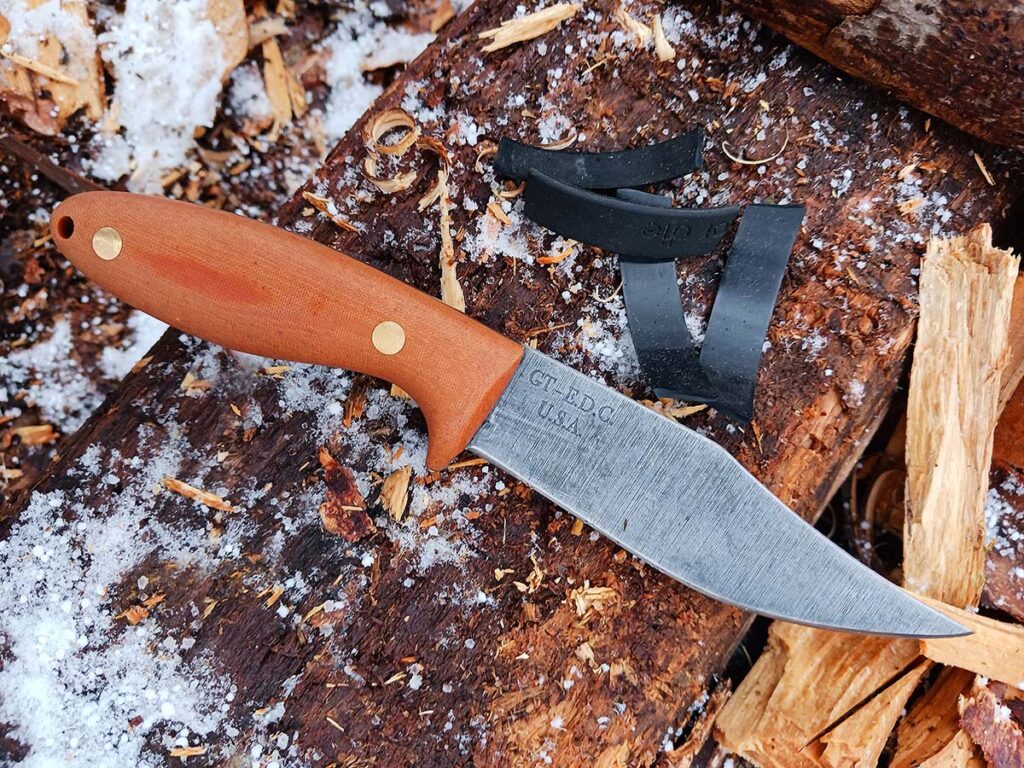
The GT-EDC belt knife is compact yet capable. At 8 inches overall with a 4-inch blade, it balances portability with cutting power. The eighth-inch thickness gives precise control and strength without excess weight, while 1095 carbon steel ensures durability in the field. A 90-degree spine adds fire-starting utility, and the full flat grind makes slicing efficient. Finished in a rock-tumbled acid wash, it carries a rugged look that matches its performance.
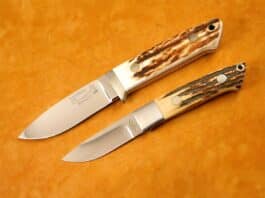
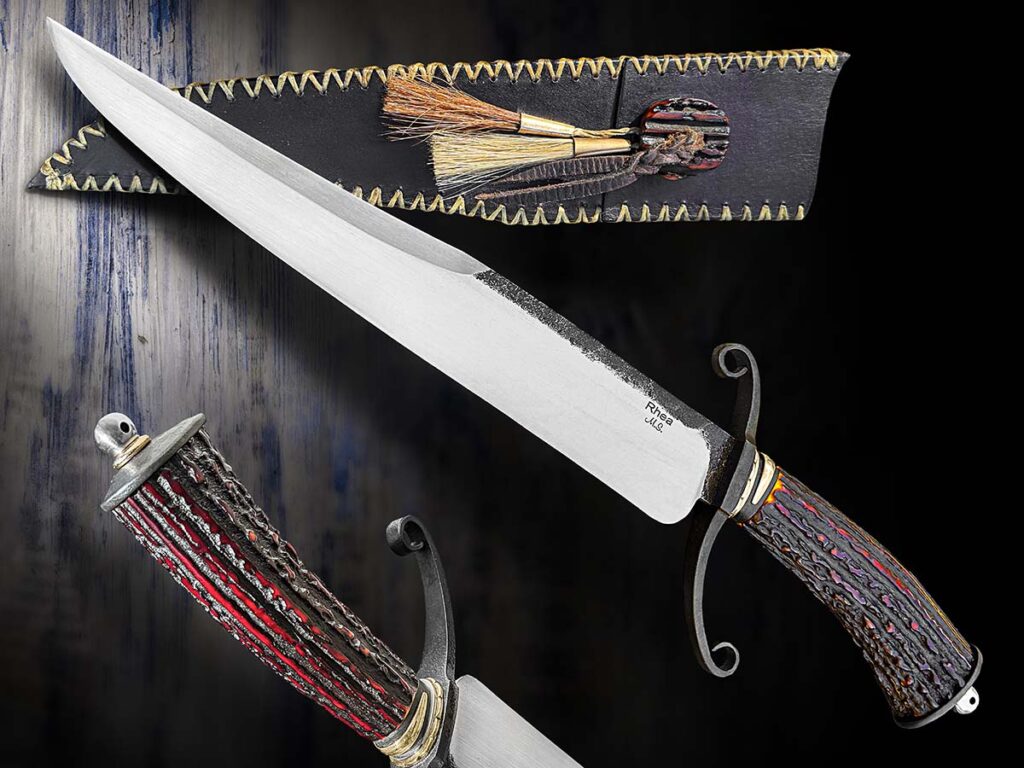
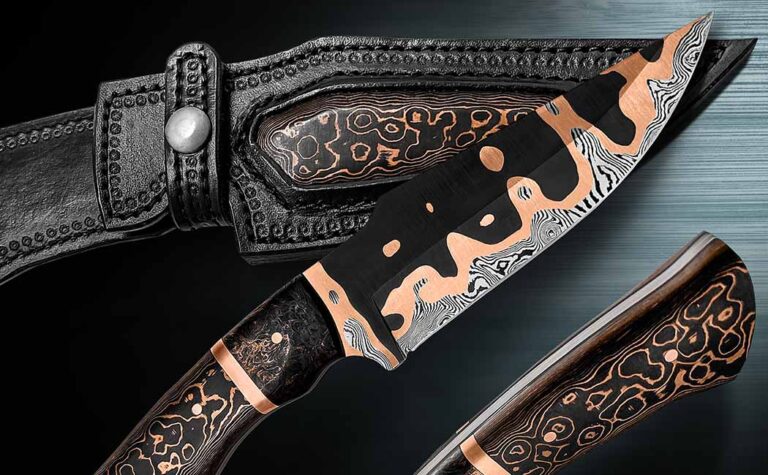
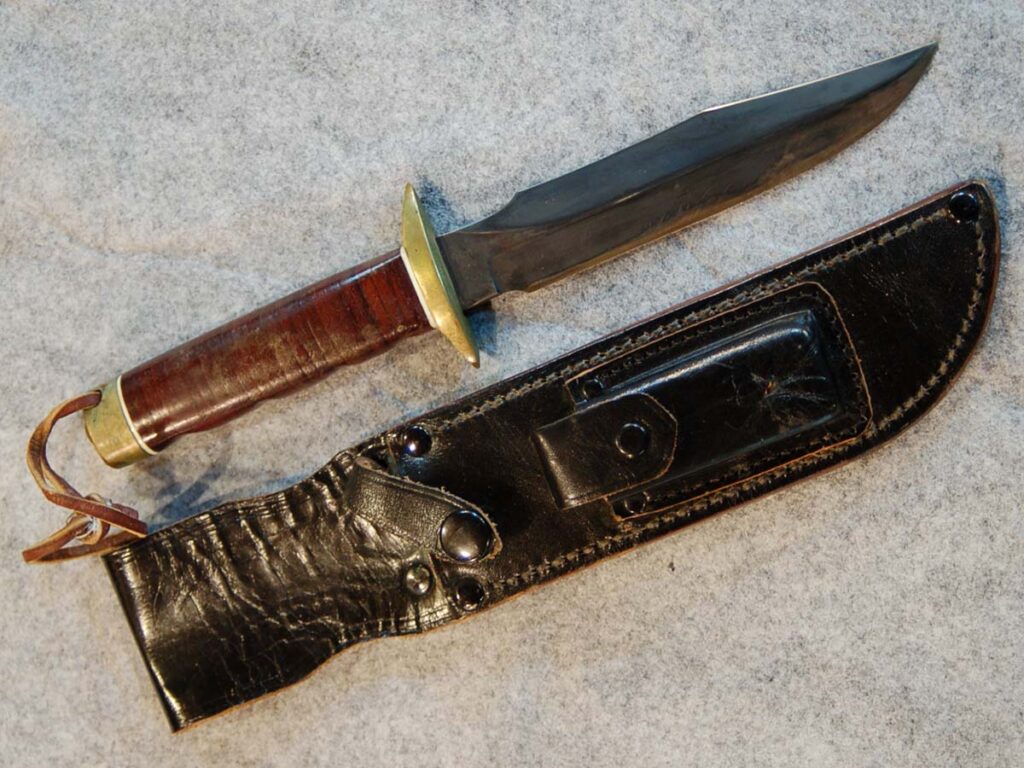
In ABS master smith Lin Rhea’s view, Jim Bowie would still be carrying a bowie knife, forged and differentially heat treated, with a few touches of class. A modern-styled knife with a hint of the Sandbar Fight like Lin’s Preacher (facing page) would fill Bowie’s bill. Kay Rhea made the sheath. (Jocelyn Frasier knife image)
The sheath is .080-inch-thick black Kydex, with a nylon cross-draw/scout belt loop. Though definitely not the typical way to carry a knife in Bowie’s days, in modern EDC terms it’s the Bowie spirit distilled into a pocket-sized package.
On the other hand, Bowie was known for carrying big steel. It was not just acceptable for him to carry a big knife, it was expected. That’s where the Thunder comes in. At 15 3/8 inches overall with a 10-inch blade, it commands respect the moment it clears leather. At 3/16-inch thick, the 52100 carbon steel blade is built for performance. The high-saber grind delivers power on every cut, while the 90-degree spine adds versatility. The rock-tumbled acid-wash finish speaks to hard use, not polish. Natural linen Micarta® scales lock into the hand, and the JRE Industries brown leather sheath completes the package.
The Thunder is more than a knife—it’s a frontier weapon, a tool and a statement. Bowie would carry it with pride, knowing size and steel would give him the edge on any foe.
Together, these knives show the evolution of Bowie’s legacy. The GT-EDC represents modern practicality—lightweight, efficient and discreet. The Thunder embodies the old-school bowie ethos—large, commanding and battle-ready.
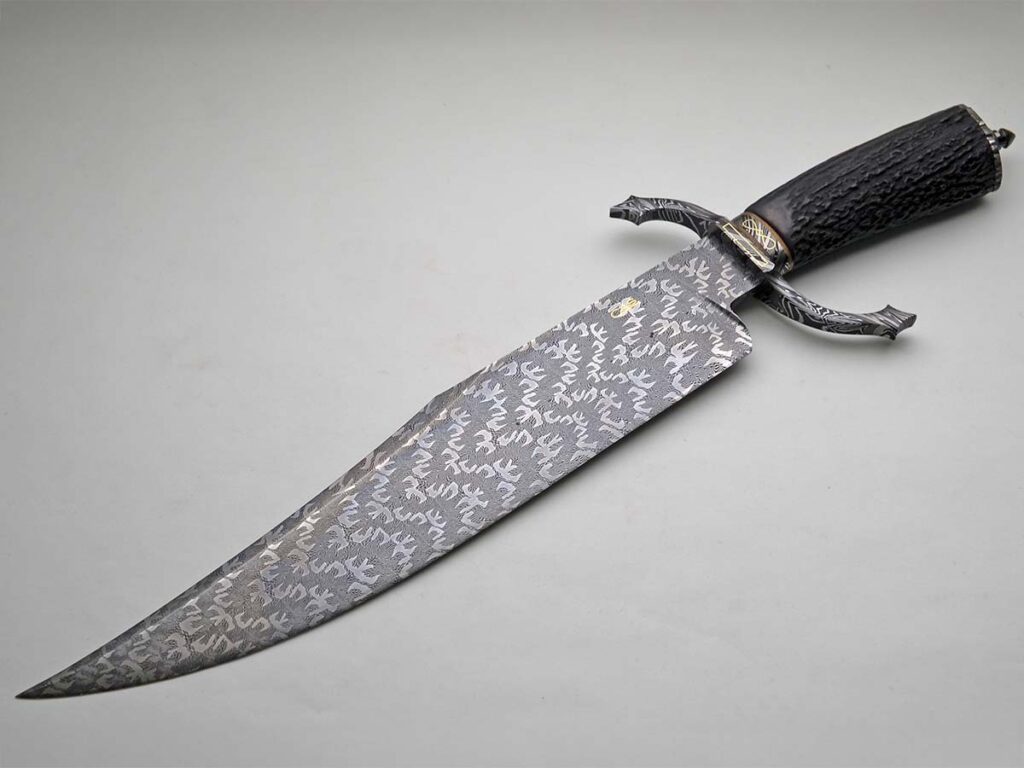
“Bowie would carry something like one of the CAS knives,” purveyor/retired ABS master smith Dave Ellis said. “They’re perfectly executed with high-end materials and expert technique.” A Sobral Brothers/CAS bowie in mosaic damascus, S-guard, gold accents and stag handle applies. (Dave Ellis/Exquisiteknives.com image)
“If Jim Bowie lived today, I believe he’d carry both,” Bolieu stated. “The GT-EDC for daily utility, the Thunder for the moments when steel decides fate—both made in the USA. In either case, he’d have the edge on any foe.”
The Preacher
Few bladesmiths merge both historic and modern influences in their bowie knives as well as ABS master smith Lin Rhea. If anyone can predict how a contemporary Bowie would blend historic knife design with modern materials and flair, it’s Lin.
“I try to pay homage to the old craftsmen and their techniques,” Rhea observed of his bladesmithing approach. “That’s how I know how to do things: the old way.”
According to Lin, after the Sandbar Fight Bowie sought out James Black, who made the knife known as Bowie No. 1. Black lived in Washington, Arkansas, just down the road from where Rhea lives today.
With the pronounced clip-point blade, it’s easy to see the Bowie influence on the GT-EDC from Bear Forest Knives. Would a Bowie-inspired EDC be on Jim’s hip?
“I think for sure he’d go with some kind of S-guard bowie knife, with a sharpened clip and a stag handle. It would be both fancy and practical,” Lin opined. “Bowie went to James Black because his blades had a reputation for toughness as well as innovation, using silver in such a way as to render the handles waterproof.”
Compared to the knives of the time, the bowie was larger than usual and had a larger handle, too. Obviously, to Lin, Bowie would still be carrying a bowie knife, forged and differentially heat-treated, with a few touches of class. He’d still carry an innovative version of his old-faithful design. A modern-styled knife like Lin’s Preacher would fit the bill.
High End
Dave Ellis is a custom knife purveyor and a retired ABS master smith. He knows how to make a world-class knife and what it takes to buy and sell knives of the highest quality and price points.
“If we were just thinking about price points, Bowie could carry a Loveless Big Bear or a Bill Moran damascus ST-24,” Dave noted. “Both would be $60,000 to $80,000 in today’s dollars.” Vintage examples of those knives are so valuable because they were made by two iconic Cutlery Hall of Famers and are historic, nearly antique. Would Bowie carry such an expensive knife that’s several decades old? You be the judge.
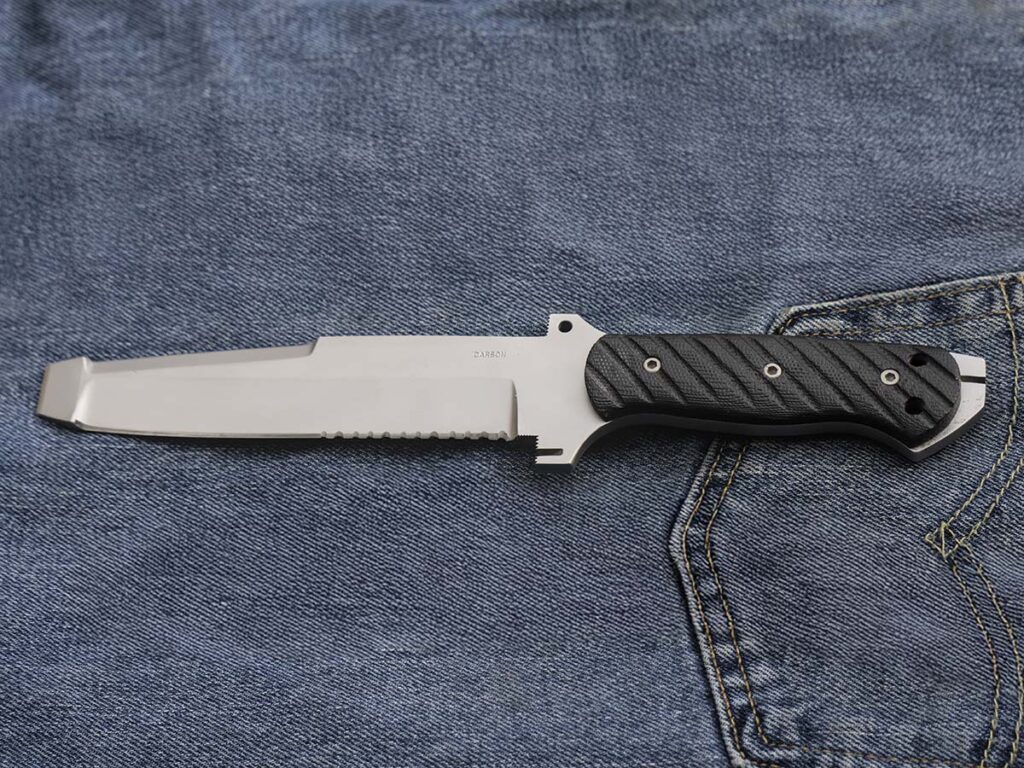
Veteran EOD tech Rob Cude said Bowie would carry at least two knives. One might be like the knife Cude and Kit Carson designed that eventually became the Buck Knives Intrepid. The original design featured a special wedge-shaped tip, a sharpened spine area for cutting metal straps and an exposed tang for durability during hammering.
Dave and your intrepid reporter discussed jewel-encrusted daggers by Cutlery Hall-of-Famer Buster Warenski, engraved Warren Osborne autos and $100,000 Japanese katanas. We ultimately recognized that Bowie had a flair for the practical. While he may very well carry a knife that screams “I’m rich!” it would also have to do its basic job.
When it comes to the highest modern expressions of the bowie knife, the South Americans stand out. Whether by the Sobral Brothers/CAS Knives, ABS master smiths Dionatam Franco and Rodrigo Sfreddo or other top artisans, the merger of high quality and performance within the bowie genre is very evident.
“I’m thinking Bowie would carry something like one of the CAS knives,” Ellis said. “They’re perfectly executed with high-end materials and expert technique, and at a first glance are still immediately recognizable as bowie knives.”
Warfighter Knives
Serving his country with acts of valor as a first-class warfighter, veteran explosive ordnance demolition (EOD) tech Rob Cude spent his career in the shadows. Success in his job meant frustration for the bad guys and safety and silence for the good ones.
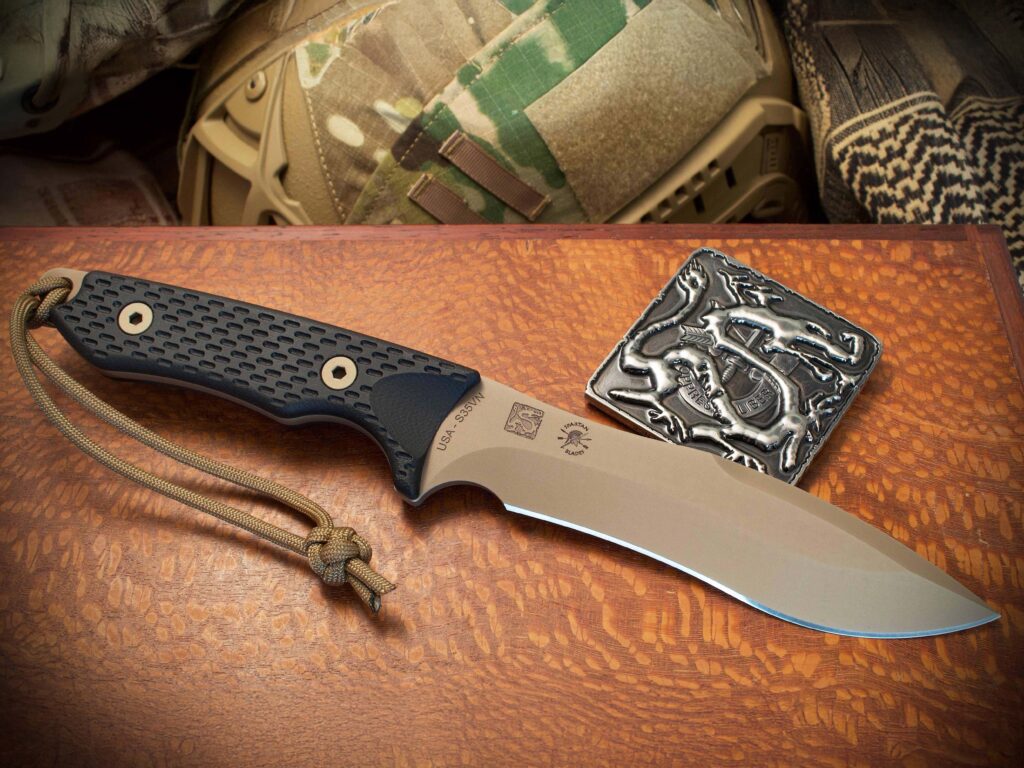
According to Rob Cude, something like the Spartan Ronin Shinto with a recurve blade, long edge and a bit of belly for utility jobs would be on Bowie’s hip. Blade steel and length: CPM MagnaCut stainless and 5 5/8 inches. Country of origin: USA. MSRP: $385-$420.
Rob’s background is in knife design for special forces, military and EOD. In the 1990s, he sought out Cutlery Hall-of-Fame maker Kit Carson to build exactly the knife that would suit his needs. The modern warfighter may jump out of a plane, swim from a boat or trek over land, none of which lend themselves to a wimpy knife.
In tandem with Kit, Rob designed the knife that would in 1998 become the Intrepid from Buck Knives. The original design featured a special wedge-shaped tip, a distinctive sharpened area on the spine for cutting metal straps, an exposed tang for durability during hammering, and a ceramic bead finish that was much more rust-resistant than a sandblasted one. Stainless 440C steel was the best game going at the time and had a suitable combination of hardness and toughness.
“If your knife edge rolls or the knife bends, you can fix it,” Rob advised, “but if it chips or breaks, you’re stuck.”
From Rob’s soldier perspective, Bowie would carry a gun and at least two knives. As technology has evolved, the tools of the soldier have evolved. Given how Bowie was responsible for the evolution of a knife style, it makes sense that his tastes would continue to evolve as well. A modern Bowie would carry one knife for work and another for self-defense.
“Something like the Spartan Ronin Shinto would be on Bowie’s hip,” Rob opined. “It has a recurve blade with a long cutting edge but also has a bit of belly that works well for utility tasks.
“Whether it’s cutting lines and straps or opening MREs, a fixed blade in the 5-to-6-inch range is on every modern fighter’s hip. He would also carry a backup knife for self-defense, and a pistol and rifle as well. Bowie was proficient in the tools of his time and that’s his real legacy. He’d carry that proficiency forward into the modern age, adapting to the tools of our time.”
In the end, of course, we’ll never know exactly what a modern Jim Bowie would carry if he could, but one thing’s for sure: you’d not want to meet him on a sandbar or battlefield to find out.
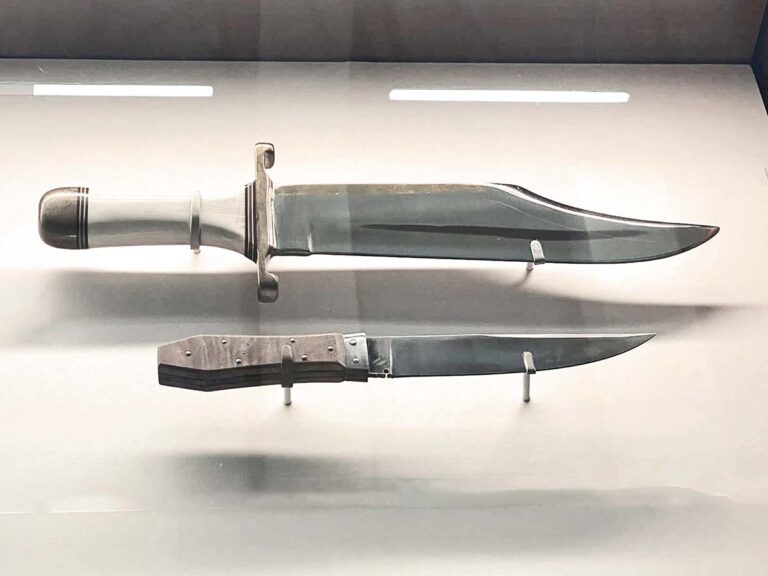
John Dennehy’s replica of his father’s Dan D Alamo Bowie, was accepted by the site on the 190th Anniversary of the historic battle.
We should always remember the Alamo, but 2026 is a particularly good year to keep the battle top of mind. It’s the 190th anniversary of the defining fight for Texas independence, and a fitting backdrop to a father-son knifemaking tale.
When Dan Dennehy donated his custom Dan D Alamo Bowie to the Daughters of the Republic of Texas in 1968, little did he know that a reproduction of the very same knife would be presented almost 60 years later to representatives of Alamo Trust just a few months before the historic anniversary of the Battle of the Alamo.
Made by Dan’s son John, the presentation reproduction is based on the original donated by Dan to the DRT in 1968. Save the engraving on the accompanying brass plaque. John did the entire repro project, which included 5/16-inch O1 tool steel like the blade material on his father’s original Dan D Alamo Bowie, and an embellished oak presentation frame.
Engraved number 5 of 10 by Pearce Richardson, the brass plaque reads: “Commemorative Dan D Alamo Bowie” over “In Honor of Those who Lost their Lives defending the Alamo in March 1836 and to the late Daniel J. Dennehy, Knifemaker, whose Alamo Bowie has proudly been on display at the Alamo since 1968.”
“It’s an honor that we can say we have knives from a father and son in our collection,” Alamo Senior Researcher and Historian Kolby Lanham said. “We are grateful to both Dan and John, two generations of knifemakers who chose to create works of art honoring James Bowie and the Alamo.”
John’s project started soon after his father’s death in 2011.
“The Alamo let me take pictures of Dan’s original knife in the spring right after his death,” he said. “I used those pictures and his knife pattern to make the reproductions. I wanted to jazz up the handle a bit since they are special editions with ivory Micarta and imitation ivory Micarta, along with some brass spacers for bling.”
From his own retelling of the story, Dan was inspired to make the donation during a visit to the Alamo, when he realized the historic site then didn’t have a single bowie knife. The namesake of the blade—Jim Bowie—was among the heroic men who fought and lost their lives at the battle.
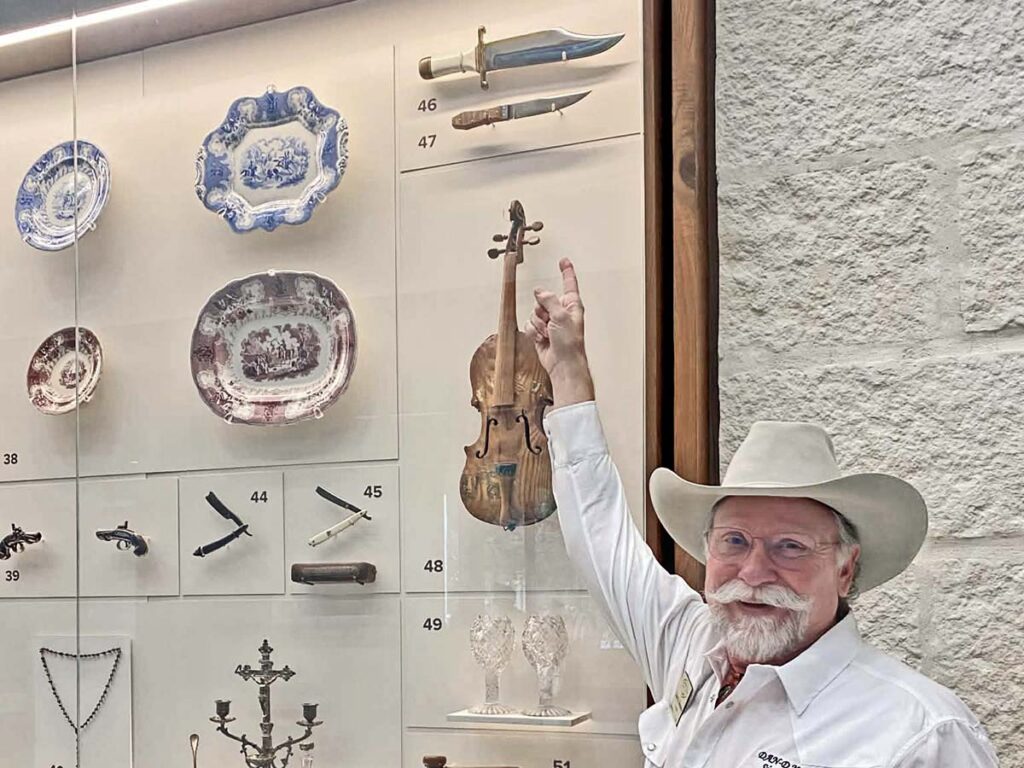
The original Dan D Alamo Bowie is displayed inside the lobby of the Alamo Exhibit at the Ralston Family Collections Center, according to Lanham. John’s knife resides in the Alamo’s artifact vault.
There are other storied knifemakers whose works are displayed at the iconic Texas site, including a reproduction of the Joe Musso bowie by BLADE Magazine Cutlery Hall-of-Fame® member Gil Hibben.
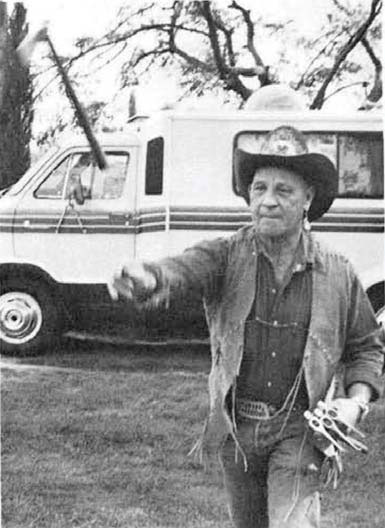
A founding member of The Knifemakers’ Guild, Dan Dennehy was also a member of the Cutlery Hall of Fame and the International Knife Throwers Hall of Fame, and for many years conducted knife-and-tomahawk-throwing demonstrations at the BLADE Show. John makes knives and sheaths and has conducted seminars on how to make sheaths at both the BLADE Show and BLADE University.
New York-born, Dan was always a Westerner at heart, John pointed out, known as “Tex” in the Navy and wearing cowboy boots and a hat most of his adult life. He also loved and revered the history of the Alamo, finding it as sacred a location as native Texans.
“Having one of his knives on display [there] was one of his most cherished accomplishments,” John said.
Ka-Bar Makes One Of The Most Legendary American Combat/Utility Knives. First Issued In 1942, The Knife Continues To Impress And Inspire Today.
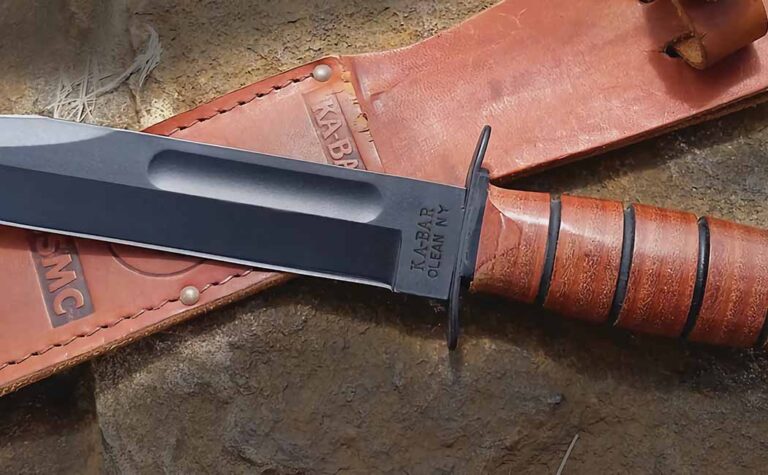
Few knives are as beloved and inspire more contemporary blades, than the Ka-Bar USMC fighting/utility knife. Ka-Bar Knives’ designation for it is the 1219C2, aka “the Ka-Bar,” and the knife was, and still is, a high-quality combat/utility tool. Ka-Bar Knives makes the contemporary version in its factory in upstate New York.
The History Of The Ka-Bar
As America entered World War 2, the Army and Marines took issue with the old World War 1-era trench knives that were being issued to them. The handles were too bulky, the blades were too brittle, and they were expensive to make.
After trying a few stopgaps, the Army asked arms suppliers to design a new combat/utility knife. Marine officers John Davis and Howard E. America worked with the Union Cutlery Company (now Ka-Bar Knives) to design a model that took elements from an old Navy knife and civilian hunting knives to create the 1219C2. In addition to Ka-Bar, Camillus, PAL, Robeson Shuredge, Case and Ontario were among those who made a USMC fighting/utility knife or a reasonable facsimile.
The knife was first issued to elite Marine units in November, 1942 and became standard issue for all Marines by 1944. Today, the knife is manufactured for military use and marketed to civilians as a utility/hunting knife.
Modern Ka-Bar Knives
Along with the original USMC fighting/utility knife, Ka-Bar makes many different combat/utility knives. This trio is a prime example of what the company produces today.
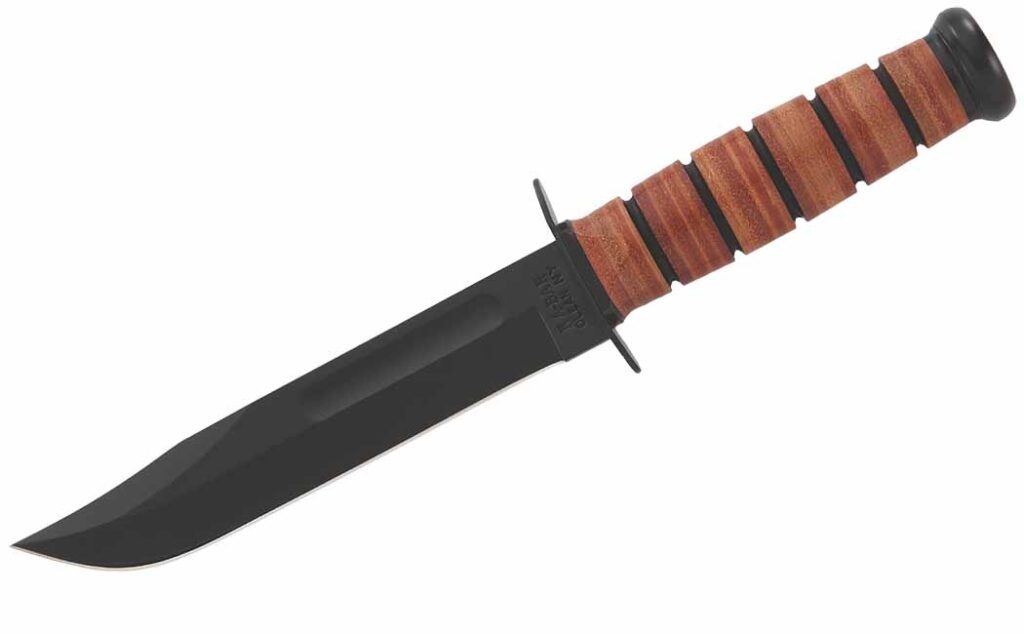
USMC Ka-Bar Plain Edge
The knife that made the Ka-Bar name famous is as popular as ever. There’s also a serrated version, but the plain edge is the original and is a hefty, economical knife.
The 7-inch clip point blade is made from 1095 Cro-Van steel with a 20-degree flat grind and a Rockwell hardness of 56-58 HRC. At just 11.2 ounces, it’s lighter than you might expect from a knife that size, which lets it flow smoothly when slicing, and the leather handle provides a secure grip. The rigid plastic sheath is MOLLE-compatible and can be carried vertically or horizontally.
Classics are classic for a reason, and the USMC fighting/utility knife is everything you could ask from a combat/using piece.
MSRP: $128.53
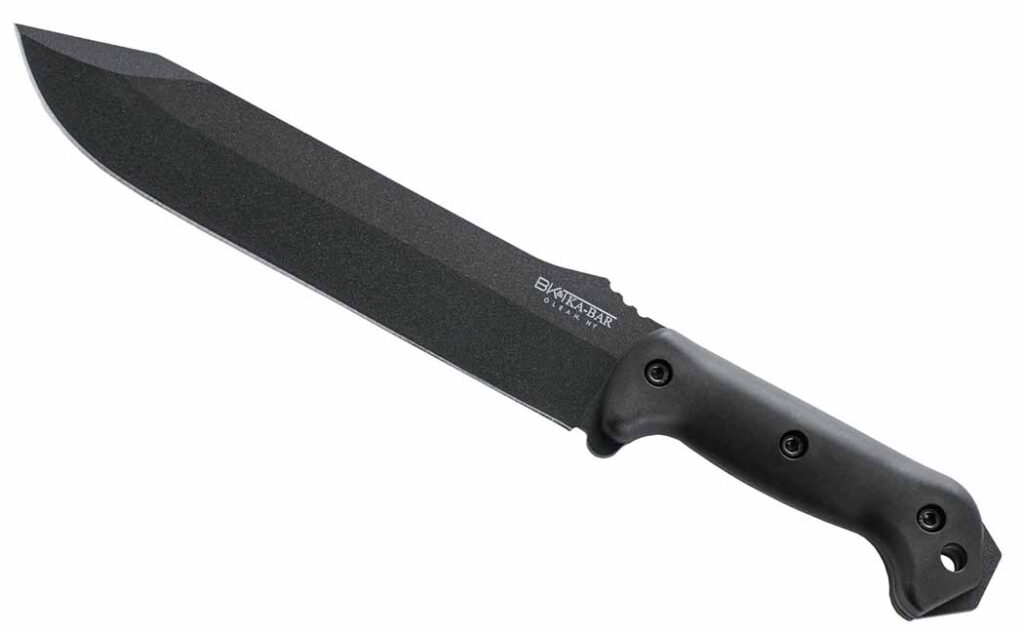
Becker Combat Bowie
Melding an American bowie-style blade with Becker’s trademark ergonomic handle design and you get this sleek, all-black combat knife. It is designed for bushcraft or camping too.
The 9.25-inch blade is married to an Ultramid handle that provides a strong grip. At 17.12 ounces, it’s a bit heftier than the USMC fighting/utility, making it excellent for more heavy-duty work like trimming thicker branches and vines or cutting through medium brush. Similar to the USMC fighting/utility, the Combat Bowie is made from 1095 Cro-Van and has a Rockwell hardness of 56-58 HRC.
A heavy-duty polyester sheath is included and is MOLLE-compatible as well.
MSRP: $178.61
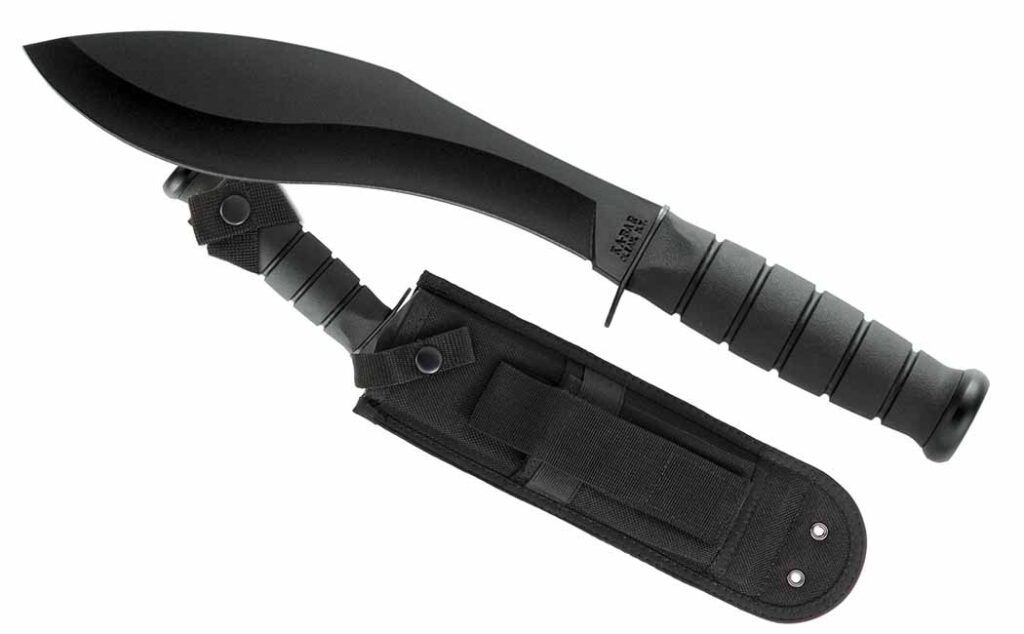
Combat Kukri
This knife may have “combat” in the name, but its bread and butter is decimating small trees and vines. The kukri is smaller than a standard machete and is more finite in its cutting. That doesn’t mean that this blade can’t flex its muscle and chew through almost any brush you put in front of it.
This knife may have “combat” in the name, but its bread and butter is decimating small trees and vines. The kukri is smaller than a standard machete and is more finite in its cutting. That doesn’t mean that this blade can’t flex its muscle and chew through almost any brush you put in front of it.
At just under 16 ounces, it’s relatively lightweight yet robust.
If you’re buying it you’re most likely looking for a high-quality outdoors knife, and this kukri is it. The 1095 Cro-Van will need to be maintained to get the best out of it over time, but that comes with the territory of owning good knives. This knife will make a great companion working through the bush while camping or while cutting through bushes in the backyard.
Revel in a short list of knife industry milestones that transformed the knife world.
Editor’s Note: BLADE Magazine is celebrating its 50th anniversary of its founding this year. To recognize this milestone, we are running a series of articles looking at the changes to the knife world the publication has been privy to over its history.
Time marches on. And in the cutlery industry, the half century from the early 1970s to the present has been filled with both revolution and evolution.
From the corner of a massive hall at a gun show, the slight mention of a new style of field tool, and the basic everyday factory blade carried in the worker’s pocket, the knife industry, both custom and factory, has blazed its own trail over the past 50 or so years, emerging from a somewhat obscure existence to the mainstream. And along the way have been those moments of discovery, awareness and excitement that have marked the trail.
For reference, a few of those moments include the following.
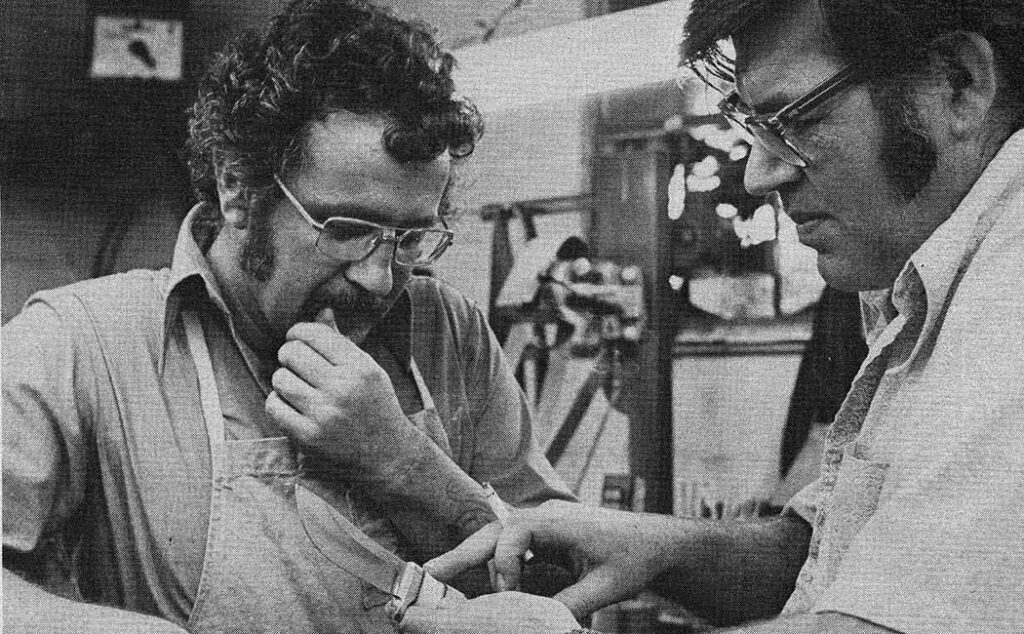
The first “meeting” of the Knifemakers’ Guild basically was the idea of A.G. Russell. What would become the Guild Show was the leading knife show for decades. A.G. (right) discusses a Harry Morseth knife with maker Lloyd Hale (left). (Sid Latham image)
1970s
Though what would become the Knifemakers’ Guild Show was first held in 1970, the show that occurred three years later is still talked about today. That was when Bill Moran reintroduced damascus steel for knife blades, kindling a revival of interest in damascus as the new “super steel” and generating a wave of collector fervor. Also in 1973, Blackie Collins founded The American Blade, a magazine for the knife industry like nothing that had been seen before. Known today as BLADE®, the publication remains a voice for the industry and a tangible contributor to the life and times of the knife enthusiast.
In the following decade, knife shows increased in number and attendance, including the BLADE Show, the New York Custom Knife Show, California Custom Knife Show and the Guild Show, the latter which led the pack for at least 20 years. At the same time, Guild members established industry trends, including the drop-point hunter and the popularization of super steels 154CM and ATS-34 by Bob Loveless, while A.G. Russell vigorously supported the knife industry through his advocacy, sharpeners, knives and growing catalog business.
Eric R Eggly, PointSeven Studios
In 1976, the American Bladesmith Society was formed, and those who forged their blades and worked in damascus at long last had their own organization to promote training and excellence with hammer-ins and other events that brought people together to learn the art of bladesmithing. By 1988, the ABS opened its own school, the Bill Moran School of Bladesmithing. For the first time, bladesmiths and knifemakers could take advantage of a year-round school that offered instruction in forging, bladesmithing and more.
1980s
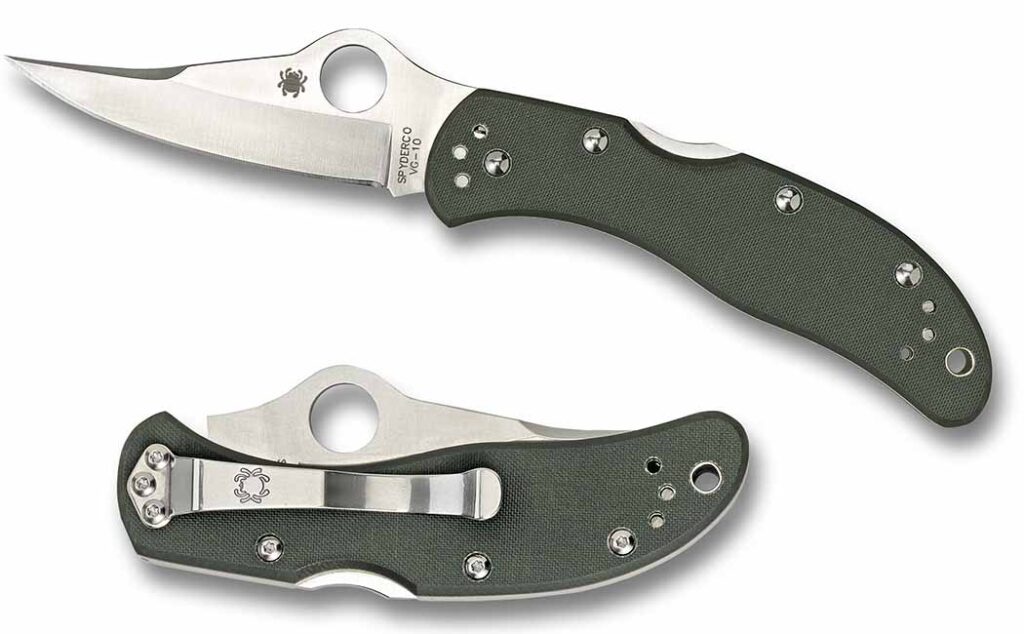
Nineteen-eighty-one saw the introduction of two watershed knife creations by Spyderco and Michael Walker. With the C01 Worker, Spyderco headman Sal Glesser introduced the first knife with both the famed hole in the blade for easier one-hand knife opening and a pocket clip for enhanced carry. Walker, meanwhile, debuted his groundbreaking linerlock folder. The innovations led to a concentration on ease of carry and deployment, focusing the industry on such elements that made the experience of knife ownership something even more special.
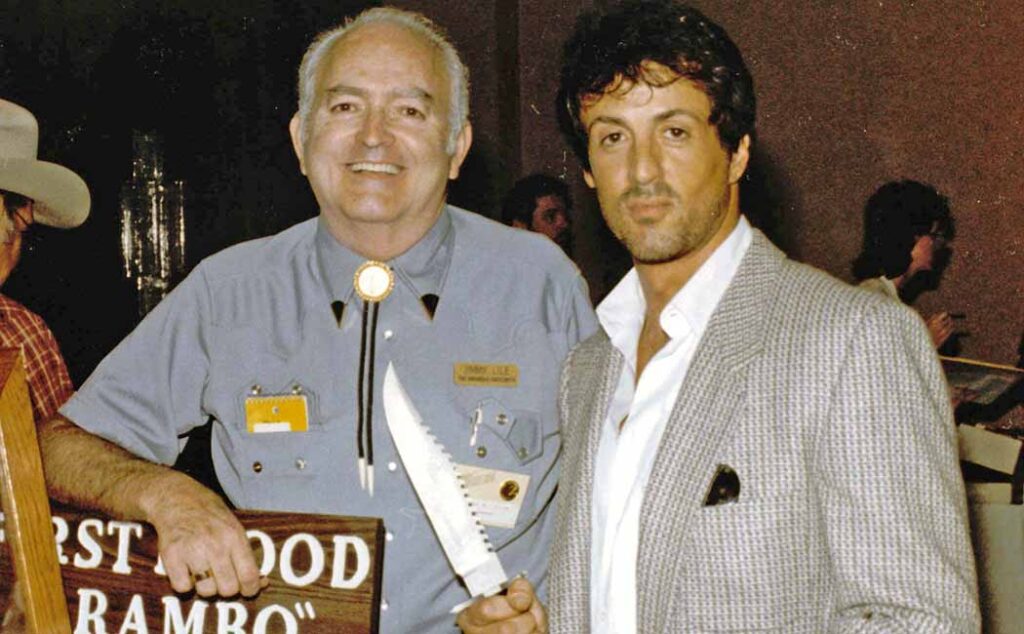
Jimmy Lile and Sylvester Stallone combined to use Lile’s survival knife in the 1982 movie First Blood, and knives were never the same again.
Hollywood took its turn in the early 1980s with the Rambo series of feature films and the knives that played starring roles. Cutlery Hall-Of-Famers Jimmy Lile and Gil Hibben became celebrities in their own right, and sure enough, other knife-and-sword-oriented films followed, including the Conan series, Commando, Predator and The Last of the Mohicans. These were just a few but the knives of custom makers profoundly influenced the marketplace. Soon enough, collaborations between custom knifemakers and factory knife companies began to flower.
1990s
By the 1990s, equipment such as CNC, laser cutters and CAD/CAM entered the knifemaking realm and brought about rapid change in the way custom and factory knives were made. The introduction of such hi-tech equipment into the maker’s shop gave rise to a debate over the very definition of handmade—a debate that continues to this day.
As early as the 1990s, the use of laser cutters—here cutting a hole in a Spyderco blade—CNC machines and other high-tech equipment began to take hold in the making of knives.
At the same time, the emergence of the internet brought the commercial knife market to the world, as custom makers, factories, dealers, collectors and others offered knives for sale on an unprecedented scale. The global reach of the internet led to a burst of information on every aspect of the knife industry, from websites, forums for the exchange of information, how-to videos, online auctions, and even a bit of the dark side—buyer beware! Know your customer and other maxims rang true.
Along with the information explosion, competition was more robust than ever, particularly with the onrush of China’s factory presence, not only in quantity but also, later, in quality. The Chinese influence has redefined notions of affordability, value, and how knives are produced and distributed, and the resulting market conditions continue to impact the buying habits of consumers worldwide.
2000s On
Of course, there are ongoing challenges. Two significant advocacy groups, the American Knife & Tool Institute (AKTI) and Knife Rights, assumed leading roles in responding to knife laws and particularly to the zeal of government regulation, which at times has threatened the livelihood and freedom of Americans to carry one of man’s oldest tools. Pro-knife legislation and the legalization of automatics in many states are evidence of the credible work that has been done, with much of the organized response from the knife industry resulting from the defeat of the 2009 effort led by U.S. Customs to reclassify one-hand knives as switchblades/automatics.
With the C01 Worker in 1981, Sal Glesser and Spyderco introduced the first knife with both the famed hole in the blade for easier one-hand knife opening and a pocket clip for enhanced carry. Released in 2014, the company’s C01GPGR Worker Sprint Run paid homage to the original C01.
Knife Innovation
The history of the modern knife industry is one of rapid change and continuing innovation. Long-time maker Tim Britton recalls the influence of Blackie Collins and Blackie’s foray into publishing. “Blackie could sell refrigerators to Eskimos,” he commented. “The American Blade magazine was one of his favorite projects, and his input and support facilitated the start of the Knifemakers’ Guild. We had one show, the Guild Show, where we could share fellowship and technology. Names like Buster [Warenski], Henry Frank, [W.W. “Bud”] Cronk, Jim Schmidt and Bob Loveless became famous at our annual shows.
“Virgil England took us to another planet and then along came the Chinese industrial monster,” he continued. “Tactical knives were their focus and they had no hesitation in copying American designs. The American Bladesmith Society developed a business model whereby rediscovered damascus steel could be taken to all new levels. There was never any question in this group about ‘what is a handmade knife’ or who is copying whose design. Knifesmiths flourished, and Forged in Fire has taken us all to a new level. Knifemaking caught on in other countries, and those makers continue to produce some of the finest work imaginable.”
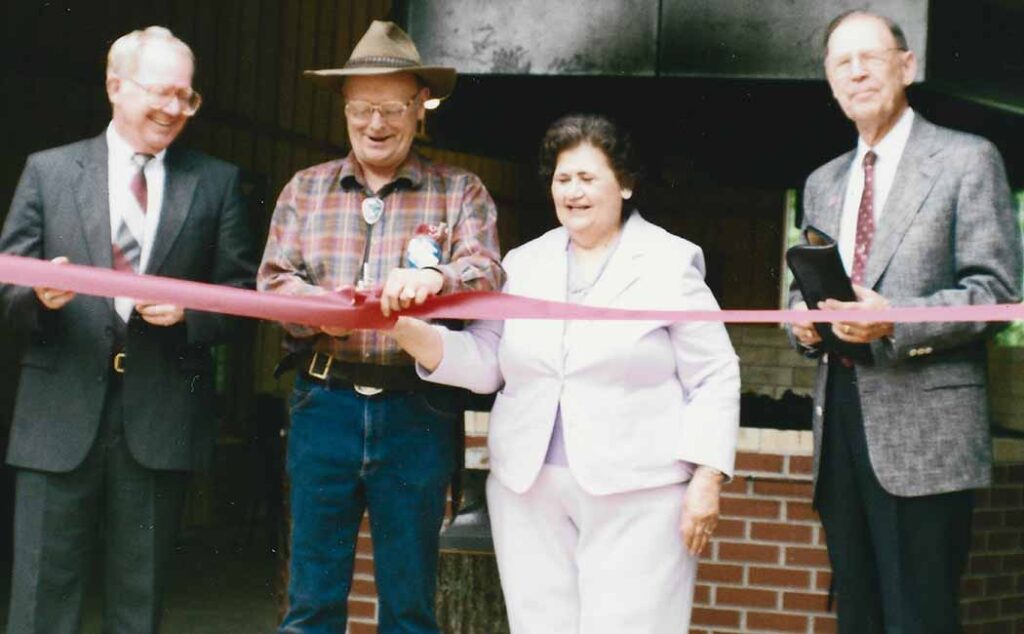
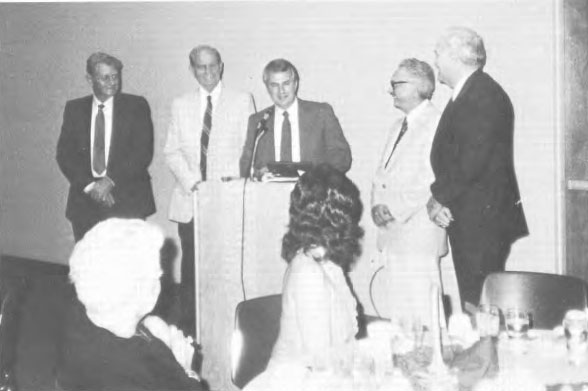
The ABS opened the Bill Moran School of Bladesmithing in 1988. The principals at the school’s ribbon cutting ceremony were, from left: Carl Nelson, president of Texarkana College, Bill Moran and Mrs. Margaret Moran, and Judge James Pilkington.
Custom knifemaker Jim Sornberger well remembers the early days of the Guild and its organization. “The Guild thing was first discussed in 1970, and that was Bob Loveless and A.G. Russell,” he said. “Actually, A.G. bought tables for a bunch of the guys and set that up. He said, ‘Let’s have a show and get a block of tables,’ and so he did that. The Guild was the best organization of knifemakers in the world, and it had the biggest knife show anywhere in the world for many years.”
As for technology, Sornberger says it is simply a fact of life. Evidence of progress and efficiency are seen in makers’ shops routinely today, including CNC equipment, mills, lathes, ingenious versions of versatile grinders and more. “You can’t reverse technology,” he reasoned. “There are always new methods of doing something.”
Ron Lake had a huge hand in the evolution of custom knives, introducing his clever tab-lock interframe folder and helping popularize 416 stainless. “It was a different world back when,” he remarked. “We had a small corner at a gun show, and Blackie Collins was sitting off by himself 30 feet away from me with a slipjoint knife, and I remember Loveless cut himself with that knife! A lot of people came and went from the knife world back in those days.”
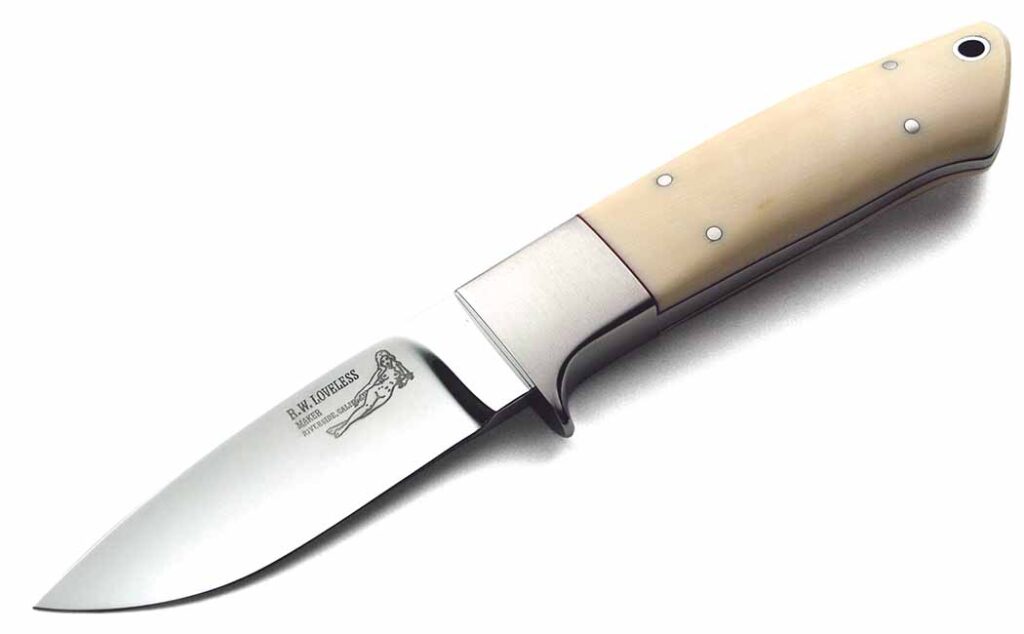
Contributions such as the dropped hunter by Bob Loveless were among the trends started by members of the Knifemakers’ Guild in the 1970s and beyond. (Exquisiteknives.com image)
As Moran brought damascus back into the spotlight in 1973 and other developments were coming along, Lake remembers the growing ranks of the virtuoso custom knifemakers, including Billy Mace Imel, Buster Warenski and others. He also recalls the sudden impact of Spyderco. “I think maybe it wasn’t so much the hole,” he said, “but the clip. That in itself was a mind-boggling event—maybe not so much at the time, but later as people started using it.”
Ron Lake, Bob Loveless, Bill Moran and A.G. Russell
The influential journalistic career of B. R. Hughes has made its own contribution to the modern knife world. Hughes was there in the beginning of the modern era. He planned the first Gun Digest Book of Knives along with Jack Lewis, and it hit the market in 1973.
“That was a meaningful year,” Hughes remembered. “Ron Lake, Bob Loveless, Bill Moran and A.G. Russell are the most influential individuals in the history of custom knifemaking, and A.G. played a bigger role than a lot of people give him credit for. He saw the need to organize and there was a meeting in Tulsa in 1970, and the first Guild Show was in 1971, and it grew unbelievably. They met in Houston and there were about 20 or so makers, and then the next year the show was in Kansas City, and there were 40 or 50, and it just kept growing.”
According to B. R., damascus was a catalyst for revival in American bladesmithing. “The inclusion of damascus saved bladesmithing,” he said, “and there were fewer than 15 bladesmiths in America in 1973. The number was going down. There was Bo Randall and then Rudy Ruana as well, but just a few younger bladesmiths.”
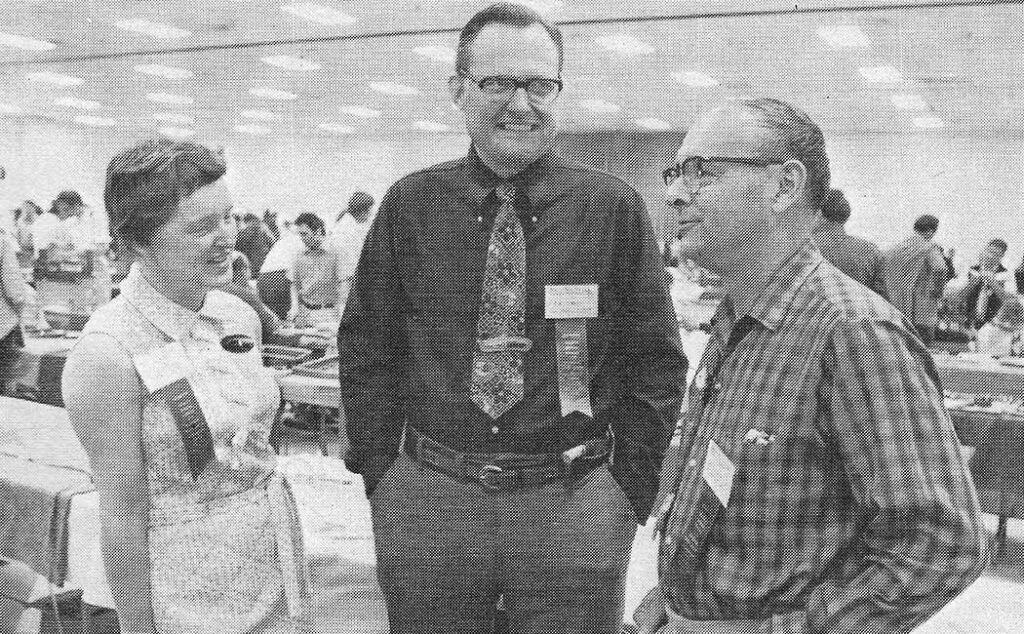
The use of a wide range of new materials in the making of knives exploded in the 1990s and continues to this day. One of the latest examples is Bill Moran reintroduced damascus for knives at the 1973 Guild Show and the rest is history. Moran (right) observes another successful Guild Show with Betty and Ted Dowell at the ’74 event in Kansas City. (Sid Latham image), employed here by Gerry Michael on the blade of his Fancy Harpoon model. (Jocelyn Frasier image edit)
Then, he says, the founding of The American Blade weighed in. “That was immense,” he offered. “I started writing about knives in the early 1960s, and there were primarily just gun magazines. I wrote for Gun Week, doing some knife articles for them, but there was no knife magazine, and the people I wrote about were people I met at gun shows. Without a knife magazine, it made it tough to write about knives.”
Hughes added, “I was fortunate to be around the first meeting of the Guild and things like that.” Indeed, B. R. saw and wrote about history as it was made.
Knife Industry Ups and Downs
These days, the world of knives continues to expand, to change, to elicit praise and criticism. Britton has watched much of this evolution. “Quality Chinese repros are available at flea markets and gun shows for $15 to $40,” he observed. “Many knifemakers are designing knives for knife companies, further blurring the differences between handmade and factory/manufactured. The internet is being used extensively for marketing—from very ornate websites to knife forums. The ‘Show Calendar’ page in BLADE is crammed full of announcements of shows from San Francisco to Paris. Several knife dealers have created a secondary market, and literally thousands of knives are available for sale 24/7.”
Concurrently, Britton is excited about what he notices these days. “We’re seeing abrasive materials, grinders, CNC equipment, new steels, and exotic types of handle materials from paua shells to hippos’ teeth,” he noted. “Creative craftsmen are exploring new horizons with acrylics and phenolics and stabilized wood burls. We see something new at every show.”
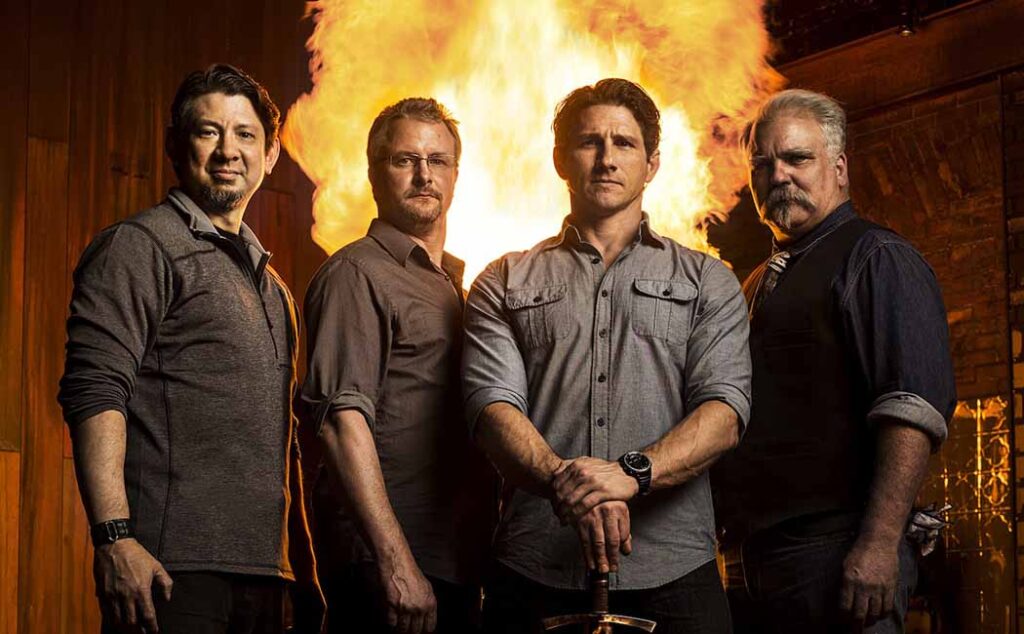
Forged in Fire debuted in 2015 and since then has exposed millions of television viewers to knifemaking and bladesmithing on a weekly basis.
That, succinctly, is a strong indication of an industry, a passion, a way of life that continues to flourish despite the strain and stress that are natural byproducts of absolutely anything and everything that is alive. A half century from now there will be more milestones, more discussions and even greater achievement.
Members of the BLADE Magazine Cutlery Hall Of Fame® mentioned in the story and sidebar are Blackie Collins, Sal Glesser, Gil Hibben, B. R. Hughes, Billy Mace Imel, Ron Lake, Jimmy Lile, Bob Loveless, Bill Moran, Bo Randall, Rudy Ruana, A.G. Russell, Jim Sornberger, Bruce Voyles, Michael Walker and Buster Warenski.
25 Knife Industry Milestones
1973 Bill Moran reintroduces damascus for knife blades at the Guild Show 1973 The American Blade debuts 1976 Bill Moran, B. R. Hughes, Don Hastings and Bill Bagwell found the American Bladesmith Society 1981 Spyderco debuts the C01 Worker, the first knife with both a blade opening hole and a pocket clip 1981 Michael Walker introduces a folder with the linerlock mechanism 1982 First Blood and Jimmy Lile’s Rambo knife appear in theaters 1983 Michael Walker first uses titanium in the construction of one of his linerlocks 1987 Buster Warenski completes the King Tut dagger reproduction 1988 The Bill Moran School of Bladesmithing opens in Old Washington, Arkansas 1992 Bruce Voyles moves the BLADE Show to the Renaissance Waverly Hotel in Atlanta, where it opens to rave reviews 1990s An explosion in Crucible Particle Metallurgy and the so-called “super steels,” and such materials as carbon fiber, mosaic damascus and more revolutionize knifemaking 1990s Computer numerically controlled equipment, laser cutters and more for knifemaking begin to appear 1990s Internet knife web pages, knife discussion forums, knife instruction videos and more start making their mark Mid-1990s Tactical folders begin to dominate the custom and factory knife industries 1997 The BLADE Show moves from the Renaissance Waverly Hotel to the adjoining Cobb Galleria Centre and completes its ascendancy as the world’s most important knife event 1990s Chinese companies begin entering the factory knife business 1998 The American Knife & Tool Institute (AKTI), the oldest surviving knife advocacy group, debuts 2001 Terrorists bring down the Twin Towers and the knife industry reacts with a slew of military inspired knives, tomahawks and more 2006 The Knife Rights advocacy group debuts 2009 The knife industry unites to defeat an attempt by U.S. Customs to declare all one-hand-opening knives switchblades/automatics 2010s Social media begins taking the internet knife business to the next level 2010s Knife Rights and AKTI work to overhaul anti-knife legislation, including overturning automatic/switchblade bans and establishing knife preemption laws at the state level 2010s European knife manufacturers such as LionSteel, Fox Cutlery, Maserin and others begin winning more than their share of BLADE Magazine Knife-Of-The-Year® Awards 2015 Forged in Fire debuts and exposes millions of television viewers to knifemaking and bladesmithing for the first time 2020 The pandemic ravages the world and also the knife world, closing knife shows everywhere—including the BLADE Show 2020s The knife industry survives the pandemic, and, thanks to internet sales, even thrives in some segments—and knife shows begin to return
These knives formed the tip of the U.S. Military’s spear.
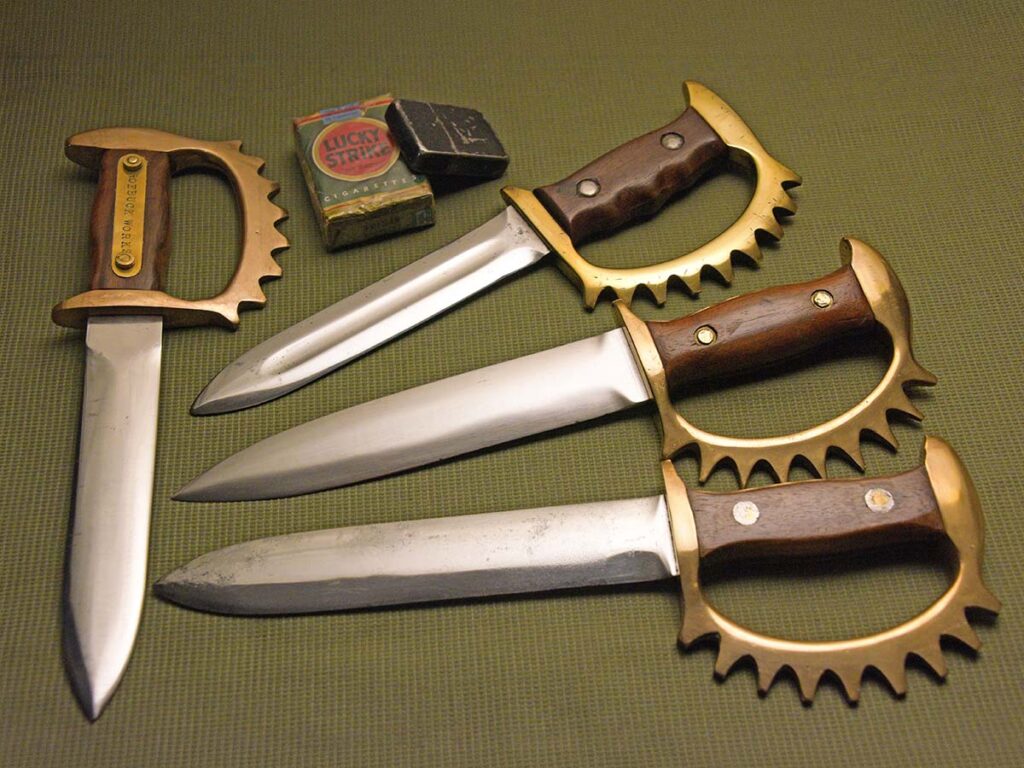
The 20th and 21st centuries saw some of the most iconic of military knives. From the World War I trench knives with the imposing knuckle-duster D-guards to today’s modern folders and fixed blades, a few, in no particular order, stand out above the rest:
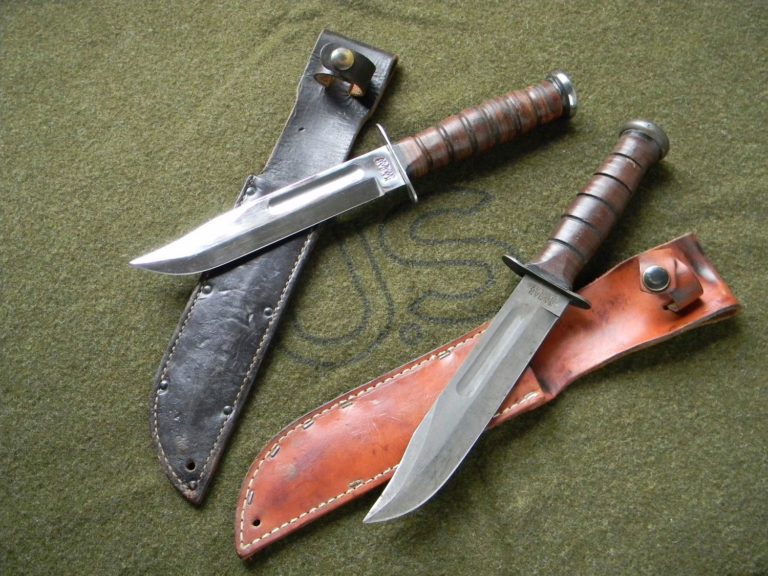
USN Mark II/USMC fighting-utility knife*: According to Army Special Forces veteran and Spartan Blades co-owner Curtis Iovito, “The KA-BAR fighting/utility knife is arguably the most recognizable American military knife ever produced. Introduced in 1942 for the U.S. Marine Corps during World War II, it solved a critical problem: troops needed a knife that could serve both as a weapon and a field utility tool. “Marines used it for everything from opening ammunition crates and cutting brush to close-quarters combat. Its design struck a near-perfect balance between fighting knife and utility blade, and it has influenced military knife design ever since.” “As an issue knife, the classic USN Mark II filled the same role as the Randall Model 1, but in a much more ‘democratized’ sense. Very few soldiers could get a Randall,” explained Army veteran and Spyderco Special Projects Coordinator Michael Janich, “but the Mark II/Ka-Bar was ubiquitous. Although it ultimately became best known as the Ka-Bar and most closely associated with the Marine Corps, it was manufactured by many other companies and widely issued. As a mass-produced item, it was—and still is—a very capable knife and continued to serve with distinction in many other wars after World War II.” “The USMC fighting knife has not always been made by KA-BAR, and KA-BAR didn’t even make them first, but they made it their own,” noted Marine Corps veteran/knifemaker Les George. “It’s the stereotypical military knife in the western hemisphere.” Added Army 5th Special Forces veteran/BLADE field editor/knifemaker Kim Breed, “It is a multi-use combat knife used in one form or fashion in all branches of the service.”
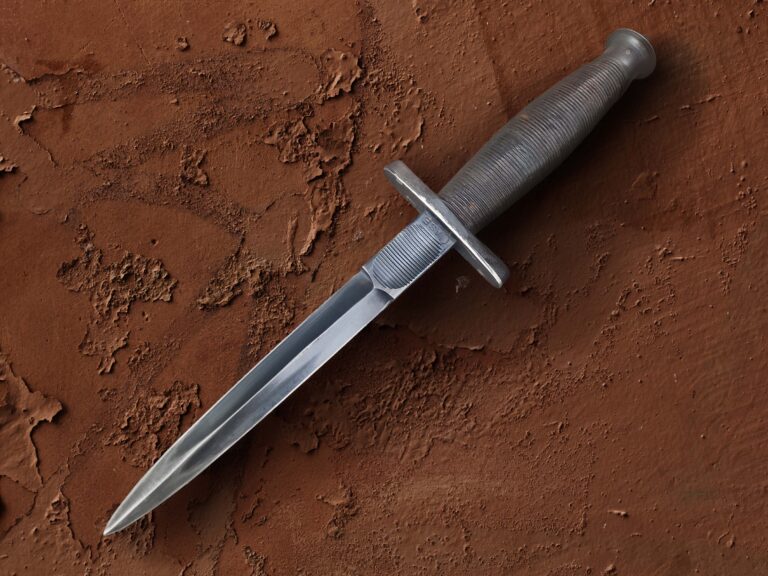
V-42: As Janich noted, “The V-42 is not only one of the sexiest fighting knife designs ever created, it also has perhaps the strongest pedigree since it was designed for and by the First Special Service Force, aka The Devil’s Brigade, of World War II fame. Its unique design and signature sheath reflect the original mission of that unit, which is regarded as the predecessor of current U.S. Army Special Forces units and Canada’s Joint Task Force 2. This iconic design is also immortalized in many U.S. military unit insignia, though it is often mistaken for the Fairbairn-Sykes dagger.”
Randall Model 1: “Randall has done more to influence modern knife design language than most,” George wrote. “The Model 1 is what I think of as peak Randall. Its influence ranges from World War II to the unit-made SOG knives in Vietnam to the modern SOG knife company.” “This iconic design epitomizes everything a military-style fighting knife should be,” Janich opined. “Its blade captures the spirit of the classic bowie knife, but in a leaner, more maneuverable form. The sharpened false edge allows it to back cut and penetrate with extreme authority, and its handle design allows for a grip that is both deft and secure. The fact that it continues to serve downrange in the same basic form to this day is a testament to the fact that it started out damned near perfect.”
Gerber Mark II: “The shortcomings of the original Fairbairn-Sykes and the many variations it inspired became very well-known both during and after World War II,” Janich wrote. “The Gerber Mark II addressed and corrected all of these to offer a superior fighting dagger design. Although it was a private-purchase item, like Randalls, it was much more accessible to servicemen and more widely carried. Its unique variations and its evolution over time also created its own rich history.” Janich added the fact it was the favored combat knife of Michael D. Echanis, decorated Vietnam veteran, accomplished martial artist and hand-to-hand combat knife writer and editor, enhanced its mystique and widespread appeal as well.
More Standouts
Gene Gutierrez
Any number of other U.S. military knives have stood out since the turn of the 20th century. Among them are the M3 trench knife, M1 bayonet, the Applegate-Fairbairn dagger and the Applegate-Fairbairn folder.
“The M3 was what the Army chose to issue in World War II,” George noted. “In purest terms, it also had a fairly short service life, but in real terms it is what became the M4 bayonet on down the line to the M7 bayonet that I used to run the assault course in boot camp in the ’90s. Its influence has been widespread.”
“The World War II-era M1 bayonet, designed for use with the M1 Garand rifle, played an important role in American infantry combat during World War II and beyond. I remember so many old World War II vets telling me stories about the bayonet,” Iovito recalled. “Shorter and more practical than earlier bayonets, the M1 reflected the changing nature of warfare where mobility and close-quarters fighting often occurred in tight environments. Many soldiers also carried the bayonet as a fighting and utility knife when not mounted on their rifles. Its durable construction and effective blade profile made it a reliable tool throughout several conflicts.”
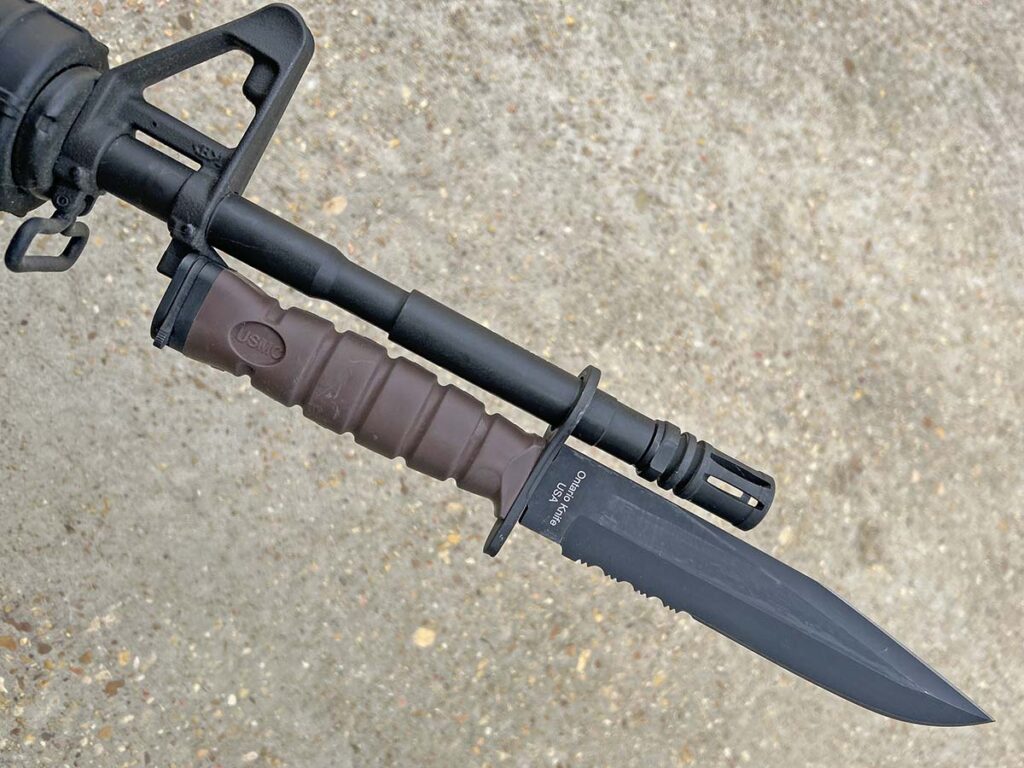
One of U.S. Marine Les George’s teammates mounted an Ontario OKC-3S similar to this one on an M4 to help quell a tense situation on the streets of Fallujah. (Les George image)
The Applegate-Fairbairn dagger and Gerber A-F folder were named after Cutlery Hall-of-Famer Col. Rex Applegate and W.E. Fairbairn of Fairbairn-Sykes Commando Knife fame.
“Another design that corrected the flaws of the Fairbairn-Sykes dagger was the Applegate-Fairbairn dagger,” Janich observed. “Designed during World War II by Col. Applegate and W.E. Fairbairn, it never got beyond the prototype stage before the war ended. Decades later, it finally saw production by several major knife companies. Although very noteworthy on its own, it also inspired a scaled-down folding version that set a new and different standard in folding and fighting knife design. The original A-F Folder design was a collaboration between Col. Applegate and consummate custom knifemakers Bill Harsey and Butch Vallotton.” Added Harsey, a Cutlery Hall-of-Famer in his own right, “The Gerber version of the folding knife was a long-running project, and I was told by Gerber that the Army ordered 50,000 pieces at one time for the troops, which were delivered.”
Few knives enjoy legendary U.S. military status as much as the SOG Bowie, which served as the inspiration for the name of today’s SOG knife company. “The Special Forces SOG Bowie is one of the most iconic knives associated with American special operations forces,” Iovito wrote. “Inspired by the knife carried by members of the Military Assistance Command, Vietnam Studies and Observations Group during the Vietnam War, the SOG Bowie reflects a fusion of classic bowie knife design with modern military needs. Its lineage connects directly to clandestine operations carried out in Southeast Asia, where unconventional warfare units often relied on rugged equipment that could handle jungle conditions and extreme use.”
Howard Cole was famous for making knuckle knives such as these three rare nine-pointers and one eight-pointer. A paratrooper named Clyde McClelland carried the center nine-pointer during World War II. (Image courtesy of Louis Chow)
Folding knives have never been so popular in the U.S. military as they have in the past 40 years, and at or near the top of that list are the Al Mar SERE, CRKT M-16 and Spyderco Endura.
“While many earlier military knives were fixed blades, modern soldiers frequently rely on folding knives for everyday field use. One of the most influential examples is the Spyderco Endura,” Janich began. “For me, the knife carries a very personal meaning. During Operation Just Cause in Panama, I found myself tangled in my parachute harness after landing while under fire. I used my Spyderco Endura to cut myself free from the harness so I could move and get back into the fight. That moment left an indelible mark on me and reinforced the reality that sometimes the most important piece of equipment you carry is the knife in your pocket. The Endura is lightweight, corrosion resistant and extremely functional, and its opening hole allows rapid one-handed deployment, even with gloves. Its reliability and practicality have made it a favorite among soldiers who need a dependable cutting tool for daily field tasks.”
In the fall of 1984, Harsey helped Al Mar do a run of just over 50 large folders for Col. Nick Rowe, who had been tasked by the Army to run the SERE (Survival, Evasion, Resistance and Escape) School near Fort Bragg, North Carolina. “All modern Special Forces soldiers, aka Green Berets, and other high-risk military members including pilots undergo this training,” Harsey stated. “I finished my part of unmarked knives in time for Al Mar to get them on an airplane bound for Fort Bragg and into Col. Rowe’s hands for an important mission date. I never heard another thing about this project. Later this knife would become known as the AL Mar SERE folding knife.”
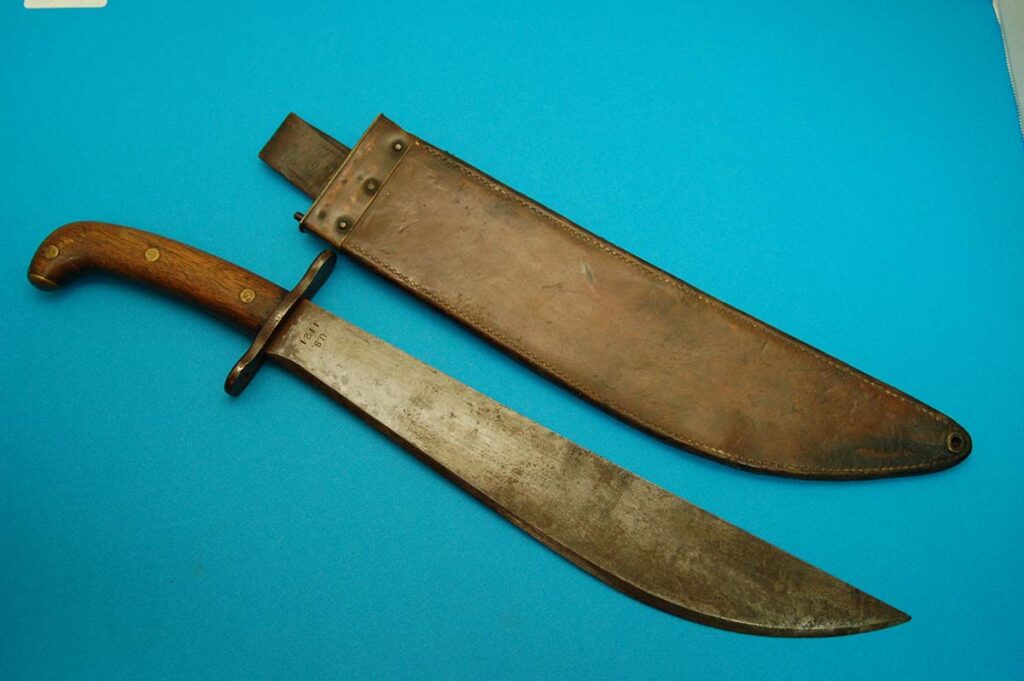
The Field Artillery Corps designed the Model of 1909 bolo for use by crew-served weapons during World War I. It was for clearing fields of fire to enable the limbers and horses to navigate the towed artillery into place. (Images courtesy of Frank Trzaska)
As for the CRKT M-16, its universality during the Iraq War guarantees its spot on the list. “I am not aware of this knife ever being issued but there was a time when you saw them everywhere,” George wrote. “Guys would buy them at the PX and clip them on the outside of their vests. They were everywhere, and they did everything!”
Standard Setters
The foregoing includes but a few of the knives that have served the USA and served it well over 250 years of saving the world from tyranny and oppression and setting the standard billions aspire to today. Other notable knives, in no particular order, include:
The M9, M11 and OKC-3S bayonets; Camillus Jet Pilot Survival Knife; Chris Reeve Yarborough; OSS Smatchet; Collins M1942 Machete; Swiss Army knife; Spartan Blades Ares, Difensa and Harsey Dagger; Randall Models 2 and 18; Gerber Silver Trident Knife and Mark I; G.I. four-bladed pocketknife; Schrade Mark II Paratrooper switchblade; G.I. Machete; Leatherman and Gerber multi-tools; and Western 49 Bowie.
According to Army Special Forces veteran Curtis Iovito, the Special Forces SOG Bowie reflects a fusion of classic bowie design with modern military needs. “Its lineage connects directly to clandestine operations carried out in Southeast Asia,” he wrote, “where unconventional warfare units often relied on rugged equipment that could handle jungle conditions and extreme use.” (Frank Trzaska’s knife and image)
Which ones are we omitting? Let us know. And while you celebrate the semiquincentennial of your favorite nation throughout the year, never forget: knives have played a monumental role in the success of the U.S. military and the building of the USA up to now and for the foreseeable future.
It doesn’t get much sharper than that.
*Though they are two different knives, the USN Mark II and USMC fighting/utility knife are grouped together for the purposes of this story because of their similarity in design and their across-the-board use by U.S. service personnel, especially during World War II. Also, the spelling of KA-BAR refers to the knife manufacturer that continues in operation, while Ka-Bar refers to the generic name service personnel gave the knife, a name that persists to this day.
The entire process rekindles fond memories for this writer, most of which involve the Hall Of Fame ceremony itself that annually occurs during the BLADE Magazine Awards Reception the Saturday night of the BLADE Show.
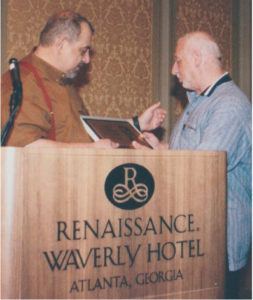
Bob Terzuola (left) presents Sal Glesser (right) with his BLADE Magazine Cutlery Hall-Of-Fame® plaque during the Hall-Of-Fame ceremonies 20 years ago at the 1999 BLADE Show.
The first such ceremony that stood out for me was in 1988 when A.G. Russell and Ken Warner inducted each other—with neither knowing at the time the other would be inducted as well! When each inducted the other the expression on the new inductee’s face was priceless, and that ceremony remains like no other before or since.
Hubert Lawell’s induction in 1989 was memorable for his bringing a copy of the old and now defunct EDGES pocketknife newspaper we used to publish up on the stage, holding it high in the air, and praising it and everything it/we did as the greatest thing for the knife industry since sliced bread. Never mind that many in the audience appeared unsure of what Hubert was saying in his low Tennessee drawl, at the end of his speech he had everyone on their feet cheering—though I’m not sure all of them were cheering because of what he said so much as he was finished saying it.
The 1993 inductions of Col. Rex Applegate, B.R. Hughes and Bruce Voyles were unique. They were the only inductions ever held outside the BLADE Show venue, specifically under a big canvas tent at Stone Mountain Park near Atlanta. Bruce became the first-ever member inducted by acclimation of the membership, which was a pleasant surprise to him. Not to be outdone, upon his induction B.R. uttered perhaps the best acceptance line ever.
“I don’t know that I deserve this Hall-Of-Fame plaque,” he deadpanned, “but I’m not giving it back!”
Following it all everyone retired to a giant fireworks presentation courtesy of the park.
Spyderco CEO Sal Glesser’s induction in 1999 was particularly memorable. Not only were we able to keep Sal from knowing until the last minute that he would be inducted, but Mrs. Gail Glesser was able to keep secret from him that she would be there, too.
Al Buck, M.H. Cole, Bill Williamson and Jimmy Lile receive their Hall of Fame awards from James F. Parker at the BLADE Show banquet.
Gail was supposed to miss the BLADE Show entirely that year due to a scheduling conflict. However, when we told her Sal was going to be inducted, unbeknownst to him she begged off on her other engagement and arranged to arrive at the show just before the ceremony began. So not only was Sal surprised to be inducted, he was equally tickled to have his wife there to share in the honor with him.
In recent years we’ve had to forego all the cloak-and-dagger stuff involving keeping the inductions secret because we have been announcing the inductions on our website well before the show, which we will do again for this year’s inductions sometime next month. Stay tuned to blademag.com for that announcement.
This year marks the 75th anniversary of many major battles that turned the tide for the Allies in World War II. D-Day, Bastogne, Anzio, Monte Cassino, the Leyte Gulf and more are forever etched in the minds of many millions of people. Yes sir, 1944 was a very bad year for the Axis.
For those who fought in those titanic struggles for freedom, 2019 designates the last of the major anniversaries they will see. Most of whom are at least 90 and older today, they obviously won’t be around for the centennial celebrations in 2044. Of course, many of the rest of us won’t as well, but then we didn’t serve in “The Big One,” as Dad liked to call it, either.
In a world that seems bent on forgetting its past, the Greatest Generation members who won that war, both at the front and the loved ones on the home front—including my parents—are unforgettable. No matter race, gender, creed or nationality, the Greatest Generation represents most of what’s good, wise, brave and kind about humanity.
Memories of them are indelible because their deeds are manifest in the subsequent accomplishments and successes apparent everywhere on the globe, including from the bounty of the USA to the remarkable recoveries of two of the Axis powers most devastated by the conflict: Germany and Japan.
Custom Knives & World War II
Bo Randall’s Model 1 journeyed to all theaters of World War II alongside U.S. forces. (Randall Made Knives photo)
The argument can be made that the custom knife industry can trace its roots to World War II. It was during the war that such knifemakers as BLADE Magazine Cutlery Hall-Of-Fame® members Bo Randall, Rudy Ruana, William Scagel, M.H. Cole and Dan Dennehy made knives for the troops. Dennehy, in fact, both made knives for the troops during the war and also served in it, joining the Navy in 1940 and seeing action in the Saipan, Philippines and other campaigns.
Other well-known makers to fashion knives for the troops during the war included Floyd Nichols, Hoyt Buck, David Murphy, John Ek, Donald W. Moore, Frank Richtig, E.W. Stone, John Nelson Cooper and no doubt more. Each played a role in inspiring what today is the modern custom knife industry.
World War II: Special Tasks Required Special Knives
The Case V-42 opened up new possibilities in knife design, proven on the battlefields of World War II. (Case photo)
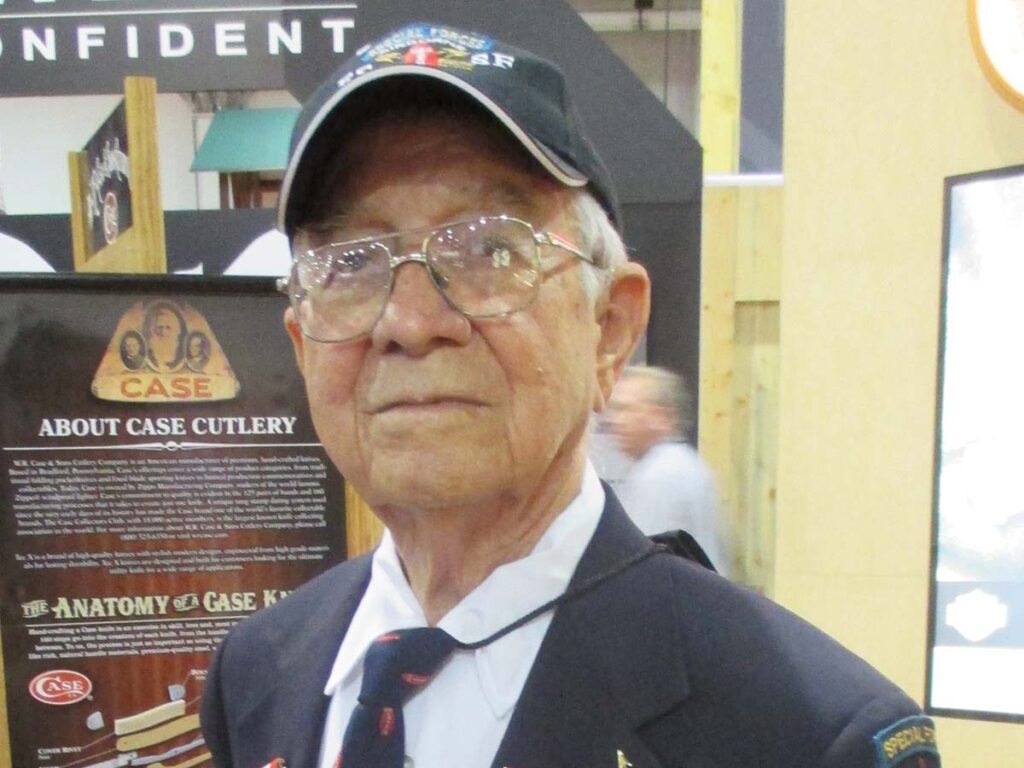
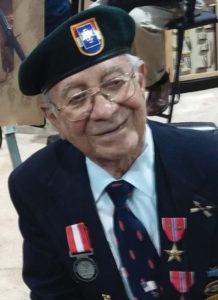
And then there were those who used knives in the war, people such as U.S. Army Corporal Eugene “Gene” Gutierrez of the First Special Service Force (FSSF). It was the FSSF that carried the legendary Case V-42 dagger and was comprised of specialists in mountain climbing, skiing, demolition and airborne ops.
Gene Gutierrez
Wounded eight times in combat, Gene was with the FSSF when it scaled the 10,000-foot-high Monte la Difensa in the Italian campaign and dislodged the occupying Germans.
The climb was “pretty much straight up,” he said of the monumental effort. It took all night under one of the heaviest artillery barrages of the war, but the Forcemen made it up the mountain and routed the enemy. Later the FSSF was inserted at Anzio, where they pushed the Germans back again.
According to Gene, the Forcemen also were specialists in psychological warfare. While on night patrol they would paint their faces black and, after dispatching Germans, leave notes on the vanquished enemy bodies that read, “The worst is yet to come.” The Germans who found the notes nicknamed the Forcemen the Black Devils, aka the famous Devil’s Brigade.
Ninety-eight now, Gene is one of the last of a rapidly vanishing breed. The surviving Forcemen get together for reunions when possible, and Gene has served as the president of their association twice. They are among the leading members of the only generation that is truly unforgettable.