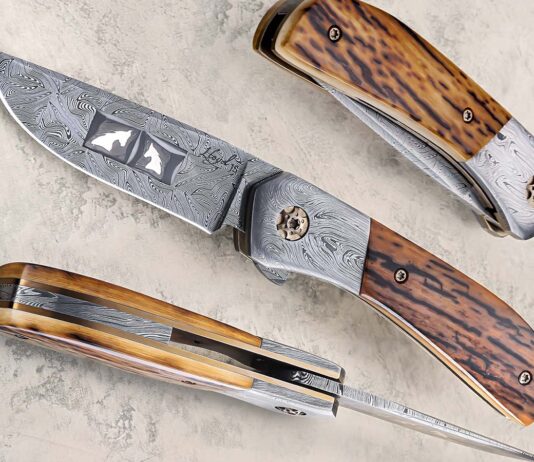
Knifemaking is the building of a knife, which includes the blade, handle and other accouterments. Blades are made by either removing metal from a steel blank via a grinder – known as stock removal – and the forging to shape of hot steel into a blade in the process known as bladesmithing. Other parts, including bolsters, guards, pommels, etc., are needed to complete the finished knife.
Knifemakers have a hard enough time making a living doing what they love without added expenses. So what are the benefits of paying a professional photographer to photograph their knives for them?
The reasons to have knives photographed are many. As managing editor of BLADE Magazine, I can tell you that often when knifemakers send me images of their newest models for possible publication, the self- or friend-taken digital images are low resolution, fuzzy, with busy backgrounds or too low quality for a high-gloss, color magazine. The images might look good on a website, computer screen or printed, but once reproduced on quality magazine paper, in four color, they lose their crispness and look fuzzy.
Here are some other reasons to have your knives photographed by a pro from photographer Jim Cooper of SharpByCoop.com.
The benefit of a professional image will promote you in a number of ways:
Large clear print for your portfolio
Crisp website image for email or display
Large digital file for printing
Posted and viewed by thousands on Bladeforums, CKCA forum, and our SBC Facebook page
All files are sent to USA and International editors of knife magazines
Guaranteed: Your knives are always available to view and search on our extensive website
A professional image shows you take pride in your work
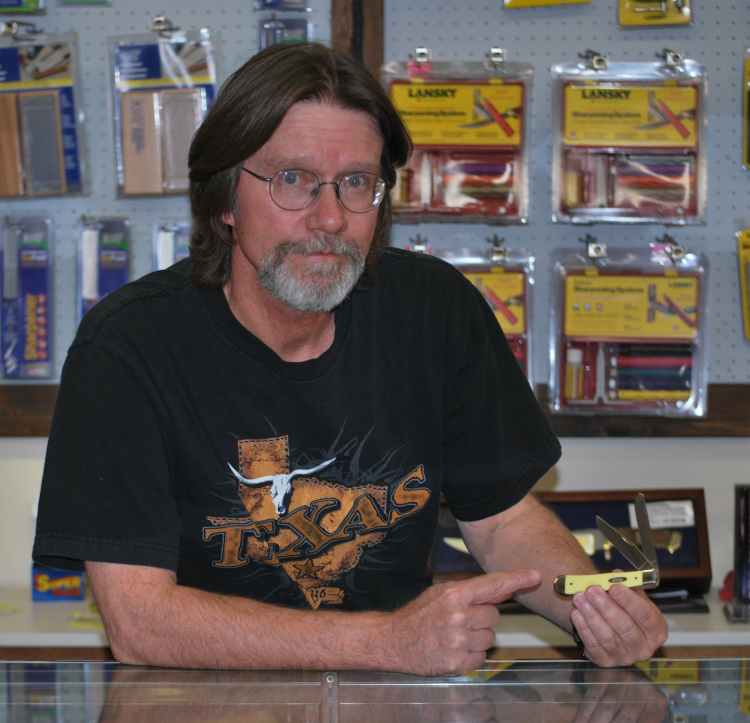
Troney Toler of Knives Plus in Amarillo, Texas, says his biggest seller by far is the Case model 161 yellow-handle trapper with blades of Case’s “chrome vanadium carbon steel”—which, according to a Case official, is 1095 carbon steel with added chromium and vanadium. (photo courtesy of Troney Toler)
There is snow on the roof but fire in the furnace of the most popular factory carbon steel knives
By James Morgan Ayres
With all the new, exotic alloys populating the knife industry in recent years, what about the sales of factory knives with blades of the “old faithful” carbon steels? To find out, I spoke with a selection of cutlery retailers from Texas to Canada and asked if carbon steel blades are still selling in the face of competition from the new alloys, and, if so, which of the non-stainless knives are hottest in terms of sales.
North of the border, Pauline Favreau of the Canadian Knife Zone says she sells carloads of carbon-steel knives. In the springtime her customers load up on Cold Steel kukris and machetes to clear weeds, vines and saplings from around their summer cabins. Given the riotous early season growth in the north, this is a big job and a tough one. According to Favreau, her experienced customers rely on Cold Steel blades of 1055 carbon steel for their ability to take a keen edge and be easy to sharpen. She sells them for around a modest 30 Canadian dollars ($29.50 American) each and says customers prefer them to expensive alloy blades and their reputation for being hard to sharpen. Moreover, when the blades get the inevitable nick or two, it is easy enough to repair the edge with a stone.
Favreau says 45 percent of her clientele generally are female, some of whom are members of the Royal Canadian Mounted Police, military and other professions. She adds that KA-BAR’s Becker Knife & Tool line in 1095 carbon steel is far and away the most popular with the Mounties, who buy models from the Becker Necker at 56 Canadian dollars ($55) to the Campanion at 106 Canadian dollars ($104.20).
The owner of Canadian Knife Zone indicates many northern outdoor enthusiasts favor the traditional Grohmann hunter and the venerable D.H. Russell Canadian belt knife, at about 75 Canadian dollars ($73.73) each, both in C-70 carbon steel. The classic Opinel with its XC70 carbon steel blade and beechwood handle priced at 11 Canadian dollars ($10.80) is a perennial favorite of backpackers and others looking for a lightweight folder, Favreau adds.
Though the carbon-steel knives mentioned are affordable, she says price is a minor factor in the choices of Knife Zone’s customers. They are looking for proven performance and usually opt for non-coated blades.
Fans of 1095
Tom Melago of Chestnut Ridge Knives in Latrobe, Pennsylvania, says he sells many Ontario kukris and machetes in 1095 coated carbon steel, with the basic Model C 1-18 being the most popular machete. According to Melago, “Ontario’s Spec-Plus 2502 kukri is one of the most popular knives of any kind in my store. It’s favored 10-to-1 by my customers over other brands of kukri.” He adds this is due to the Ontario kukris’ reputation for quality and because they are made in America, which is a strong selling point. At his list prices of $29.99 for the machete and $53.99 for the kukri, these big boys appear to be a bargain.
Melago says though the choppers see considerable use as utility tools, most of his customers who buy big blades do so for survival packs and bug-out bags (BOBs). With Chestnut’s list prices in parentheses, Ontario’s RTAK II ($94.99) and RAT 7 ($87.99) in 1095 carbon steel also are finding their way into many Pennsylvania BOBs, as is ESEE’s entire line in 1095. From the Junglas ($155.99) to the ESEE 3 ($89.99) and ESEE 6 at ($116.99) to the tiny Izula ($49.95), Melago says all sell as fast as they can be ordered, and all have proven to be tough and easy to sharpen. (Again, all parenthetical list prices are Chestnut’s).
Like Favreau, Melago states price is not a factor in his customers’ choices. He says all of them express a willingness to pay more for models made in America, and most opt for non-coated blades.
Tougher Steel
At J.T. Knives in Port Jervis, New York, Joe Tarbell says the entire Ontario Spec Plus line of 1095 carbon steel knives continues to sell as well as always, which is very well indeed. Like his retail counterparts, Tarbell indicates even though the Spec Plus line is priced affordably from about $45 to $100, price has little to do with his customers’ knife-buying decisions. He says customers who request carbon-steel knives seem convinced carbon steel is tougher than any stainless. Some are older customers who have used carbon steel for years and are not interested in changing. Ease of sharpening and toughness are the deciding factors.
Tarbell says many of his customers are outdoorsmen and into survival skills. They prefer carbon steel for its traditional qualities and because “they get a better spark with a flint fire starter” on it. While they are concerned with rust, they also understand the simple steps they can take to avoid it (keeping the steel clean, a little oil, storing the knife in a dry place, etc.).
The J.T. headman states he has seen an increased demand for the Dustar Israeli combat knives, which use D2 tool steel. At a list price of $225, it is a relatively expensive factory knife, but he says buyers seem to appreciate the qualities of D2 and its solid construction. Tarbell adds his store also does well with anything from the Benchmade Bone Collector series, all in D2 blade steel as well.
Have Blades, Will Rust
The story on carbon-steel knives is very different at Troney Toler’s Knives Plus in Amarillo, Texas. Toler says he sells many traditional carbon-steel pocketknives and few fixed blades. His biggest seller by far is the Case model 161 yellow-handle trapper with blades of Case’s “chrome vanadium carbon steel”—which, according to a Case official, is 1095 carbon steel with added chromium and vanadium. According to Toler, he orders the knives 50 at a time and, at a list price of about $50 each, he often runs out of them.
In general, Knives Plus has two classes of customers. “The first,” Toler said, “is the grizzled old farmer or rancher who won’t have anything but a blade that ‘will rust.’” Such a customer has been using the knives for a half century and figures “if the blade won’t rust, the steel is no good.” Of course, the customer knows how to care for carbon steel, so maintenance is not an issue.
The other kind of customer will return a knife if a spot of rust shows up. “Those folks are better off with a Spyderco,” Toler notes. “Occasionally, I’ll see one of the old guys come in and buy a Spyderco, but that’s unusual.”
Boker, Queen and Eye Brand pocketknives in carbon steel are also good sellers for Toler, with such Queen models as the mini trapper with D2 blade steel a special favorite. He says D2 is “almost stainless” but not quite. About the only fixed blades Knives Plus does much business with is the ESEE 3-P in “well-tempered 1095.”
Even in today’s world of hi-tech alloys, the age-old carbon steel still earns its keep. Maybe it will continue to do so for another thousand years or so. Who’s to say it won’t?
For more on the latest knives, knife legislation, knifemaking instruction, knife trends, knifemakers, what knives to buy and where and much more, subscribe to BLADE® Magazine, the World’s No. 1 Knife Publication. For subscription information click on http://www.shopblade.com/product/blade-magazine-one-year-subscripti…?r+ssfb020412#BL1SU
How the iconic custom maker transformed pocketknives and the knife industry.
The story of the knife is one of evolution, with thousands upon thousands of steps along the way. When you boil it down, however, it’s really just the passing of knowledge gained from one individual to the next. One who earned an immortal slot in that incredibly long span of time is BLADE Magazine Cutlery Hall-of-Fame® member Tony “Old Dog” Bose.
Born of humble beginnings, Tony suffered the loss of an eye at an early age—a setback for anyone, though especially a craftsman—and grew up in Indiana far from any cutlery center. Nonetheless, what he did have was a job repairing knives, and that was all the springboard he needed to launch him into becoming a highly revered custom knifemaker.
Tony produced his first custom knife in 1975 and by 1990 was going full steam—this while the Gulf War was inspiring the modern tactical knife movement. But he had his own plans and continued to gain popularity with the traditional slipjoint crowd, a popularity that surged throughout his knifemaking career. He had a huge impact in his day, not only for the sheer quality of his work and innovative styling, but for his lasting contributions to both the custom and factory knife industries.
Tony Bose As Mentor
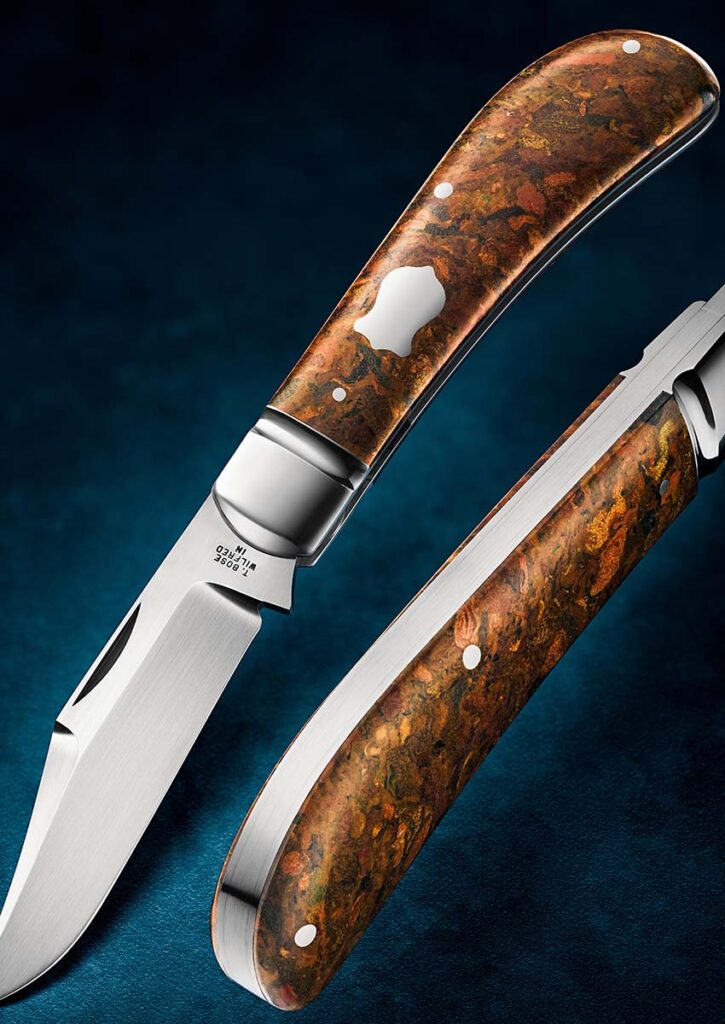
Another of Tony’s slipjoint standards is the Lanny’s Clip. “In 1989 I met a good ol’ boy named Lanny Shell,” Tony wrote. “He asked me to make him a knife between 3¾ and 4 inches closed for heavy work with a clip blade in it. I didn’t know what to call it, so I called it Lanny’s Clip.” (Caleb Royer image)
One way to judge a master craftsman is by the people he taught.
“I first met Tony at the Guild Show in Florida,” notes Cutlery Hall-of-Famer Bill Ruple, a knife legend in his own right. “I had just begun making knives and when I saw what he had on his table I was blown away! Before that I was making folders and a few fixed-blade knives. After seeing his work I focused on multi-blades. As time went on, we became great friends. One of my biggest regrets was not taking time to go and visit him. He invited me many times.
“Any time I had a problem, Tony was there to talk me through it. I’d always pick what I considered to be my best knife and have him critique it at the BLADE Show. He set the standard for all of us multi-blade makers. Reese [Tony’s eldest son] is continuing to set that standard today. I was just one of many who benefited from Tony’s generosity to share his knowledge.”
ABS master smith Harvey Dean, who makes top-notch slipjoints in addition to his award-winning fixed blades, has fond memories of Tony’s mentoring and friendship.
“I met him around 1993 at the New York Custom Knife Show,” Harvey recounts. “He had quite a few slipjoints for sale, and if I recall they did not last long [before they sold out]. I remember most of the people that bought them had memories of carrying his type of knives many years ago. Tony brought them back into popularity.
“Tony’s influence, I think, was his approach to making slipjoints. His grinds, swedges and the function of the knife were all spot on. His handle material was always exceptional. For me, Tony’s generosity in sharing his knowledge was the most important thing. I could call Tony anytime for help and he always helped me out. I still have, I think, three patterns Tony made for me, mailed them to me, and would not take any payment for them.”
Tony did the same for Ruple and ABS master smith Steve Dunn. “Tony sent me many patterns over the years and never charged me a penny,” related Dunn, who passed away last year. “He will go down in the books as the best slipjoint maker ever.”
At a BLADE Show circa 2010, Ruple told Tony his favorite knife ever was the Bose saddlehorn trapper.
“After the show I received a package from Tony,” Bill writes. “Inside were two different-sized saddlehorn trapper patterns. He had hand ground them! That’s the kind of guy Tony was. He was a kind, generous gentleman, always willing to share his vast knowledge of knives.”
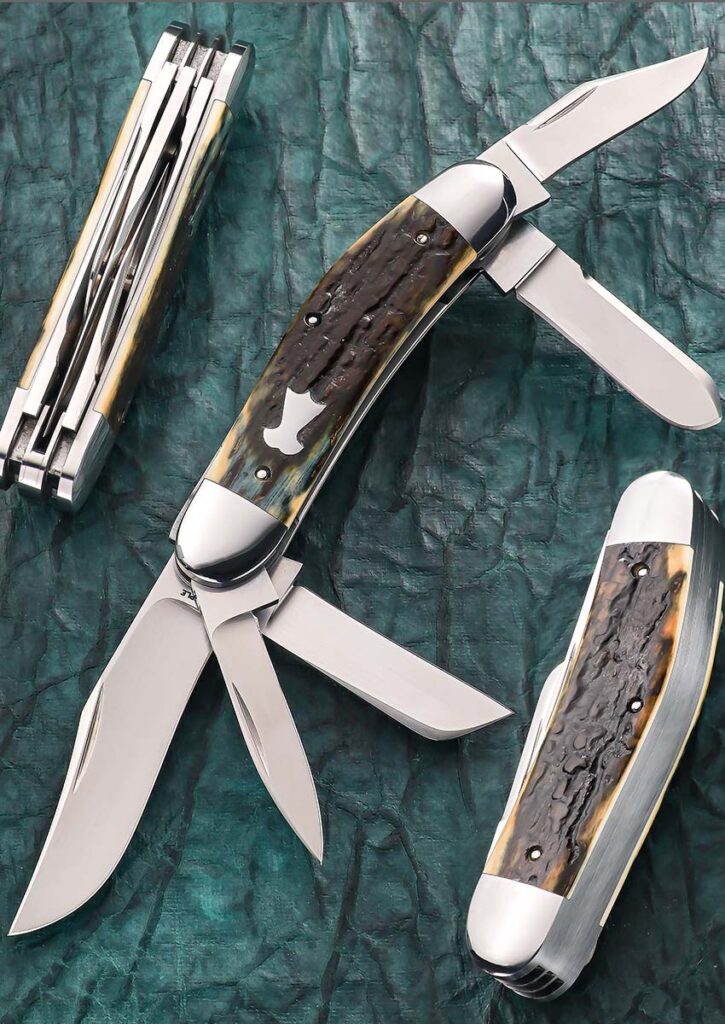
One look at Tony’s knives at a Knifemakers’ Guild Show and Cutlery Hall-of-Famer Bill Ruple started focusing on making multi-blades. The rest is history, including Bill’s five-blade sowbelly. (SharpByCoop knife image; image of Ruple by Chris Wellhausen)
One of Tony’s greatest achievements, in his own words, was teaching his son Reese to make folding knives. Tony commented on mentoring him in about as strong a statement as it gets.
“I have helped a lot of guys figure out how to make pocketknives,” he noted, “but Reese is the only one I have taught.” Today, Tony’s son is considered one of the world’s best slipjoint makers.
Reese has fond memories of his father.
“When I’m asked about Tony, a few things come to mind: generosity, influence and impact,” Reese says. “Tony’s generosity with his time and knowledge were truly something special. I can’t even begin to count the number of phone calls we had over the years. I do remember one of our first conversations when Tony told me, ‘Boy, you are gonna have to learn swedge work.’ He was always ready to give advice about knifemaking and even the day-to-day of running a knife business.
“Many makers went in and out of his doors with no money ever exchanging hands. It was this time spent sharing advice, knife patterns, and even loaning out vintage knives that illustrated the influence Tony will continue to have in the knifemaking world.”
Tony Bose & Case Knives
The knife collaborations Tony did with W.R. Case & Sons increased the awareness of and interest in the company to much higher levels, even during times when the cutlery world was consumed with tactical fare. His was also a constant presence at assorted Case collector events for knife enthusiasts of all ages, giving seminars, meeting and greeting all in attendance, etc.
His contributions were such that on July 14, 2023, he became the first person in over 20 years to be honored with a Wall-Of-Fame induction ceremony at the W.R. Case & Sons facility in Bradford, Pennsylvania. The induction included a plaque of Tony installed on the Wall Of Fame in the Zippo/Case Museum. Tony’s son Reese, Bill Ruple and others were on hand for the event.
Fred Feightner, Case director of marketing communications, remembers the early years in 1999 when Case hired Tony as a designer to elevate the company’s folding knives to a greater level of quality and relevance.
One of Tony’s greatest achievements, in his own words, was teaching his son Reese to make slipjoints. “I have helped a lot of guys figure out how to make pocketknives,” Tony noted, “but Reese is the only one I have taught.” From the looks of his son’s five-blade congress pattern, Tony taught Reese well. (Eric Eggly/PointSeven image)
“My first one-on-one interactions with Tony came nearly 20 years ago as a result of an assignment I was given by Tom Arrowsmith, our company president at the time,” Fred recalls. “I had only been with the company a couple of years, so I was pretty new to the knife industry with very little exposure to the world of custom knives. The assignment was to produce an eight-to-10-minute video about Tony to support the introduction of the swayback pattern, our latest online edition of our Case-Bose series.
“Naturally, I was excited to be traveling to meet this famous knifemaker. So, with stars in my eyes, off I went to Tony’s shop in Indiana. The address I was given took me to Tony’s house. Once there, I was surprised to learn this superstar was making his impeccable knives from inside his attached garage. Tony came out to meet me and took me inside, showed me around the shop a bit, and introduced me to his son Reese, who was situated in a far corner. Then Tony offered me a cup of ‘cowboy coffee,’ which turned out to be coffee boiled in a camp pot and kept warm over a hot plate that was within easy reach from his desk all day.
“Over the next two days I would be treated to the most in-depth knifemaking tutorial series one could only imagine,” Feightner exclaims. “Being an eyewitness to the painstaking care that Tony took in preparing even a single knife for one of his customers was truly awe inspiring. I still recall watching him hunched in his shop chair, sanding down knife parts by hand for hours until they fit to perform perfectly when assembled. He was such a patient teacher! It was never a problem for him to answer questions while he was working away. That visit really provided me with the foundation I needed to do my job better as a Case marketing communicator.”
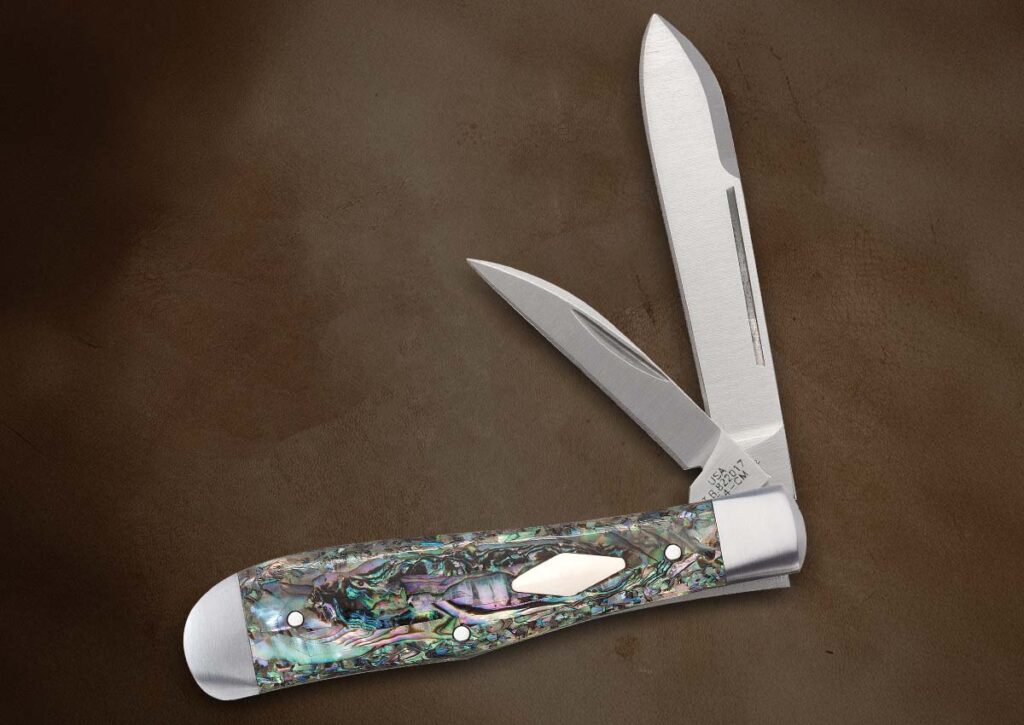
Tony collaborated on knives with Case for two decades, including this Eureka jack in abalone and 154CM stainless steel in 2017. (Case image)
Tony’s collaborations with Case worked like magic. His upscale Case XX limited editions, delivered in signed brown leather zipper pouches, are some of the finest pocketknives ever produced by the company—or any company for that matter—and his Bose-branded boxed knives are highly collectible.
His signature Lanny’s Clip, designed for a friend, has become legend among both custom folder makers and Case collectors alike. Tony passed away in 2020, only one year after being inducted into the Cutlery Hall of Fame, but his imprint on the cutlery industry will last as long as his knives walk and talk—which will be a long, long time.
We Take A Look Inside The Shop Of ABS Master Smith Steve Schwarzer And See How He Makes His Mosaic Damascus Wonders
Of all the forgers of mosaic damascus in the knife industry, none stand out any more than American Bladesmith Society Master Smith Steve Schwarzer.
Steve began forging in the early 1970s. In 1981 he received his ABS master smith rating, his papers signed by none other than one of four ABS founders/BLADE Magazine Cutlery Hall-Of-Fame® member Bill Moran, and was officially recognized as an MS in 1983. Steve has an intense passion for forging mosaic damascus and his contribution to this steel niche over the decades has been immeasurable. Unselfish to the extreme, he has forged damascus for many custom makers and tutored many on forging and the making of pattern-welded steel over the years—which he continues to do to this day.
His awards over 50 years of knifemaking are too numerous to name, as have his appearances in BLADE®. BLADE is delighted to feature Steve once again, this time in a supersized edition of “Shop Dump” to give readers a deep dive into the equipment this modern-day master uses to achieve his magical works.
Inside Steve’s Shop
Steve rescued his Kent USA precision surface grinder from a knifemaker friend. In the process of retrieving it, Steve almost destroyed it while loading it. However, another friend restored it to better than new.
As you can imagine, Steve has acquired a lot of equipment over his many years of knifemaking and has honed his shop to perfection. We asked the artisan to give us an extended tour of his digs and he gladly obliged. He kicked the tour off with his forging hammer.
“The Chambersburg 2 Hammer was my first real game changer,” Steve notes. “I had owned several mechanical hammers before I found it. The control in forging set me apart from others. It also allowed me to work much larger masses of damascus. I have trained dozens of the current top makers pattern welding using this machine. I built my second shop around it. It’s now in my home shop.
“Next up is my custom-built 50-ton Coal Works computer-assisted C Frame press. This is a recent acquisition and is also a game changer for controlled forging. It has a return to 1/100 of an inch. Basically, it comes with millions of electronic stop blocks. It has the ability to swap dies to any configuration in minutes. I have built many presses over the years; this one has all the benefits and adaptability afforded by all the others combined. I worked very closely with the crew at Coal Iron to bring this beast to life. I’m still exploring its capabilities.”
Grinders are a must-have of any maker’s shop and Schwarzer has a passel of them.
“I own four Beaumont grinders—one for over 20 years—and they are great machines that track properly,” Steve states. “Three are 2×72 belt grinders, two with controllers. They’re constructed of steel, making it very easy to make tooling and various fixtures for any project. The disc grinder runs perfectly true, making grinding precision angles a breeze.”
Steve Schwarzer’s Forges
Steve’s ribbon burner is one of several forges in his shop. He designed it and a close friend built it. It’s purpose-built for working very large canister damascus.
Steve brings the heat to his steel with a forge of his design.
“My forge is one of several I run in my shop. It’s a ribbon burner designed by me and constructed by a close friend. It’s purpose-built for working very large canister damascus. I have built dozens of forges over the last 40 years. This is the latest version. My previous forges were all versions of a Don Fogg design.”
If you’ve read past installments of “Shop Dump,” you know it’s not at all uncommon for equipment to be passed down from one maker to the next. Such is the case with Steve’s mill and surface grinder.
“My Kent USA knee mill is my go-to for all precision drilling and milling. It was rescued from a retired knifemaker who took excellent care of it,” Steve relates. “It’s variable speed, making it handy for all types of tooling.
“I also rescued my Kent USA precision surface grinder from the same knifemaker. It had a history when I went to retrieve it. I made a rookie mistake loading it. Long story short, I, for all practical purposes, destroyed it. I broke about everything on it. I had in mind to scrap it. I called a friend who owns one and asked if he wanted it for parts. He said, ‘Let me look at it.’ I took it to his shop. He is a true wizard. He totally restored the machine I thought was lost to better than new. He also taught me how to properly grind with it. I will always be grateful.”
If walls could talk there is no telling how many amusing tales Schwarzer’s shop could tell.
“I have a shop full of machines, all with some story attached,” the affable bladesmith said. “My tool rack has dozens of hammers and tongs collected over 40 years. This is my happy place. I love teaching and sharing the stories with students and friends.”
For more information contact Steve Schwarzer through his website at steveschwarzer.com.
Most beginning bladesmiths can hardly wait to forge out their first damascus blades. Making damascus is challenging and exciting, especially when you advance enough to try and create the more complex designs. I still enjoy the challenge forging intricate mosaic damascus patterns, and especially figuring out how to make new ones.
I also enjoy teaching and passing down whatever knowledge I have collected over the decades. So, in 2008 I opened a knifemaking school in Pine Plains, New York. Most of my classes are based on the forging technique.
The most exciting thrill of teaching is watching a few of my students advance to become competent bladesmiths in their own right. I can honestly say I have met a lot of very nice, talented folks over the years at my school. Some just want to be hobbyist or part-time makers, and others hope to one day become full-time knifemakers.
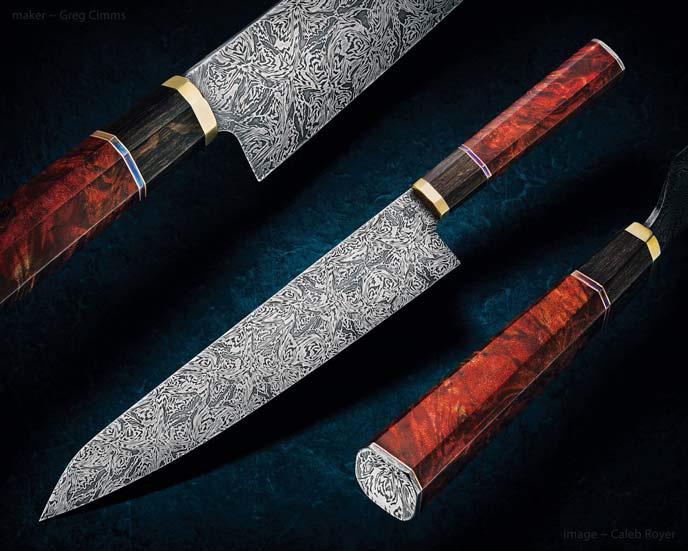
Greg Cimms forged the blade for his chef’s knife of multi-bar mosaic damascus in a pattern originally worked out in clay. (Caleb Royer image)
They are talented bladesmiths who have been doing incredible work so far. These gents have only been making knives a couple of years. They have learned the proper way to forge and forge weld and have made some nice damascus. I knew they were ready for the next challenge making more complex damascus. I decided it was time for me to hold a more advanced multi-bar mosaic damascus class for them.
The class was four days. On the first day we went down to the shop and I explained what multi-bar mosaic damascus was and how it is made. I also explained how powdered mosaic damascus is made, though it is a completely different process.
The Problem: “Shooting in the Dark” with Mosaic Damascus Designs
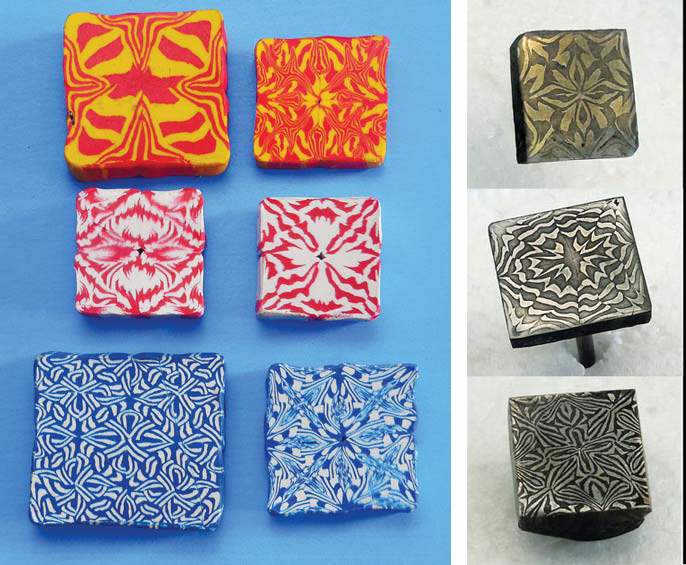
While we were sitting around the table I gave everyone a box of different colored clays. Some thought I was making a joke with the clay until I showed them some of the damascus patterns I had made. Some of those clay designs I made in the early 1990s.
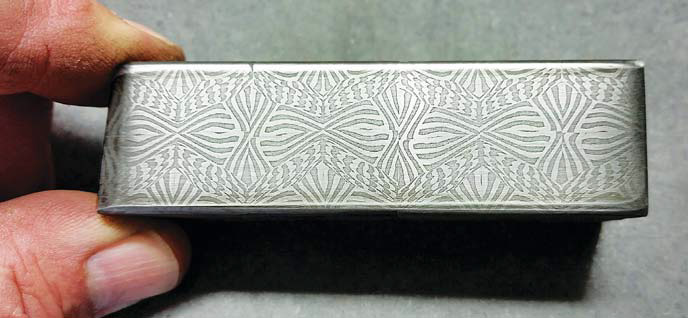
Bill Greulich followed the same steps he used to develop his pattern in clay to forge his first billet of multi-bar mosaic damascus.
Back then I was working in an art foundry full time pushing a lot of hours, so I had very limited time to forge my knives and tomahawks, never mind work out new damascus patterns. At night I would work out damascus designs on paper. The weekends were often spent working hard at the forge making damascus from the paper designs.
Unfortunately, many times when I finished the mosaic damascus billet, even though some did turn out to be nice patterns, they were not quite what I wanted. Basically, when you work out designs on paper, at least for me, I felt I was shooting in the dark without night vision. I knew I had to find some answer or solution to my problem.
The Solution: Kids’ Modeling Clay
While I was thinking what would be the best solution, the answer was right in front of me. I was working on a sculpture using red and yellow wax, and that is when it occurred to me. I started cutting off a few slices of red and yellow wax and made a billet out of it. I folded, twisted and so on as I would do with steel. While the wax was not so pliable in the cold form, it still gave me the idea of what I had to do.
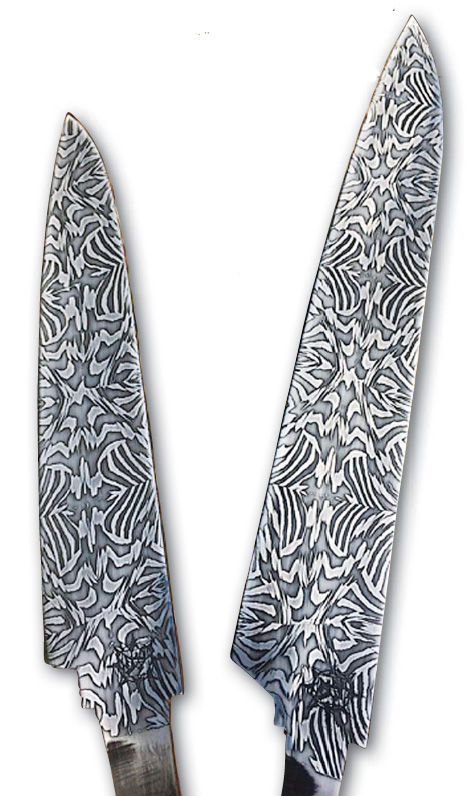
Greg Cimms forged these two blades from a billet he designed and made in the author’s Advanced Damascus class.
The next day during lunch break I ran out to the arts and craft s store and bought two boxes of multi-colored clay, the kind kids used to play with or use at school. I was very excited for my new finding and anxious to see how well it would work.
I made my first multi-bar mosaic clay billet that turned out better than expected in allowing me to preview the mosaic damascus designs. Making clay damascus does not mean you will like every pattern you create, but it is still a lot more efficient and easier on the pocketbook than forging all day long to find out the design is not what you wanted.
I could hardly wait to show my wife Lori that I had found the solution to my problem. Over the years, I probably came up with more designs in clay than I would ever be able to forge out in steel.
A Shortcut with a Long History
That is how I got started making clay damascus. I shared this technique with fellow makers. Actually, similar techniques have been done in glass beads for hundreds of years. I have many books on Indian trade beads in beautiful designs.
As kids we used to play with marbles that also had beautiful designs in them. It just never occurred to me to incorporate any of this into my knives.
Making Clay Billets
On the first day of class I demonstrated making a clay billet and explained, step by step, what to do and what to watch for.
Next I showed the group how to take the same starting multi-bar billets, and, by using different arrangements and folds, create two or three different mosaic damascus designs.
As the students started working out their designs in clay, I asked them to write down every step they took: how many layers they started with, how many times they cut the billet, how many times they folded it, in which direction they folded, in which direction they forged, and so on. This written reference is very important if you want to recreate the design in steel.
I got such a kick out of watching grownups having fun with clay, showing off to each other the designs they had created. It reminded me of back when I started making clay mosaic damascus and how excited I was.
That day everyone seemed on a diet because no matter how often I said “Lunchtime!” no one was hungry. Finally, Lori came home from work and we had dinner. At the table the only conversation was which of their designs they would choose to forge out on the second day of class.
The award-winning knifemaker and designer passed at 82 after a life filled with adventure and craftsmanship.
Award-winning knifemaker and knife designer Grant Hawk of Hawk Knives passed away peacefully at his Idaho City, Idaho, residence on November 8. He was 82.
Born in Boise, Idaho, on Feb. 15, 1941, to Woodrow Allen “Kelly” Stroud and Dortha Bunce, Grant’s life was a remarkable journey of adventure, resilience and creativity. His early years were spent as a cowboy in Boise, where his connection with the outdoors and love for craftsmanship began. The 1960s saw Grant moving to California to make camper trailers, but he quickly became entangled in the revolutionary spirit of the era, leading to a brush with the law. This encounter prompted a pivotal decision in his life: to adopt a new identity and retreat to the Idaho mountains.
In his seclusion, living in a teepee, Grant’s interest in gold prospecting blossomed. This pursuit marked his gradual reintegration into society and laid the groundwork for his future endeavors. It was during this period of reflection and growth that he discovered his true calling in knifemaking.
Alongside his son, Gavin, Grant embarked on a remarkable journey in the world of craftsmanship. Together they forged a path in knifemaking, combining adventurous spirit with Grant’s innate skill and creativity. Their collaboration led to the creation of distinctive and innovative knife designs, earning acclaim in the knifemaking community.
His final accomplishment was completing his autobiography, which he delivered to the printer just two days before his passing. On the night of his death, he was in good spirits and feeling well, but unexpectedly fell ill and passed away gracefully within 15 minutes.
Grant’s life was a tapestry of diverse experiences, from cowboy to gold prospector, and finally to a revered knifemaker. His legacy lives on through his son Gavin and their shared creations, which continue to inspire and captivate knife enthusiasts around the world.
Grant’s story is a testament to the power of resilience, adaptation and the pursuit of passion. His memory will be cherished by his family, friends, and all who knew him as a man who carved his path, much like the knives he so skillfully crafted.
Acclaimed, Talented Knifemaker Henning Wilkinson Is Making Beautiful Knives And Living A Life Worth Emulating.
I’ve been in the blade-making business right at 50 years. I’ve met and befriended hundreds of bladesmiths and knifemakers. I have a long history of designing and making knives and other edged tools in carbon steel and mosaic damascus. I have pioneered many of the modern techniques used in the production of these blades. The techniques are now in their third generation.
The newer smiths and makers — especially in the damascus end of the business — do things with steel and design that border on magical. Some of these modern magicians have been in the business only a few years. I feel very privileged to have met some of them and spent shop time with a few more. One is Henning Wilkinson.
I started following his social media posts a few years ago. Even then, the level of his work was nothing short of astounding. His blade designs and mosaic patterning are all well thought out and extraordinary. He and I began corresponding on social media and developed a friendship through our mutual interest in damascus blades.
His blade designs and fitting of all the design parts is in my opinion some of the best on the planet. As a result, I wanted to see his methods firsthand. Meanwhile, Henning also had great interest in my methods of forging and pattern development. So began the plan to spend time in the shop.
We agreed I should go to South Africa and teach a couple of classes. The trip coincided with the Knifemakers Guild of Southern Africa Show. It was great fun meeting new friends and visiting with many old ones half a world away. The classes were a great success and I learned much, including that braai* has no equal and biltong+ is better than jerky. (I had to throw that in for my South African friends).
Henning is a deeply religious man who lives his faith as best he can in all he does. His knifemaking skills are a showcase of that dedication. He is an advanced martial artist and very skilled with firearms. Some of his techniques and skills come from a trained gunsmith background, and are a lot of what drove me to fly halfway around the world to see those handwork skills with my own eyes. I was not disappointed. I asked Henning to send me his biography to help with this story.
Henning Wilkinson: In His Own Words
Damascus, ivory and gold engraving help highlight Henning’s dagger with a Renaissance flavor.
I was born Jan. 13, 1978, in the little town of Brakpan, South Africa. My dad was a blue-collar worker who started his working life at 16 doing an apprenticeship as a tool-and-die maker. He was always busy on weekends doing all sorts of jobs, from building concrete mixers to doing electrical work — pretty much anything you could think of. He now owns his own wood furnisher business.
Growing up, using machines and tools for whatever reason was never a problem for me. My father believed that to work with your hands from an early age would give you a head start and an advantage in life.
My mother was always busy with something to generate extra cash. I remember from a very early age her making clothing as a seamstress, from wedding dresses to underwear. Even my wife had the privilege of having her wedding dress made by her mother-in-law. My mom was always carting all the kids around from one sports event to another. Both my parents supported us however they could, and still do.
My first recollection of Christ was growing up in a home where He was loved and honored. I can remember as a young child walking into my parents’ room in the early hours of the morning and finding them both on their knees praying. This has remained my foundation for every decision and my way of living.
I joined the family business in woodworking where I learned a great deal in all different fields, from electrical to mechanical, as we did all our own repairs and maintenance on the machines in the factory. I started my apprenticeship as a gunsmith in 1998. I learned a lot about the fine finishing and fittings of different materials to one another.
I started making knives in 2000 while doing my gunsmithing apprenticeship. I fell in love with a knife called the Commander made by Ernest Emerson, which at that stage I couldn’t afford (it would have been three months’ salary for me back then). Having a father who taught me whatever you cannot afford you can make yourself, I jumped to the task not knowing what I was getting myself into.
During the process I met a good friend, Carel Smith, who guided and still guides me in everything knifemaking related. Carel invited me to the Knifemakers Guild of Southern Africa Show and my eyes were opened to the possibility of real knifemaking.
After I built a folder, Carel invited me to forge a blade and make some damascus. I was immediately hooked, captivated by the process of forging damascus, spending the first couple of years building and perfecting machines to make my own. In 2006 I was admitted into the Knifemakers Guild of Southern Africa, being only the second person to forge blades to be so honored.
Right from the start I attempted to make a better knife than the one before. I would not settle for anything other than my absolute best effort on every piece, from fit and finish to heat treatment and into the smallest detail, always trying to push my limit.
Then everything changed.
In 2012 I walked away from knifemaking as I believed I could not provide for my family the way the world told me to. I took on a job in the oil and petroleum trade as an underground utility surveyor. I thought I had it made. However, after a couple of years I was in a deeper hole than when I started—physically, emotionally and pretty much every way thinkable.
God slowly decided to drag me back into what I was made to do.
In late 2018 I decided to carry on as a full-time knifemaker. It was a leap of faith and the most rewarding decision of my life. Being able to do what you love can only be described as a massive blessing.
I am a Christian and I believe that God forms every piece through my hands, which is why I have a 9k-gold cross as a maker’s mark. My aim is to craft each piece in praise to God, and to make it so it will set itself apart and stand out as the best knife in any collection.
Picture In Steel
Henning (left) and Schwarzer (second from left) hammer hot steel while interested observers observe in the two friends’ forging class in South Africa.
On June 15, 2018, I did a Facebook video on how to grind a false edge. I received a comment from a gentleman whose work changed the way I looked at knifemaking. I used to think that because I could make damascus and drill a couple of holes, my knives were good. However, a “picture painted in steel” of a bird hunter with his rifle and his dog# made me realize that this could be far more—it could be an art that would leave people in awe of what can be done. The gentleman is Steve Schwarzer, whom I am now lucky enough to have as a close friend.
In 2019 I was able to exhibit at the BLADE Show, and was immediately accepted into the family of worldwide knifemakers. This has left me inspired to inspire those whom I see as my peers.
Shortly after BLADE Show 2019, Steve visited me in South Africa. We had the privilege of spending time together and learning from each other. It was a massive honor to stand shoulder-to-shoulder with him during a damascus course we hosted together.
During the visit I learned the definition of what a true master is. It is not a stamp on a knife or an award certificate. It is someone who never stops in striving to learn every intricacy of his or her art, perfecting every part no matter how big or small it might be, staying humble in the process and never assuming his or her own greatness.
Among a thousand lessons learned during Steve’s visit, for me this was the most important. The second lesson is that we will only have this journey called life once, and the decisions we make will be the determining outcome of that journey. I have never laughed as hard in my life during Steve’s two-week visit. His friendship and guidance are an invaluable blessing to me. It is an honor to call him my friend.
To me, knifemaking is a way of life, constantly trying to perfect and add new aspects to the knives I make. Through the fashioning of these pieces I continue to learn more about myself as God wants me to be. Knifemaking has given me the freedom to be a father to my two children and a husband to my four wives (my loving wife and the best three dogs ever).
One of the memories I will always cherish is one of my son as a small child standing on a tin in front of a lathe machining some steel. He has recently started making knives and this next journey together as father and son working in the shop together is another great blessing for me.
I specialize in art knives and high-end exclusive pieces, from folding knives to swords, using only the best end materials. Bringing 20 years of knifemaking experience and a lot of passion to each piece, I am proud to be a 100 % sole authorship maker. I am a member of the Knifemakers Guild of Southern Africa and the American Bladesmith Society. I hope you can see the passion in my work and will enjoy every moment you spend with it.
*Braai is South African barbecue
+Biltong is a form of dried, cured meat that originated in Southern African countries.
#The “picture painted in steel” was Steve Schwarzer’s groundbreaking scene of hunter with rifle and dog done in mosaic damascus in the early 1990s that set the world of knives on its ear.