Knifemaking

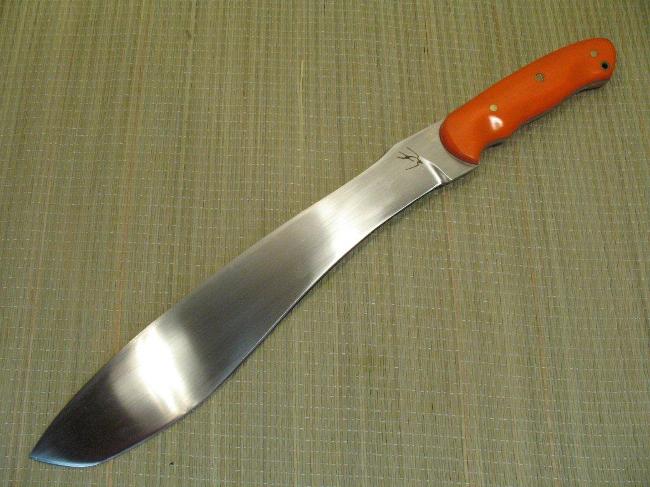
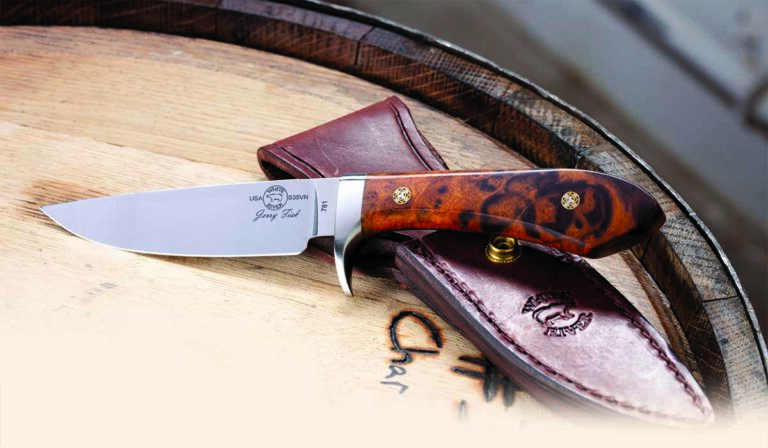
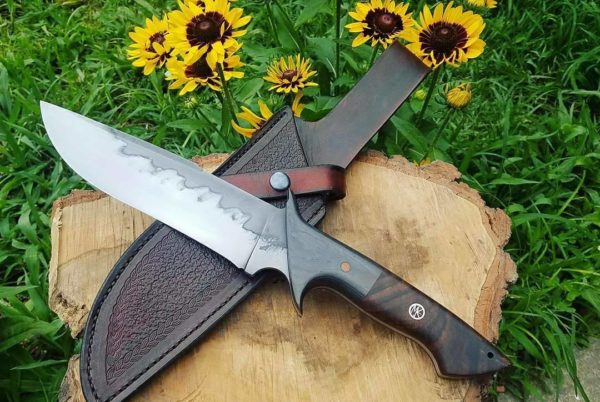
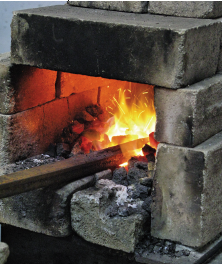
Knifemaking is the building of a knife, which includes the blade, handle and other accouterments. Blades are made by either removing metal from a steel blank via a grinder – known as stock removal – and the forging to shape of hot steel into a blade in the process known as bladesmithing. Other parts, including bolsters, guards, pommels, etc., are needed to complete the finished knife.

Featured Knives – – Knife Collecting – – Tactical Knives – – Survival Knives

Custom Cleavers That Have Culinary Chops

Four custom makers push the boundaries of the tried-and-true cleaver.

An inclination toward the kitchen and a desire to design and deliver cutlery used on a regular basis has spurred a number of custom knifemakers to try their skill with the cleaver. It’s a staple in most kitchens and its uses are as varied as the food prepared there.

Robert Wayman of Middleburgh, New York, sees his cleavers as complementing years of food preparation. “I’ve done a lot of my own food processing, and I spent several years in commercial kitchens when I was younger,” he commented. “So, I’ve always had an affinity for culinary knives and especially cleavers. The cleaver is such an iconic blade. I love to make everything from heavy-duty butcher cleavers to medium-duty kitchen cleavers, Chinese cleavers and lighter-duty veggie cleavers for the kitchen.”

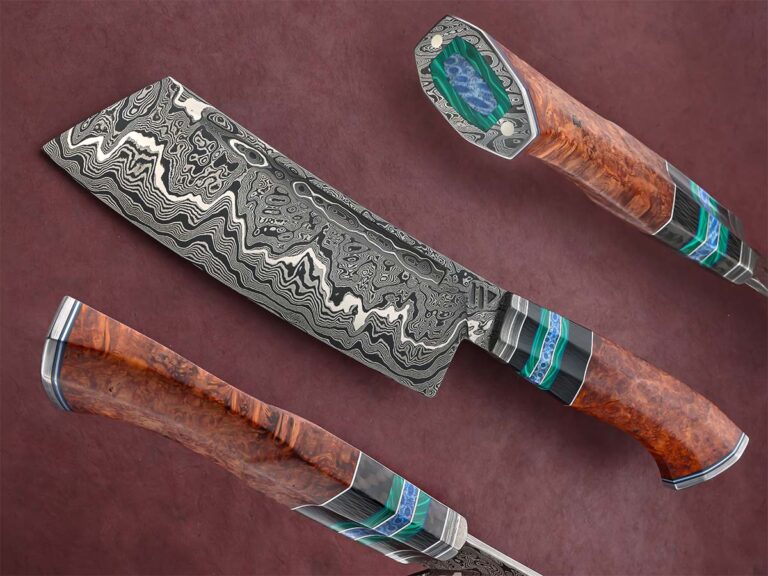
Robert’s featured cleaver is 14 inches in overall length with an 8-inch blade of pattern damascus go-mai five-layer steel. The core is a 100-layer random pattern damascus made of 1084 and 15N20 high-carbon steel and a layer of nickel and matching damascus cladding. The handle includes a damascus collar, stainless steel and G-10 spacers, crosscut carbon fiber, green malachite and blue coral accents, stabilized amboyna burl and a damascus butt cap with stainless mounting pins inset with blue coral framed with green malachite.

“I packed a lot into that one,” Wayman smiled. “As a maker, I’m all about sole authorship. I make all of my own high-carbon damascus steel in-house, and a cleaver provides a great opportunity to showcase that steel. One of my favorite things to forge is a large cleaver with an integral bolster.”

Wayman sees large blades, such as those associated with cleavers, as inherently challenging, while making a task-specific blade, such as a cleaver, adds another layer of complexity. Although they are labor-intensive and involve a lot of time in the shop, performance remains the key.

 “Overall weight needs to be taken into consideration, as well as how that weight is distributed for the style cleaver you are making,” Robert advised. “Ergonomics is an important consideration for any knife or tool, but especially for kitchen cutlery. Whether it’s in a professional or home kitchen, you’re making a handle that a chef or cook could use for hours of food prep on any given day. So, it must be comfortable.”

Edgy Ebony
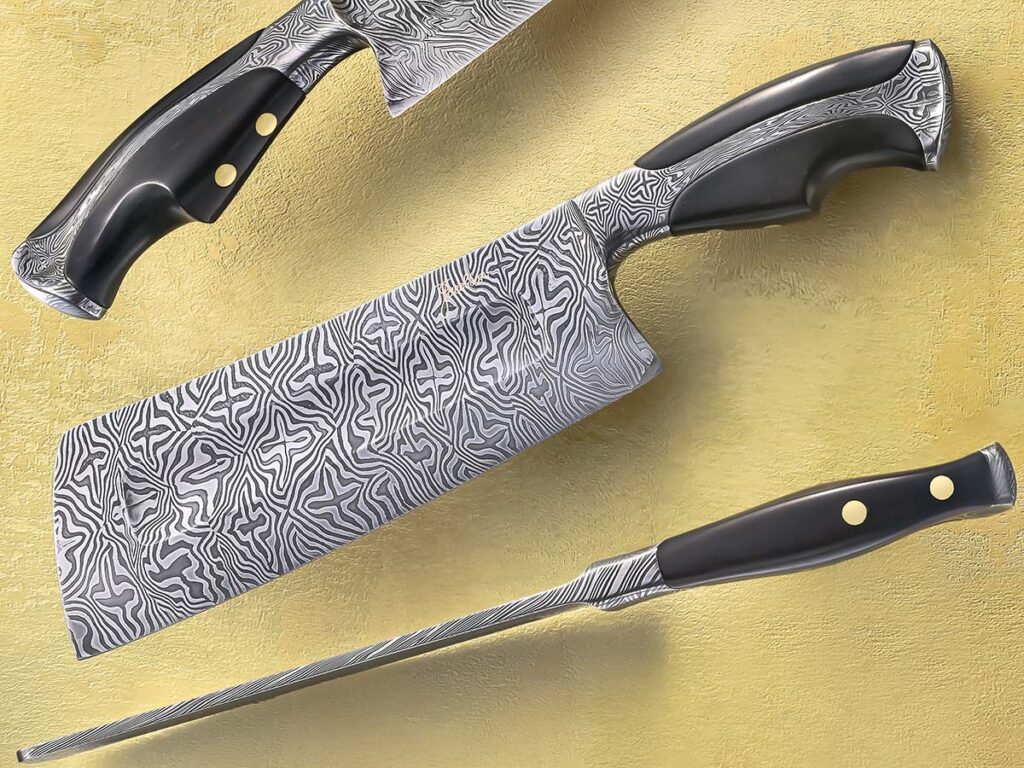
Having served time in professional food service, practical utility is never far from David Jacobson’s mind. However, he isn’t afraid of adding some flourish to his creations, such as the gold-inlay signature near the spine of his mosaic damascus bladed and ebony scaled cleaver. (SharpByCoop image)

David Jacobson’s integral 13-inch cleaver with ebony handle scales sports an 8¼-inch mosaic damascus blade of 1085 and 15N20 steels and a gold inlay signature—his first such accent. He used brass bolt pins to finish the ebony scale attachment.

“I love cooking and making cool chef’s knives and kitchen tools,” Jacobson related from his Felton, California, shop. “Edge geometry for chopping and balance are challenges, and fullers are nice when slicing vegetables for food release. Cleavers are not only for the kitchen. They are great for large fish processing at the dock, chopping through bone and restaurant back-alley butchering. The wide blade shows off the many designs in the damascus steel, and I chose a traditional profile for this particular cleaver. I’ve always liked a black handle with big brass pins—old school.”

Cutting Mustard
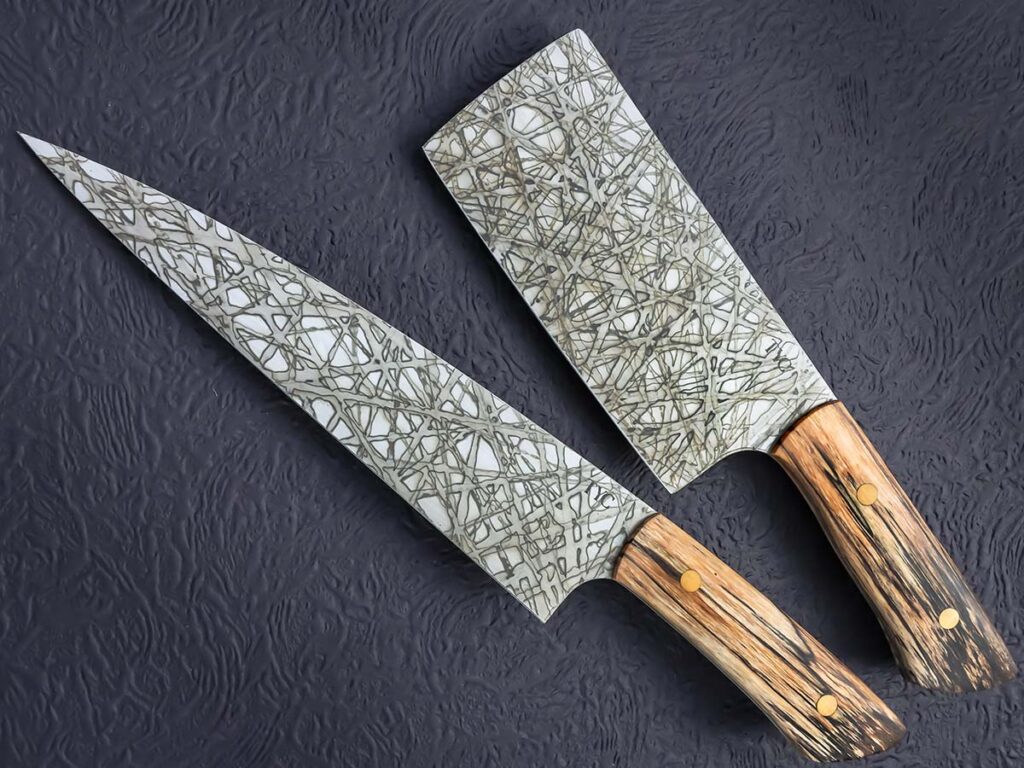
Given the amount of steel and the need to pay attention to minutia is what Bill Tyc figures steers most makers away from cleavers. Tyc achieves an intricate pattern on his cleaver-chef’s knife set through a simple mustard patina, but applied with a straight edge for a pattern he calls “Lines of Insanity.” (SharpByCoop image)

The pairing in Bill Tyc’s featured ensemble is stunning in its presentation. “The cleaver as well as the chef’s knife are made of 52100 high carbon steel from the NJ Steel Baron,” he remarked. “The handles are stabilized spalted tamarind from Wood Dynamics fastened with brass Corby bolts. The pattern on the steel is a mustard patina done with a ruler edge, hence the name “Lines of Insanity” pattern. The cleaver is 11½ inches overall with a 6¼-inch blade. It’s 3 inches tall and ¾ inches at the heel. I felt the spalted lines of the tamarind wood would look perfect with the mustard patina.”

Tyc, who resides in Waterbury, Connecticut, remembers making kitchen knives that did something no other creations had generated. He got immediate feedback from users.

“In fact, the first ‘kitchen’ knife I sold was a cleaver at the Mystic Knife Show in Connecticut,” Bill remembered. “A gentleman circled the floor three times, every time touching a cleaver I had on the table. Last pass, he picks it up and just says, ‘I’ll take it.’ My wife and I look at each other with a thumbs up, and off he goes. Well, the following year, the gentleman comes into the show, right up to my table, and says, ‘Last year I bought a cleaver from you.’ The wife and I again look at each other because we most certainly remembered. He says, ‘I have so much fun using that cleaver every day!’ I reached across the table, shook his hand and said, ‘I’ve been waiting 20 years to hear that! I could pack up and go home, I feel so good.’”

According to Tyc, many custom knifemakers shy away from cleavers because they require a lot of work. At just about any knife show, only a relative few are seen for sale. But he adds cleavers’ utility far exceeds their supposed kitchen niche, pointing out they are handy for camping, survival exercise, yard work and bushcraft as well.

“The most important things are balance and weight,” Bill observed. “A knife used as often as a kitchen knife or cleaver has to feel good in the hand, not just initially, but long term. You may find yourself using your kitchen knives for many hours through the week. You want it to be comfortable, not a labor.”

Veggies Beware
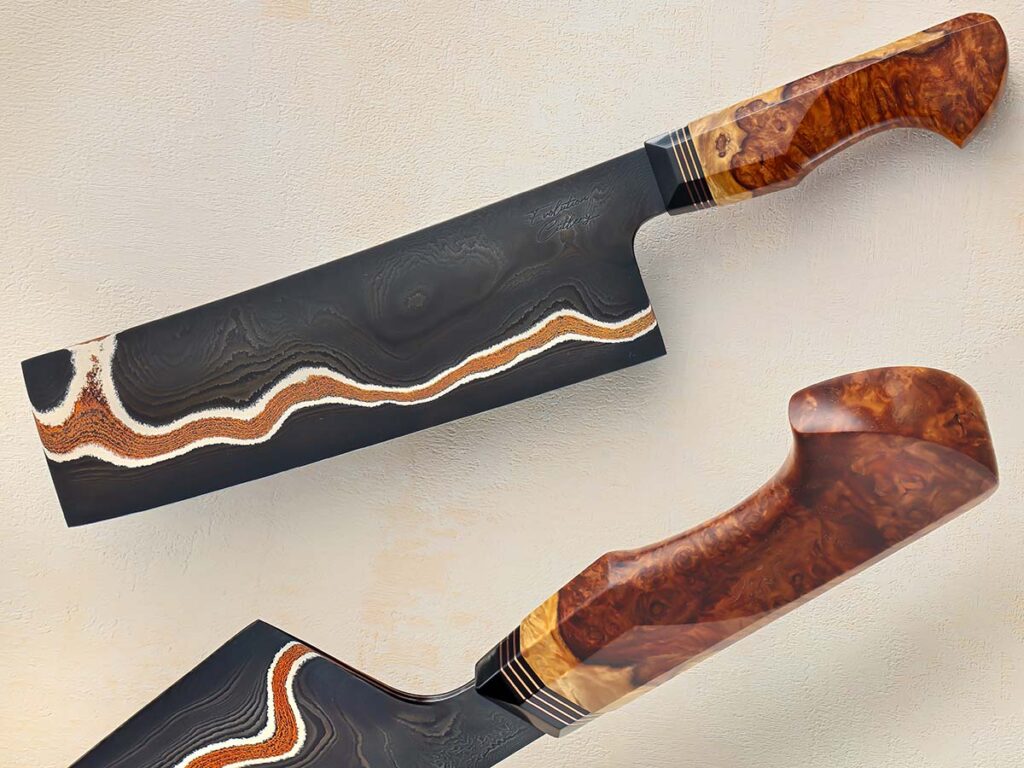
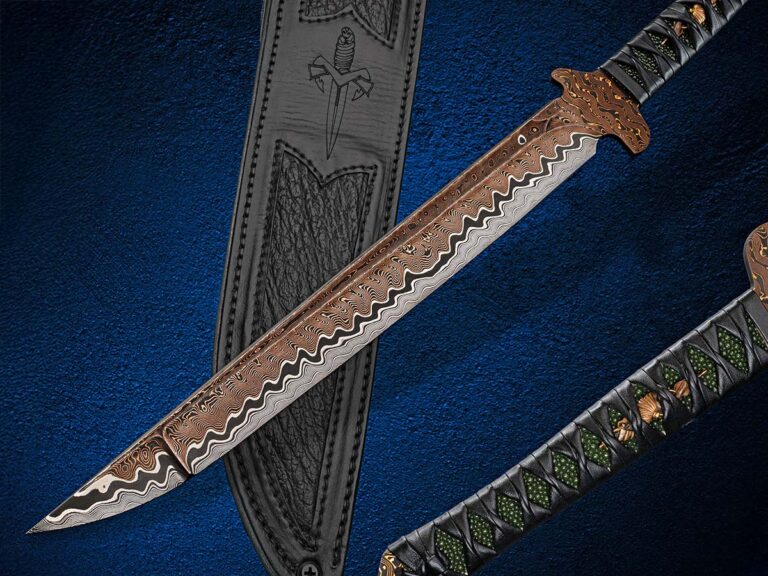
One of the unique advantages of the cleaver, Dan Tomplins points out, is the large canvas it allows for the steel. In the case of his nakiri—vegetable cleaver—its 81/2-inch copper mai blade can’t help but catch the eye, particularly with the steel’s blacked-out finish enhancing the patina'd copper. Note too, the hybrid octagonal/western-style handle made from amboyna burl. (SharpByCoop image)
One of the unique advantages of the cleaver, Dan Tomplins points out, is the large canvas it allows for the steel. In the case of his nakiri—vegetable cleaver—its 81/2-inch copper mai blade can’t help but catch the eye, particularly with the steel’s blacked-out finish enhancing the patina’d copper. Note too, the hybrid octagonal/western-style handle made from amboyna burl. (SharpByCoop image)

In 2016, Dan Tompkins began making knives, and three years later, he started Evolution Cutlery in Highland, New York. His kitchen knife work began simply because he wanted to make cutlery used on a daily basis, and his cleaver immediately attracts attention.

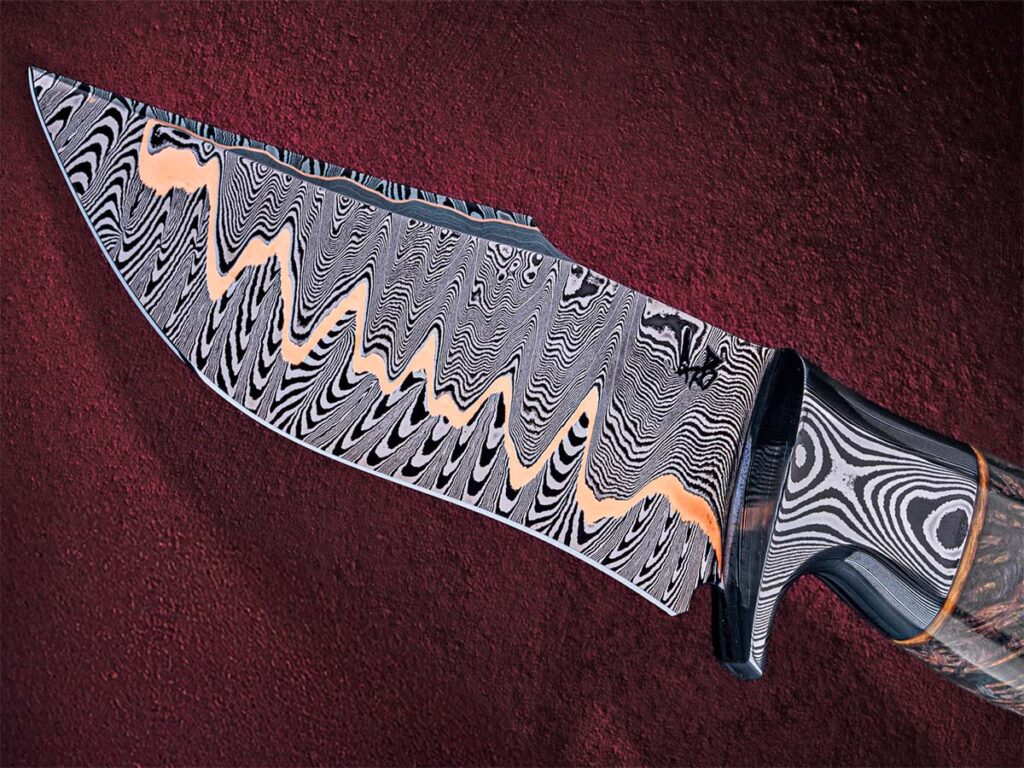
“The big square profile is a great canvas to show forging skills, especially if using mosaic damascus. It allows a lot of room to see the details in the patterning,” said Dan. The subject steel is Baker Forge copper mai with a blacked-out finish and layers of patina’d copper in the nakiri, or veggie cleaver, design. The handle is Tompkins’ hybrid octagonal/western style made from amboyna burl, heirloom fit to a copper and G-10 bolster. The cleaver blade measures 8½ inches, and the overall length is 13 inches.

“One challenge in making cleavers is getting the edge geometry perfect for the intended purpose,” explained Dan. “There are many different types of cleavers, so the proper geometry is an important consideration. Heavy-duty blades require a heavy convex edge, while veggie cleavers are best with a laser-thin edge. When it comes to kitchen knife ergonomics, not only do you have to have a good feel in the handle’s shape and contour, but you also have to have proper balance to make the knife comfortable to use all day. While cleavers will almost always be slightly blade heavy in balance, they should still be balanced not far in front of the handle … Balance can make a light knife feel heavy or a heavy knife feel light. In my opinion, even a heavy knife with proper balance is far more comfortable to use than a light knife with improper balance.”

 Tompkins sees the cleaver in action in varied settings, not just the kitchen. Camp chores like chopping wood or preparing food outdoors can be handled easily with a cleaver made for such adventures, and he makes the cleaver to fit the anticipated tasks.

Versatility is readily apparent in these custom cleavers, and their functionality is in lockstep with good looks driven by their makers’ creativity.

Check Out More Cool Customs:

10 Knifemaking Questions with Naked & Afraid’s Laura Zerra

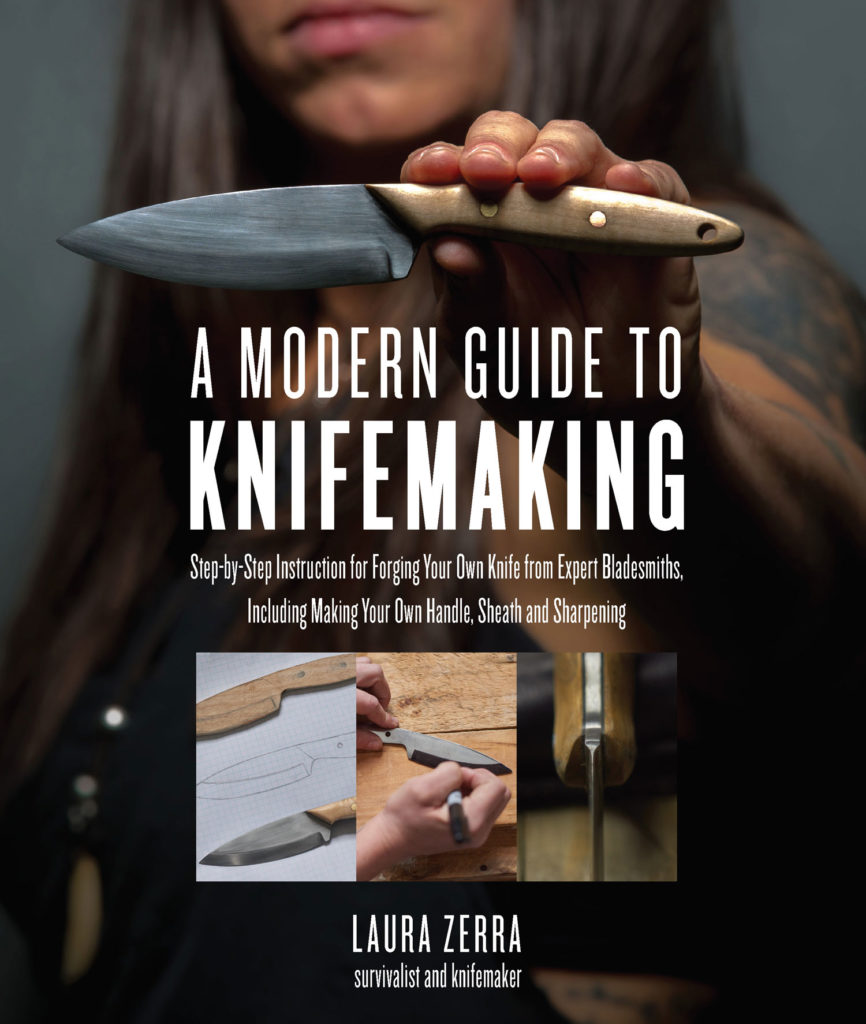
You may know Laura Zerra from her appearances on the Discovery Channel program, Naked & Afraid, or at BLADE Show. What you might not know is that she’s also an accomplished knifemaker with a book coming out July 3, 2018, titled, A Modern Guide to KnifemakingNo less than BLADE Magazine Cutlery-Hall-of-Fame® member Ken Onion, Kaila Cumings, and Mike Jones contributed to the tome.

Fresh from an extended stay in the wilderness, Zerra talked with BLADE about knifemaking, survival knives and the biggest mistake people new to knifemaking make.


BLADE: Most people know of you through Naked & Afraid. Did you get into knifemaking after appearing on that show or was this something you were always practicing?

LZ: I used to be a farrier, so I got my first introduction to knifemaking through blacksmithing. I used to mess around with steel in the forge, and that led to trying my hand at making knives. As a survivalist and outdoors person, I’ve always had a love for knives, and starting to make my own was a natural progression.

What spurred you to write your new book, A Modern Guide to Knifemaking?

I was working on outlining a survival book, and my editor saw that I’d just been at BLADE Show. We talked about the possibility of me writing a book on knifemaking. I’ve always loved knives, and have been in numerous situations where my life literally depended on my blade. I’ve also been humbled by all the legendary knifemakers I know, and I don’t have the expansive years of experience and talent that a lot of them do.

The thought of writing a book on knifemaking was really intimidating at first, but I realized that my perspective would allow to me to write a book that could really break it down for a beginner, and that my relationship with knives as a survivalist could offer some unique insight. Knifemaking is one of those skills that everyone does a little bit differently, so I wanted to interview some experts in the field and have them offer their two cents, as well.

How to make survival knives

Can someone with little knifemaking experience pick this up and go at it?

I wrote the book that I wish I’d had when I first started knifemaking. I wanted someone with absolutely no experience to be able to pick up my book and be able to make their first knife, from start to finish. While I do talk about what has worked for me in my experience, I think knifemaking is personal. I really wanted to encourage the reader to experiment with different processes as well as designs to develop their own style and find what works for them.

What’s your philosophy when it comes to knifemaking?

As a survivalist, first and foremost, my knives have to be functional and durable. A knife has to be able to complete the tasks I need it to, and I don’t want to have to worry about it breaking or losing an edge quickly when I’m depending on it for my survival. That being said, I don’t think that means it has to be unattractive; I think a functional knife can still be beautiful, and a skilled knifemaker can complete both these objectives.

Laura Zerra knives
Zerra says she prefers working with 1095.

What are your favorite steels to work with?

I like working with 1095 steel. I find it easy to move with a hammer, and it holds a great edge with a good heat treat. But I have to admit, I’m a sucker for damascus carbon steel. Well-made damascus really does well with that balance of function and beauty. I just love the moment of pulling it out of the etch and seeing how the pattern has played out on the steel.

What’s the biggest mistake people make when first starting out making knives?

I think the biggest mistake people make is not getting started at all. I’ve talked to so many people who have told me, “I’ve always wanted to make a knife!” but have never actually done it. Getting started can be intimidating for people, and that can be enough to prevent them from ever getting out there and doing it.

If I could tell people one thing, it would be to commit to doing it; not in a year, not when you have time, but right now. And don’t be scared of making mistakes. Mistakes are a natural part of getting into any new skill, and are an important part of the learning process; but you have to actually get out in the shop to start making them!

Laura Zerra knifemaker
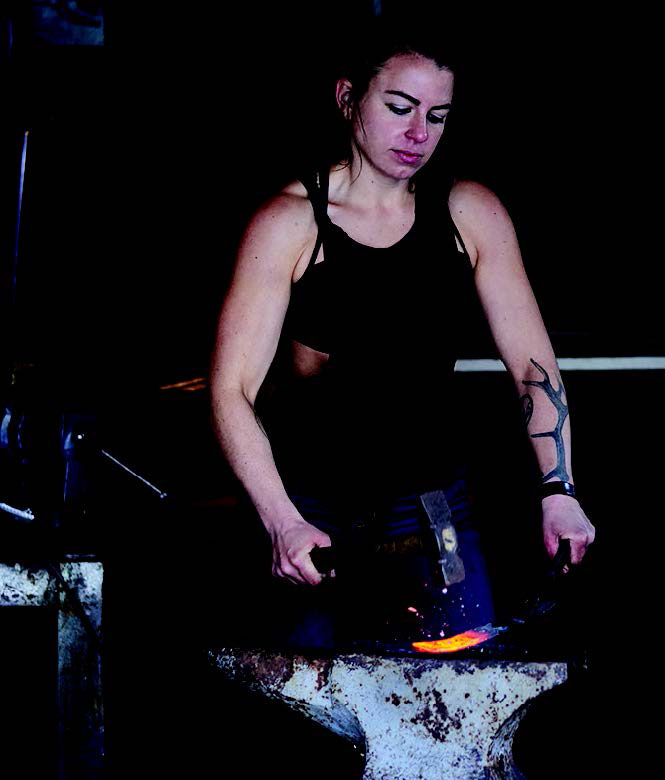
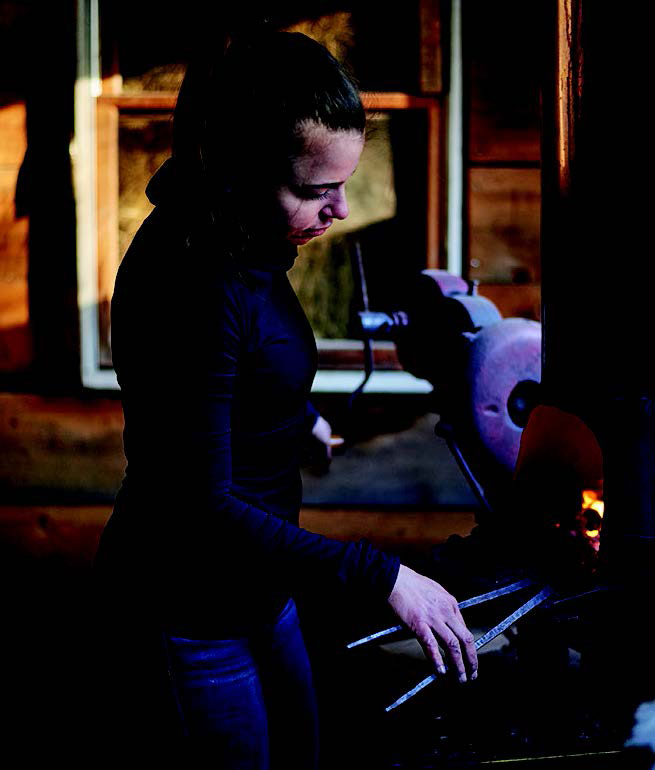
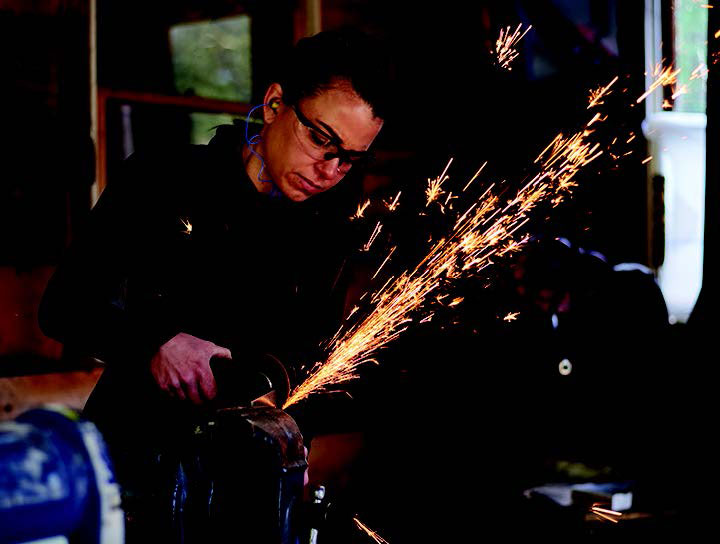
Laura Zerra, star of TV’s “Naked & Afraid,” at work in her shop. (all shop images provided by Laura Zerra)

Is there such a thing as a “survival knife” or are there only knives used for survival purposes?

I think the term “survival” is too broad to describe a specific type of knife. Where am I surviving? What’s the environment like? What tasks will I need my knife to perform?

Different circumstances will be best met with different qualities in a knife, from overall size and shape to steel choice to blade geometry. To try to make a “One Size Fits All” blade that will be the best tool for every survival situation seems like an impossible task.

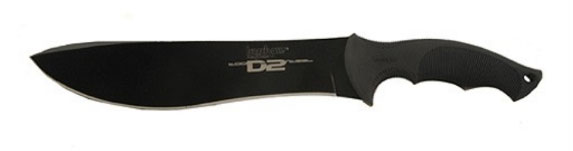
In seasons 1 and 2 of Naked & Afraid, you brought with you a Kershaw Outcast and a Diving Sparrow Mako Shark, respectively. Both of those sport big blades (10 inches and 11.25 inches). Is it safe to say that machetes are better than knives with smaller blades for survival purposes?


Kershaw Outcast
Kershaw Outcast

Mako Shark knife
Mako Shark

I brought those knives based on my location in the tropics. Both of those knives made easy work of cutting through a massive amount of palm leaves and opening coconuts. It’s a bit more difficult to carve trap parts or butcher meat, but it can still be done.

A machete can be used to complete more delicate tasks by changing the way you use the cutting edge; for example, when gutting small game, I hold the machete between my feet and move the animal across the blade instead of trying to move the big knife across the much smaller animal.

For jungle survival, I absolutely recommend a big blade because the of amount of material you’ll be chopping though. Put me in a desert or a deciduous forest, however, and I’m likely to bring a smaller blade; it just depends.

What’s your take on survival knives versus survival multi-tools (those 31-in-1 sorts of things)? Are those multi-tools any better than a knife that’s just a knife?

I prefer a simple knife. A multi-tool has its place in urban survival and everyday use, but I find all those extra tools and edges can limit the use of your blade and get in the way. As a primitive survivalist, I’m used to improvising with what I have so maybe that’s part of it. I know people who love multi-tools, so I guess it’s personal preference.

Laura Zerra knifemaker
Careful around the grinder, warns Zerra.

In the name of safety, we run a series on blademag.com about knifemakers’ worst accidents in the shop (so that no one else repeats the same mistakes). Have you ever had an accident in the shop? What did you do differently the next time around?

Yup! When I first started using the grinder, I ground a big notch out of one of my fingers. It took a minute to start bleeding, but then it gushed for quite awhile. I had to quit for the day, because my hands were so slippery from my own blood that I couldn’t hold the blade anymore.

It definitely gave me respect for the grinder, and I was more aware of the fact that the belt removes flesh much faster than steel. I also had a shirt catch on fire from hot steel dust gathering in a fold. I’d love to tell you that I wear a leather apron now but I’d be lying.

Keep up with Laura Zerra on Twitter, Instagram, Facebook and her website.


You Never Know Who You’ll Meet at BLADE Show

Laura Zerra is just one of the celebrities who have attended BLADE Show. The 2018 version takes place June 1 to 3 in Atlanta. Buy tickets and find information here.

Hot Bluing Video

0

Hot bluing process

Knife Handle Material: Natural, Synthetic And Hybrid Moments

Natural and synthetic materials are equal parts fashionable and functional.

2024 Knives annual
This article appeared in the 2024 KNIVES annual.

They complement one another in an easy, seamless union—blade and handle. One without the other means the knife is incomplete, or it isn’t a knife at all.

Along with the search for proper blade steel, appropriate handle material is the second critical element in the presentation, form, and function of the knife itself. Natural and synthetic handles play their roles. They bring utility and aesthetics to the package, and the maker’s choice sets the tone. Availability, cost, and maker’s preference fit into the equation when choosing the right handle material. And then, of course, the intended knife use weighs heavily.

In the end, it’s the eye of the artist that drives the visual element, and the job to be done by the user that directs his or her choice. The handle makes the knife complete.

At Masecraft Supply Company, co-owner Chris Hartman sees the supplier’s role as the facilitator. Never interfering with the artist’s concept, he views Masecraft as a provider of the palette. “We don’t advise what to use,” he reasons. “We are not big fans of, ‘You know what you should do …’ or telling a customer what to use, but more in supplying a wide variety of options to choose from. We are always willing to answer questions about our materials a customer may have, but it’s just not a good idea to advise what is right for them. That’s the maker’s choice.”

With that said, where is the market headed today? What does the landscape look like in terms of availability, trends, and timing?

“The majority seem to be sticking with composite laminates like G-10, canvas and linen Micarta, and Richlite,” Hartman says. “Natural materials like bone and horn seem to be in a continuing decline. Exotic woods still do well, but availability and pricing have become issues over the last two years.”

John Cammenga, vice president of operations at White River Knife & Tool, Inc., deals primarily in synthetic knife handle materials. He indicates that knifemakers who build hard-use models often lean toward durable synthetic handles and that the laminate trend holds up there as well, particularly with material available in a variety of colors.

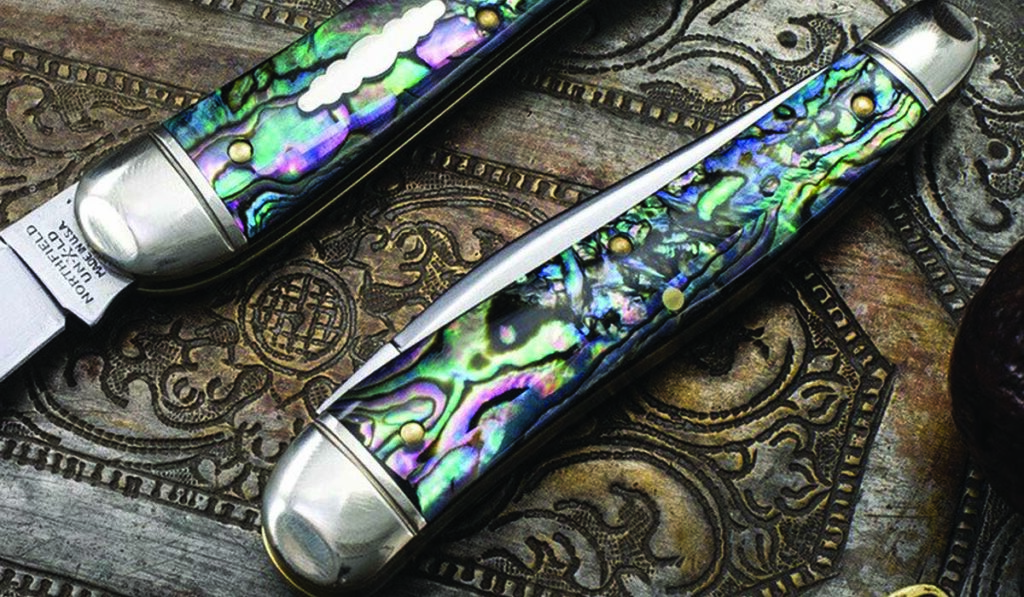
Northfield UN-X-LD knife
This Northfield UN-X-LD knife from Great Eastern Cutlery (GEC), which registered the trademark and uses it on premium GEC pocketknives, features ALVS (acrylic laminated veneer shell) handle scales from Masecraft Supply Company. The dazzling shell veneer consists of real shell and high-impact acrylic laminated together within the sheet.

“The majority of our handle materials are synthetic,” Cammenga says, “and this is primarily due to stability and longevity. But many look great as well. Multi-color layers of fabric bonded with phenolic or polyester resin can have the look of wood, yet last much longer. Additionally, many of these are tackier when wet, giving the user additional hand purchase in tough weather or when processing game. Carbon fiber and G-10 are available in an ever-expanding array of colors and patterns and almost bulletproof when it comes to wear and tear.”

Choosing Knife Handle Material

The choice of materials, Cammenga explains, comes directly down to the proposed use of the knife. For hunting, fishing, camping or bushcraft, White River almost always recommends synthetic handle material. However, John still gives a nod to personal preference. Some users simply must have a natural handle, and the aesthetic factor comes into play there.

“It’s hard to beat the beauty of a highly figured burl!” he comments. “Some, such as desert ironwood burl, are not only beautiful but also extremely tough.”

Tom Krein is an experienced custom knifemaker who worked for the great Bob Dozier and ran the custom shop for A.G. Russell Knives before embarking on his own venture during 30 years in the business. Making small utility and hunting knives primarily, he agrees that handle material choice relates to a few simple concepts.

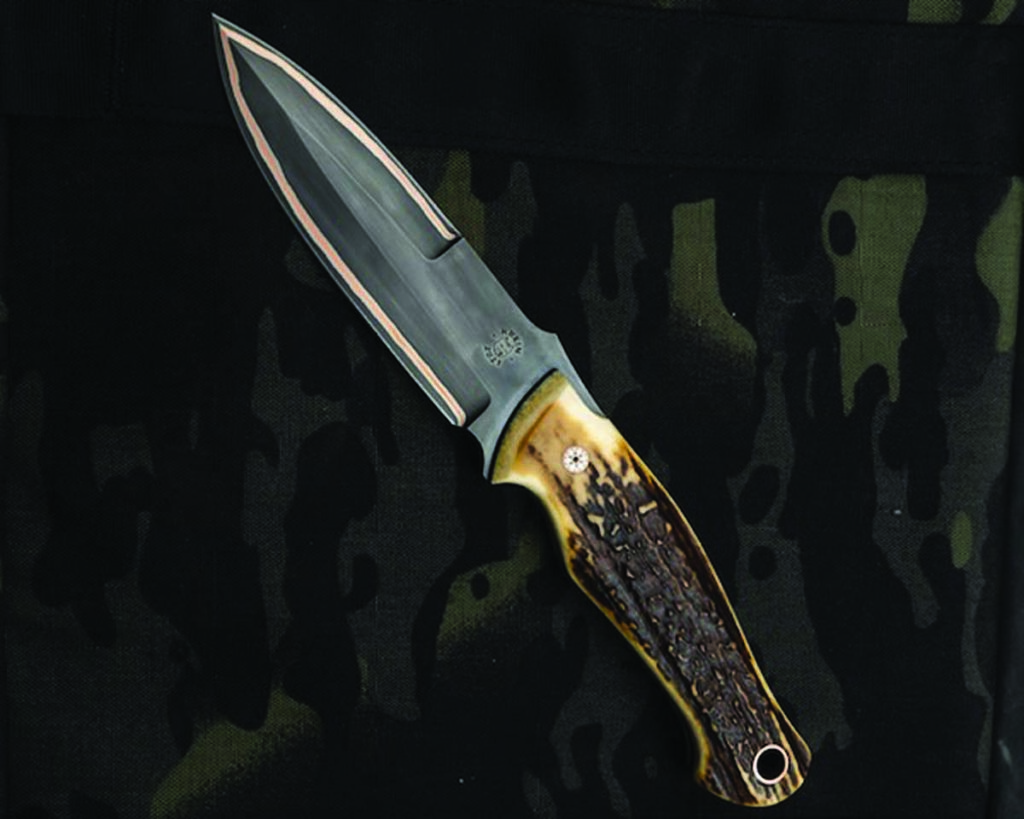
Tom Krein’s “Mako” model features a Dion Damascus san mai steel blade with a copper-color stag handle.

“It comes down to the customer’s needs, willingness to care for the knife, aesthetics, and budget,” Krein relates. “Natural materials should hold up nicely with proper care assuming everything goes according to plan. Sometimes stuff happens—a knife falls into a sink of water, or it starts to rain while hunting, or your knife gets lost in the yard for a week. Synthetics hold up better when stuff goes south. For customers, I recommend getting what you like and learning how to take care of it. For knifemakers, I suggest picking the mind of another maker who uses the material you want so you can learn how to use it. Overall, we are a helpful bunch of people.”

Traditional handle materials and their innovative, eye-popping counterparts coexist at Santa Fe Stoneworks, a provider of materials to the art knife market since 1978. Santa Fe not only affixes those materials to its own knives, but also provides the service for Spyderco and Kershaw while doing private label work as well.

President Bill Wirtel leads the family business, and the company’s roster of natural handle materials includes the best of the best. “We work with factory knives and apply gemstones, exotic woods, shells like gold- and black-lip pearl, and fossils such as woolly mammoth tooth, tusk, bone, and petrified dinosaur bone,” he remarks.

As for Santa Fe’s synthetics, Fordite, a car paint overspray, Surfite surfboard overspray, and a cholla cactus-like material that is made in the shop have found favor with makers and buyers alike.

Material Mash Up

“We are looking for design and color, so we mix natural with manmade stone and epoxies,” Wirtel explains. “Our fossils are all stabilized so they work great for a handle material. We see hybrid materials gaining popularity as they provide the best of both natural and composite materials. Fordite and Surfite have been selling well. Our synthetic cholla cactus line that we make here, stabilizing it with different colored epoxies, is becoming a big seller as well. We also have mammoth tusk fusion. This is stabilized fragments of mammoth ivory that are fused together under immense pressure. The result is a beautiful and hard composite that is densely packed with mammoth ivory.”

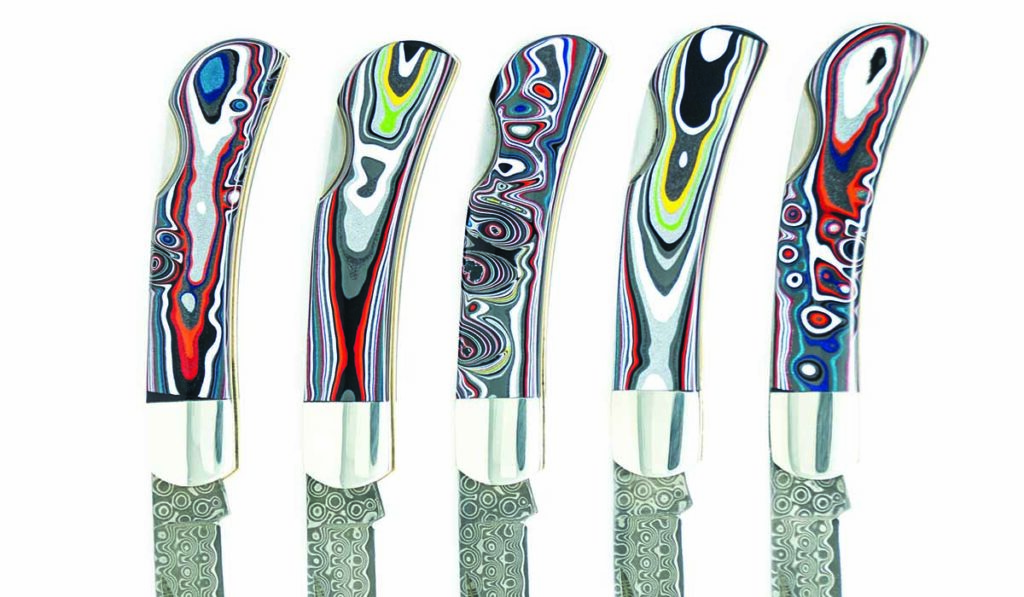
Fordite car paint handle material adds a fun flair to this series of Santa Fe Stoneworks 3-inch lock-back folders
Fordite car paint handle material adds a fun flair to this series of Santa Fe Stoneworks 3-inch lock-back folders with damascus blades.

Fordite is an interesting option that comes from a surprising source. Also known as Detroit agate or motor agate, the material consists of pre-1985 automobile paint that hardened sufficiently to be cut and polished. It formed from enamel paint slag, which built up over the years in layers on the tracks and skids where cars were hand spray-painted. The buildup hardened in ovens intended to cure the paint on car bodies. After so much of that buildup, the brightly colored and layered paint had to be removed. Its allure caught on with some autoworkers who brought pieces home with them. From there, the beautiful Fordite material, which can be cut and polished into a spectacular look, found its way onto knife handles.

The Masecraft perspective is somewhat dictated by availability. “Sambar stag is not coming back,” Hartman stresses. “It has been banned by India for export since sometime around 2005, I believe, so that’s almost 20 years now, and I see no chance of this ever-changing. What’s still available out there now is it. Game over!”

“Black-lip, gold, and white mother-of-pearl all are still available,” he adds, “just not in larger size pieces as they were 20-50 years ago. They are overharvested and not as healthy as before. Demand for shell is down overall. It is not very tactical, and we seem to be in a tactical and bushcraft market for the last two decades. Shell tended to be more of a gentleman’s pocketknife material, so it’s not exactly the big trend right now.”

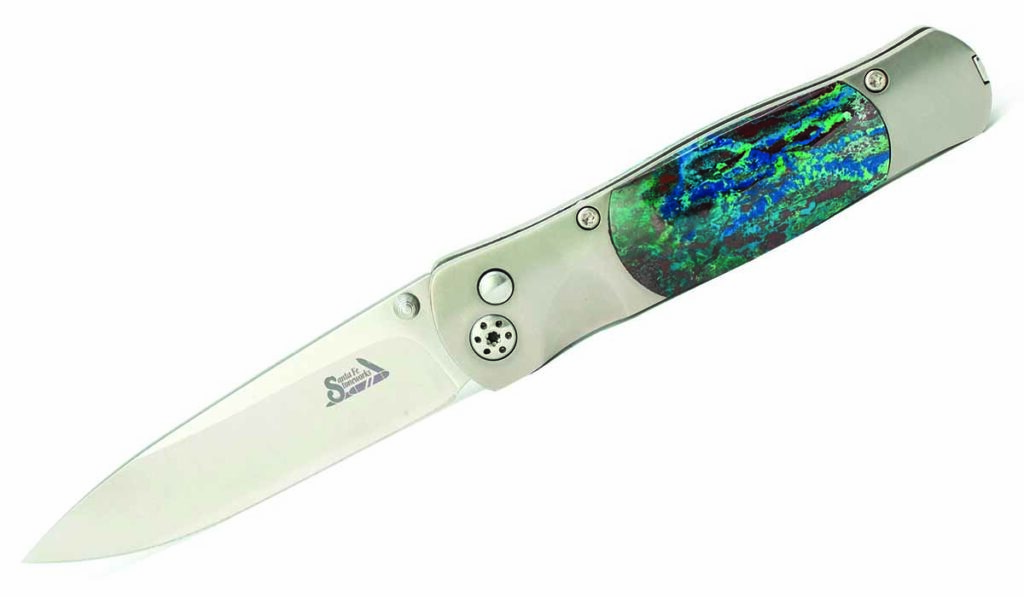
Santa Fe Stoneworks El Rey model is handled in a spectacular turquoise/abalone/bronze hybrid gemstone
This Santa Fe Stoneworks El Rey model is handled in a spectacular turquoise/abalone/bronze hybrid gemstone and includes a mother-of-pearl button inlay.

“Many of the companies that used a lot of shell on knives are gone or simply don’t have the people who know how to work with it anymore,” Hartman adds. “Shell is still one of the most beautiful materials ever, so much so that it seems to be the hardest to reproduce in any type of synthetic alternative that even comes close to its natural beauty. We can come close, but there is still nothing like the real thing.”

Krein sees a swing toward synthetics and higher-end natural materials as well. “Right now, there is a huge push to find and use vintage Micartas,” he relates. “I’ve also seen G-10 usage go up a ton over the years. G-10 holds up to use extremely well, is relatively inexpensive, and machines and grinds easily. I’ve also noticed quite a few new businesses that specialize in exotic stabilized woods. Stag has always been a desired and quality knifemaking material, and with exceptional stag being much harder to find, it is even more desirable, particularly when done [harvested and finished] properly.”

Watching the high-end polymer Ultem begin to trend as a new synthetic handle material has been interesting for Krein, and his affinity for giraffe bone has not waned. It’s something he calls the “latest real pickup in natural materials.”

White River Knife & Tool fillet knife with cork handle
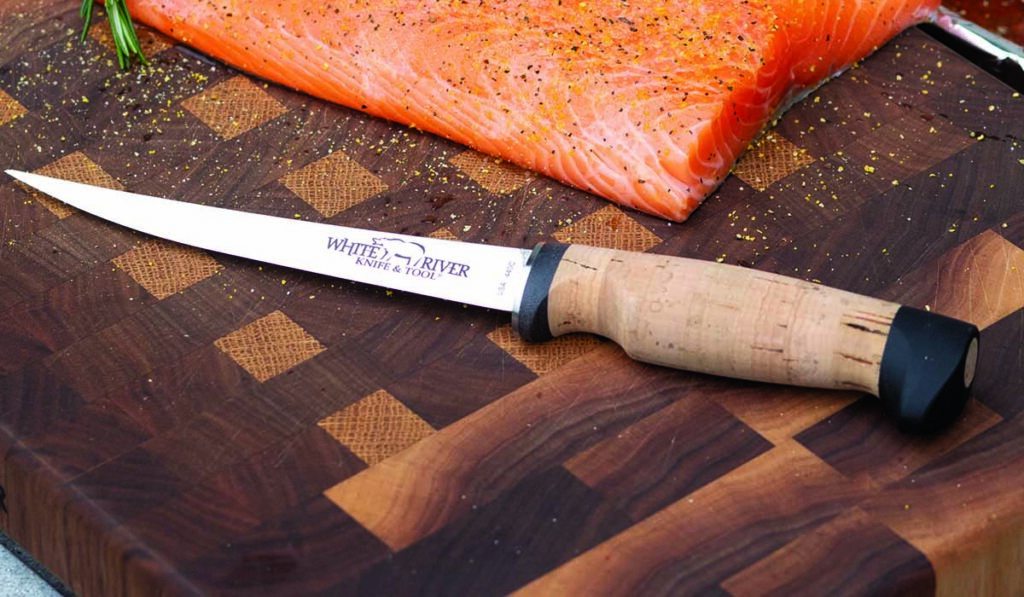
White River Knife & Tool purchases synthetic material made in the USA, so supply chain issues have not been a problem. The one material the company imports, cork, has increased in price, but its supply has been uninterrupted. White River’s Traditional Fillet knife incorporates a handle of imported cork for easy cleanup and a tight grip in slippery conditions.

“I often see new makers using very exotic materials,” Krein concludes. “These materials are costly and often not used anywhere close to their potential. I recommend that new makers learn to use simpler materials like Micarta to their full potential. This leaves funds available for other materials and equipment while allowing a new maker to develop their skills. Just because a knife has expensive materials doesn’t make it better or more interesting to me. It’s developing the skills to make simple materials look elegant that I appreciate.”

Those Hybrid Moments

Hybrid handle material is on the rise, and Cammenga is pleased with the growing popularity of marbled synthetics. “Right now, there is strong demand,” he notes. “This is true in both cloth/resin laminates and carbon-fiber/resin laminates. For those who want natural wood, bone or antler, acrylic ‘stabilized’ scales have been popular for quite some time. They provide the user with a natural material, which has been made tougher by introducing acrylic resin into the fibers. Currently the marbled look is in with almost all materials, but we have made several knife models using G-10 and rubber combinations, as well as others from polyester cloth and resins.”

Masecraft is keeping a close eye on the development of new materials, but the course is charted by ingenuity rather than discovery. “As far as new natural materials, that’s going to be extremely rare,” Hartman observes. “The earth is not really producing anything new, so unless we have not discovered it yet, the odds are low. More likely, some natural materials will disappear and become endangered, banned, or extinct. Human history tells us the availability of natural material will decrease while prices increase. You will see more hybrids of natural and synthetic combinations, and all kinds of new synthetics will continue to be introduced.”

vintage Micarta
Knifemaker Tom Krein says there’s a huge push to find and use vintage Micarta, such as on the handle of his pocket bowie model.

Supply often dictates how well demand is satisfied, and the inherent scarcity of some handle materials has been exacerbated by supply chain concerns in areas. Even as the COVID-19 pandemic has eased, the resilience of the supply chain remains an open question. Some suppliers and makers have faced shortages of stock items, while others have adapted, moved on to other, more readily available options, or simply been patient.

“I have been sourcing materials for over 44 years, and most of our suppliers know us and what we want,” Wirtel relates. “Obviously, we’ve had supply chain issues, but we have been able to work around them. We make our product to order, so we range in delivery time from a few weeks to a few months.”

Krein is positive regarding availability, saying, “There have been slight wait times for some synthetics, particularly Micarta, during the pandemic, but it seems like everything is back on track here. There has and will continue to be more demand for quality stag than availability. I’ve seen a bit less of quality exotic stabilized woods like exhibition-grade ironwood and Koa.”

While the supply chain phenomenon has been universal, Hartman is pragmatic. Going with the flow makes the Masecraft operation run as smoothly as possible. “There are supply chain issues with everything globally,” he observes. “I can’t think of anything on the planet that hasn’t been affected in some way, shape or form and that doesn’t have a price increase or isn’t in short supply, and it’s all things, countries, and markets.”

Dozier Knives produced this fixed blade with a Richlite handle from Masecraft Supply Company
Dozier Knives produced this fixed blade with a Richlite handle from Masecraft Supply Company composed of approximately 65% Forest Stewardship Council (FSC)®-certified recycled paper and 35% phenolic resin.

“If you don’t have the chip, you can’t produce the car,” Hartman says. “If you don’t have OD Green dye, you can’t make OD Green G-10. If one key part is missing due to supply chain issues, the product simply cannot be made, and that is affecting all things.”

Staying domestic has been a problem solver for White River Knife & Tool, according to Cammenga. “Because White River purchases synthetic material made within the U.S., our supply chain has not been a problem. The one material we do import, cork, has increased in price, but our supply has been uninterrupted.”

Considering the handle-blade combination that makes the knife come together for the spectrum of customers and users, today’s material options appear more diverse than ever. Although some shortages in natural materials may never be plentiful again, fusions of natural and synthetic options open the door to creativity. And the imagination is always fertile ground for innovation.

More On Knife Handles:

Remembering Tim Britton: Rest Easy Marine

The knife community lost one of its last members from the golden era of knifemaking with the passing of George Miller “Tim” Britton, who died after a short illness on December 9. He was 85.

A veteran (1959-65) of the United States Marine Corps and known as North Carolina’s first professional knifemaker, Tim began fashioning knives in 1971. Early on he specialized in small personal and fancy boot-type knives and assorted fixed blades and wound up his career making all manner of classic slip joints.

He appeared in early ’70s issues of The American Blade and later in BLADE®. He learned about knives and how to make them from Jim Mustin of Cajun Knives and BLADE Magazine Cutlery Hall-of-Fame® members Frank Centofante and Blackie Collins. Other influencers were Tim’s knifemaking contemporaries such as Cutlery Hall-of-Famers Ted Dowell, Jimmy Lile and Bob Loveless and well-known makers Rod Chappel and Bob Dozier. Tim was an admirer of Chappel’s handles and those of Bill Luckett, too.

Britton’s career spanned the early days of O1, 440C and D2 for blade steels to today’s CPM grades.

Tim specialized in classic slip joints, this one in BG42 stainless steel, Fiji fire pearl and 24k-gold inlay. Closed length: 3.25 inches. (Eric Eggly/PointSeven knife image)

“I started with O1 in 1972 and Blackie Collins talked me into 440C,” he once told BLADE. “Peer pressure … Ted Dowell, Frank Centofante, Jimmy Lile and Bob Dozier had settled on D2. [Today’s steel] leaves them all in the dust.”

No matter the steel, its proper heat treatment and also edge geometry, not to mention comfortable handles, were of critical importance to Tim.

“Buying a knife from a reputable maker should be simple,” he once observed. “My questions would be steel type, Rockwell hardness and what kinds of tools the maker has in his shop. I’m a dinosaur.”

A colorful character known for speaking his mind, he spent time as a member of The Knifemakers’ Guild and the ABS.

“Forging is a macho trip,” he once stated. “I fancy myself a smithy in times past.”

He understood well the importance of effective marketing, regularly running one-third page color ads in BLADE, and he demanded the most in return from them. He also loved the BLADE Show and was a regular exhibitor along with Deb, his wife of 26 years.

Rest easy, Marine, and semper fi.

Remembering Others The Knife Industry Has Lost:

Damascus Steel: Experts Forecast Growth In The Knife Industry

From copper-infused patterns to stainless steel sheets, discover the innovations driving the red-hot market for production damascus.

Are we seeing a bit of “global warming” in the knife industry, where red-hot damascus steel is getting even hotter? BLADE® spoke with some industry leaders, and 2025 and beyond looks good to them when it comes to production damascus in both carbon and stainless steels.

There are many individual makers who make high-quality damascus in simple and complex patterns in their home shops, backyards or shared maker spaces. This article focuses instead on production damascus forged by specialized outfits such as Baker Forge & Tool, Damasteel, Chad Nichols Damascus and Vegas Forge. At a level beyond “regular” damascus makers, these companies make steel for the masses, for production companies, and specialize in innovative new materials that are sure to delight the industry.

BLADE readers will be familiar with Baker Forge & Tool, a prolific producer of innovative damascus patterns that include copper, such as CopperMai, TigerMai, GoMai and others.

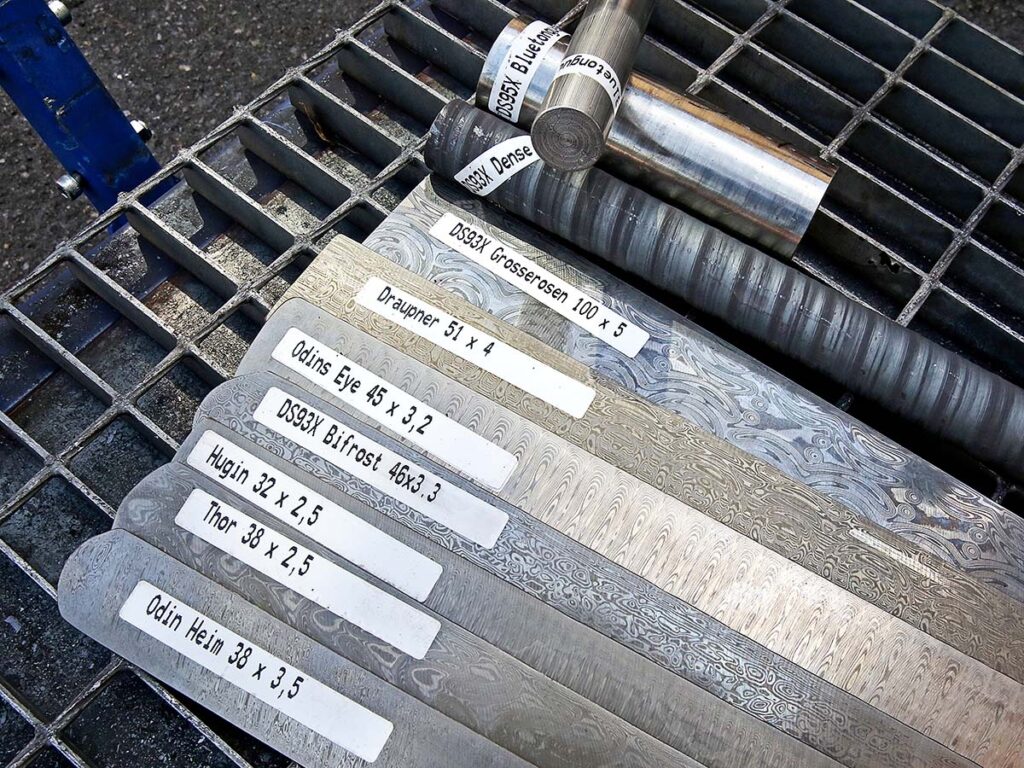
DS93X steel—fourth from bottom in bar form—is Damasteel’s standard mix, “combining good performance with good looks.” “For us it’s more about expanding the patterns than about trying new steel combos,” noted Per Jarbelius. The other patterns in bar form are representative examples of what you can expect from the Swedish steel maker.

“We make carbon steel damascus patterns with copper, and they’ve been hot. We expect them to stay hot through 2025,” Coy Baker said. When it comes to steel selection, the company most often sticks with the gold standard combination of 1084 carbon and 15N20 nickel-alloy steels.

Baker also has been experimenting with Apex Ultra as a core steel for its copper san-mai. For those unfamiliar, Apex Ultra is a tungsten steel alloy, kind of a super-52100 carbon steel. It’s made in small batches and is hard to get in the USA, but Baker has found that the material makes a great damascus core.

“Demand for our Apex core billets far outpaces supply,” Coy noted.

Baker has also been experimenting with stainless and copper damascus and san-mai, using 154CM and AEB-L stainless steels. This writer also makes knives and that combo sounds quite challenging to forge. Baker confirmed that it was very challenging and wouldn’t reveal any secrets, other than the 154CM etches light and the AEB-L etches darker.

Growth In The ‘Sip

Down in beautiful Bush Springs, Mississippi, Chad Nichols makes traditional carbon steel damascus at a production level.

Vegas Forge has always been innovative and 2025 will be no exception. “We’ve figured out how to do copper in with the damascus pattern manipulation, not just as a line between san-mai,” Jesse Harber noted. (Vegasforge.com image)

“I stick mostly to carbon steel 1075 or 1095 plus 15N20 with occasionally a little bit of 3V,” Nichols explained. “I’ve got my process down and these steels go together well.” He makes a variety of mosaic patterns, most of which go to a single manufacturer. “The carbon steels are so much more organic,” Nichols said. “You can do so much more with them in a cost-effective way.”

Nichols’ goal for 2025 is to increase his production of mosaic patterns.

“There just aren’t many people doing production mosaics,” he said. “It’s a great opportunity for growth.”

Another area he’d like to see grow in 2025 is the use of exotic and historical materials. He’s made a run of steel for Boker with steel from a German Tiger tank, and has a run coming for William Henry with some leaf springs sourced by WH.

Collab Designs

Damascus isn’t just a U.S. product. Damasteel produces high-quality stainless steel damascus in Sweden.

Chad Nichols (above) stated the goal at Chad Nichols Damascus for 2025 is to increase the production of mosaic patterns.

“Our DS93X steel is our standard mix, combining good performance with good looks,” Damasteel’s Per Jarbelius remarked. “For us it’s more about expanding the patterns than about trying new steel combos.”

DS93X is described as a “patented powder metallurgy product” that includes “two different hardenable steel grades.” “We use only stainless steel,” Jarbelius explained, ‘because it doesn’t rust and has the same or better performance.”

Damasteel historically produces a new pattern each year. For 2025 it also has begun a special project to collaboratively design patterns. Benchmade collaborated with Damasteel to make a steel pattern called “Monarch” exclusively for the Benchmade Gold Class Necron balisong. Jarbelius is excited for the potential to expand the collaborative effort with other companies who want proprietary patterns.

In another innovation, Damasteel has developed the capability to produce stainless damascus in sheets, not just bars. This will come in handy for small-batch and mid-tech production. The sheet steel pattern is called “Drakkar,” which is the old Norse word for the dragon-shaped Viking longboats.

Copper In The Pattern

What happens in Vegas may stay in Vegas, but that’s not the slogan for Vegas Forge, whose damascus is well known worldwide. It is a consistent producer of high-quality carbon and stainless damascus in complex patterns.

Baker Forge & Tool has been experimenting with Apex Ultra as a core steel for copper san-mai. This integral fighter by Greyson Weltyk features Baker copper damascus for its recurve harpoon blade. (Bakerforge.com image)

“One of our most popular patterns is ‘Reptilian,’ which has three alloys included: O1, 1075 and nickel,” observed the company’s Jesse Harber.

Vegas Forge has always been innovative and 2025 will be no exception.

“We’ve figured out how to do copper in with the damascus pattern manipulation, not just as a line between san-mai,” Jesse noted. “We can take our Reptilian pattern with copper in it, and then clad that billet over an O1 or 1095 core.”

As far as stainless goes, Vegas Forge continues to push the complexity of its patterns. Its most popular pattern, “Virus,” begins with a single stack of 1200 pieces! The company uses 154CM cores for most of its stainless san-mai, along with CTS XHP when available.

Ultimate Hotness

What kind of knives do the manufacturers predict for ultimate hotness in 2025?

Damasteel has developed the capability to produce stainless damascus in sheets, not just bars. The sheet steel pattern is called “Drakkar,” the old Norse word for the dragon-shaped Viking longboats, and is used here on a chef’s knife by a local Swedish cutler.

Both Baker and Jarbelius indicated culinary knives will stay hot, especially in stainless. Baker pointed out that stainless steel handles kitchen abuse better, and this writer agrees. Per said Damasteel’s Damacore and DC18N nitrogen steels are top of the line, and the company has a culinary knife coming in partnership with BLADE Magazine Cutlery Hall-of-Fame® member Ken Onion and CRKT. Both Damasteel officials and Chad Nichols agree that complex patterns are expected to do well for the pocketknife and one-off makers.

Jarbelius “expects growth in the complex pattern market” even as Damasteel’s basic traditional rose, ladder and twist damascus patterns remain best sellers. Nichols states that the mosaic niche he addresses will continue to grow.

All four steel makers expect growth in the production side of the market. Even in a slower economy, the big knife manufacturing companies are still producing limited runs of high-quality damascus knives. Baker looks for growth in his damascus-core san-mai steels.

“They’re easier to get a consistent etch on than the mono-steel cores,” he explained.

Chad Nichols stated that he expects growth in the use of mosaic damascus steels by factory knife companies in 2025.

Manufacturing is all about consistency and efficient processes. Damasteel achieves consistency by using the same steel combo for all its patterns. Nichols gets there by batch building for specific manufacturers so that each run is internally consistent. Harber mentioned that he was approached at BLADE Show West* by multiple production companies looking to order steel for 100-to-200-piece runs. He indicated he expects the mid-range sub-$800 production folders to stay hot.

Gonna Be Intersting

The new year is going to be an interesting one for the economy and politics, both of which are inextricably entwined. Fortunately, thanks to the work of those in the damascus industry, it’ll also be an interesting year in the world of knives. If nothing else, knife enthusiasts will have plenty of beautiful damascus production knives coming off the assembly lines to keep them entertained.

More On Steel:

The Tony Test: Lockback Whittlers

Tony Bose said if you can make a lockback whittler, you have arrived as a knifemaker.

While the whittler is a classic pocketknife pattern that dates back at least to the 1850s, a variation on the theme incorporating both the lockback and slip joint mechanisms offers a challenge to the custom knifemaker and a delight to the owner of this intriguing style.

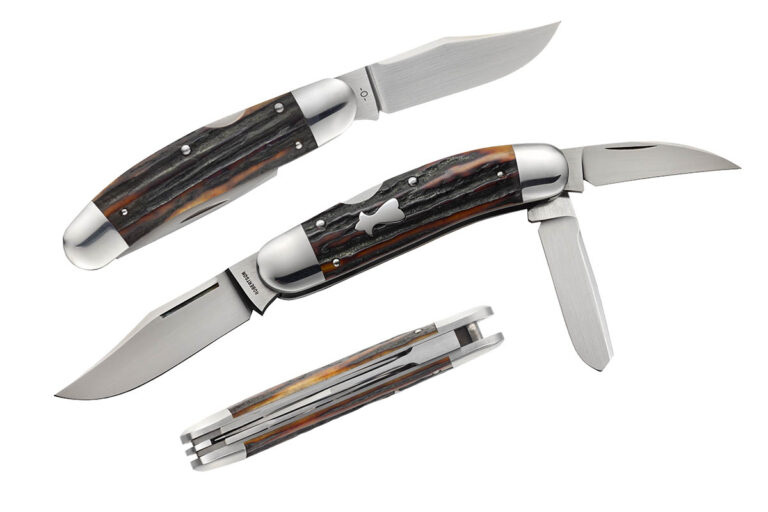
Custom knifemaker David Taber explains his take on the whittler as a three-blade knife with the main blade on one end and two secondary blades on the other. Simple as that. However, from definition to completed construction it’s a bit more complicated, particularly when the lockback mechanism is thrown into the mix.

“The whittler as originally designed was very functional in that the larger main blade is used for making larger cuts and the two smaller blades are for more detailed cutting,” Taber advised. “The knife is necessarily thin by design with the two small blades nestled on either side of the main blade in the closed position, which makes for a slim, pocket-friendly knife.”

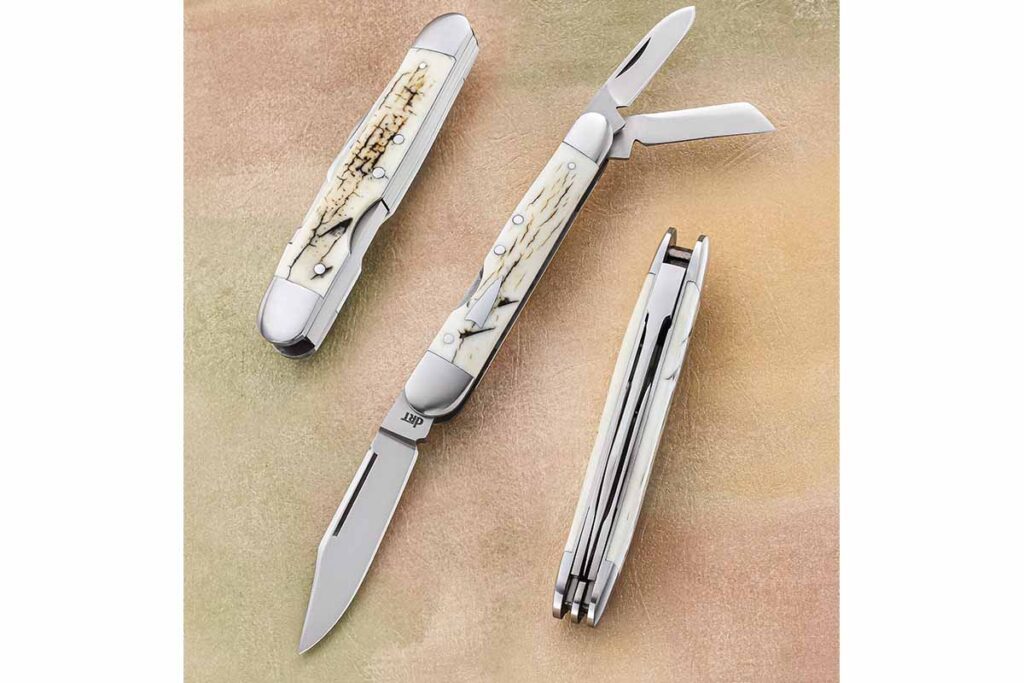
Taber’s rendering of the lockback whittler features hollow-ground blades of CPM 154 stainless steel and a mammoth ivory bark handle. The main locking blade length is 3 inches and his price for a comparable piece would be $2,100. He attributes an early interest in the lockback whittler to comments made by BLADE Magazine Cutlery Hall-Of-Fame® member Tony Bose in a 2008 issue of BLADE® relating to the skill level required to make one.

BLADE Magazine Cutlery Hall-Of-Fame® member Tony Bose (Kerry Hampton image)

“I was intrigued and called Tony,” David remembered. “That single conversation started a lasting friendship and started me collecting and eventually making knives. In later years he challenged me to make a lockback whittler and shared his pattern with me. He said, ‘If you can make one of these, David, you will have arrived.’”

Taber took on the task with gusto and through personal experience describes the challenge. “The difficulty, in my opinion, lies in centering the main locking blade in the closed position between the two slip-joint blades at the opposite end without rubbing during function. Equally difficult is balancing the two springs that operate the two slip joints on the one end and the underside of the lockbar on the other end. Think of it like a sophisticated teeter-totter,” he explained. “Care must also be taken to maintain the length, particularly the end that controls the lock tab. It has been my experience that to shorten it even the slightest amount will increase the load deflection rate and thereby make the lock tab not function properly.”

David Taber’s lockback whittler sports hollow-ground blades of CPM 154 stainless steel, stainless bolsters and a mammoth ivory bark handle. His price for a similar knife: $2,100. (SharpByCoop knife image)

The level of difficulty in making the lockback whittler contributes to its collectability, Taber says, which in turn makes the design rarer in the marketplace. “The typical collector of the lockback whittler is usually aware of the skill required to make such a knife and achieves great satisfaction from owning one,” he reasoned.

MOST DIFFICULT?

Knifemaker Luke Swenson shares a connection to Bose with Taber. The Case-Bose collaboration effort introduced Swenson to the design. “The blade configuration and the smaller blades being half the thickness of the main blade set it apart from other patterns,” he commented.  “Some whittlers have a ‘catch bit’ or a piece of liner material to hold the blades apart at one end so the main blade clears, and some have a tapered wedge, commonly called a splitback. In the case of the lockback whittler, there is a full spacer that rests between the rear slip-joint blades. Also, in a lockback whittler the small blades and spacer are exactly one-third the thickness of the main blade. The main blade locks, and I believe this is for safety and allows for harder use.”

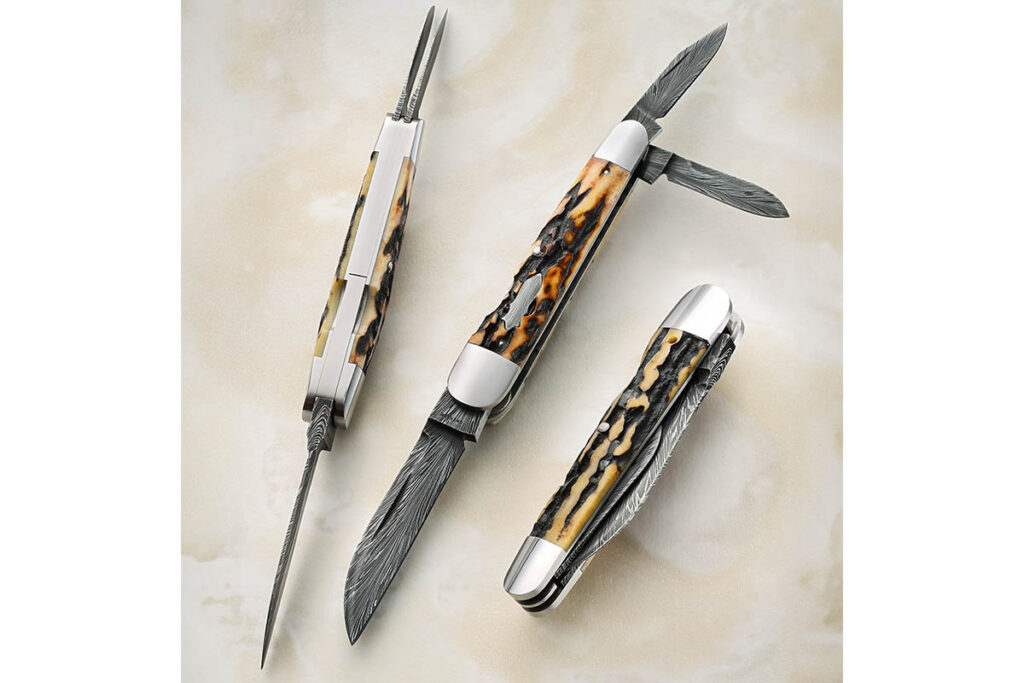
Swenson’s lockback whittler features a hollow-ground 2.8-inch blade of feather damascus forged by Mike Tyre. The fittings are 416 stainless steel and the handle is natural stag. Luke’s price for a similar piece is around $3,000. He describes the lockback whittler as “the most difficult pattern to build, even more so than a six-blade. I believe it isn’t just the combining of elements, but the springs are somewhat tricky in that you have to be paying attention—one false move, or even one over-aggressive pass on your grinder, and you’ll be making new springs. Grinding the small blades isn’t easy and requires a developed feel for getting them right. Very challenging! But if it’s right, the results are magic.”

Feather damascus forged by Mike Tyre comprises the hollow-ground blades of a lockback whittler by Luke Swenson (inset)in natural stag and integral bolsters and liners of 416 stainless. Closed length: 4 inches. Luke’s price for a similar knife: $3,000. (SharpByCoop knife image)

According to Luke, the construction of the slip joint and the lockback are completely different, at least in the opening stages. Putting the two mechanisms together with tiny parts, delicate springs and narrow tolerances tests the skills of the knifemaker in an extraordinary way. “The blades have to sit in the handle to make their tips sit in the handle,” he concluded, “and yet the nail nicks have to be accessible. That takes time and patience to get right.”

Renowned custom knifemaker Wolfgang Loerchner happened past Swenson’s table at the East Coast Custom Knife Show some time back and asked if Luke could make a lockback whittler. “This was in the March of that year, and we agreed on a BLADE Show delivery in June,” Luke laughed. “Keep in mind I’m an unknown maker, and starstruck doesn’t quite describe what I was feeling. I said, ‘Sure, I can get one built.’”

From there, Swenson went to “The Maestro,” Cutlery Hall-Of-Famer Bill Ruple. “He was quite amused and laughed, a little more than was polite I thought, but he agreed to help me through the process,” Luke recalled. “Like all my slip-joint making, anything I learned to do right was in Bill Ruple’s shop. He was key. I don’t believe I would have made the deadline if he hadn’t helped me. I’d send him pictures, and he’d say, ‘remake this and fit it like this instead.’”

The bottom line for the Swenson lockback whittler is its tremendous appeal. “It is a sleek, streamlined beauty,” he offered. “Like anything Tony Bose decided to do, it is elegant and feels comfortable in the hand.”

COMPLEX SIMPLICITY

When knifemaker Tim Robertson envisions his next lockback whittler project, he knows what he’s getting into. “What truly makes the lockback whittler so difficult to build is the way the springs operate,” he noted. “The slip joint is a standard arch spring pushing down on the blade tang while also lifting up at an equal force on the rear of the lockbar, keeping the blade firmly in position. Too much load on either end loosens the opposite end. In a nutshell, the springs have to be balanced between lockbar function and slip-joint function.”

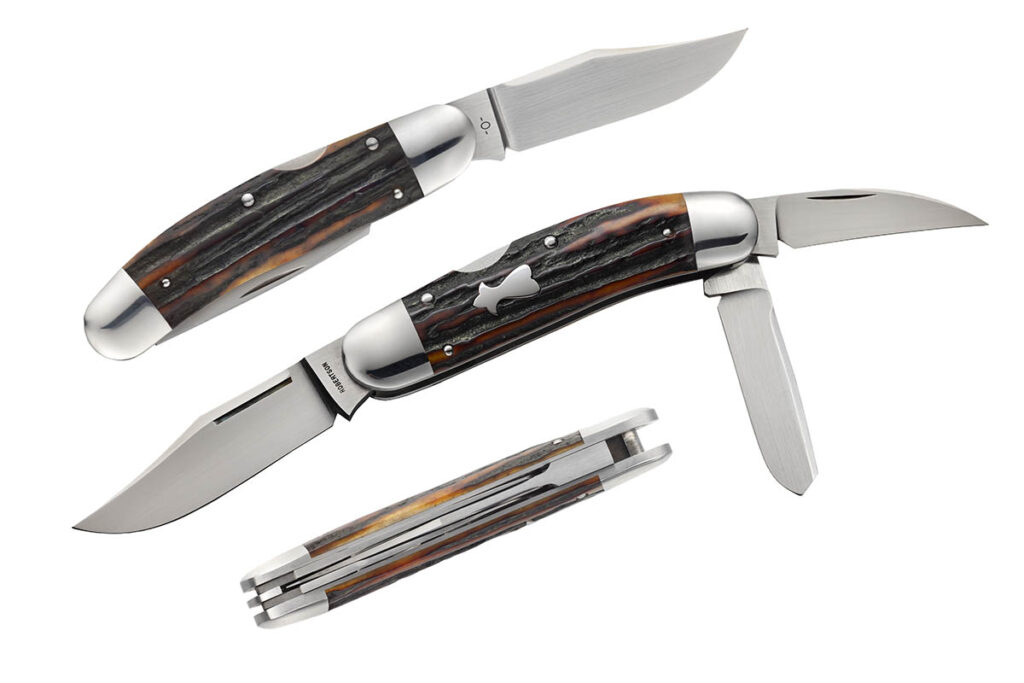
According to Tim Robertson, “The lockback whittler is appealing due to the complexity of the multiple parts and simplicity of design and operation.” Note the spacer that separates the two smaller blades Robertson mentions in the story at the bottom of the closed knife at right. (Mitchell Cohen knife image)

Robertson has become well known for his lockback whittler proficiency, and two recent examples have won awards. His winners of Best Locking Folder at BLADE Show West 2022 and the 2023 Knifemakers’ Guild Best Multiblade Folder both sport CPM 154 stainless blade steel, 416 stainless frames and stag handles. His prices for similar knives would be about $2,500 each.

With a simple explanation for his foray into lockback whittlers, Robertson remarked, “I just wanted to see if I could do it. The lockback whittler is appealing due to the complexity of the multiple parts and simplicity of design and operation.”

Defining the whittler as a knife with three blades and two springs, Tim commented, “The most common types are the splitback variety with a tapered spacer separating the two pen blades. The reason for the tapered spacer is to allow clearance for the blade to fold into the handle without having to have the main blade thickness increased, and then offset ground for the clearance so that one pen blade falls on each side of the main blade.”

SIDE-BY-SIDE KNIVES

Knifemaker Rhidian Gatrill consulted friend and historian Neal Punchard on the origin of the lockback whittler. In response, Rhidian learned that the earliest examples of it were probably made in Sheffield, England, a major center of European cutlery, and later by German and American cutlers.

“It is a premium pattern and difficult to make, so not many companies took on the challenge,” Gatrill explained. “Some of the early Sheffield multiblade sportsman knives and a few rare jackknives had lockback main blades and slip-joint blades, but they are basically two knives side by side. There’s nothing quite like the lockback whittler. There are a few other pocketknives that have locking main blades and slip-joint secondary blades, but they’re not lockback knives. The electrician knives, for example, have a [locking liner] on the screwdriver blade. And there are pen-blade-release knives where the small secondary pen blade gets pushed in to unlock the main blade.”

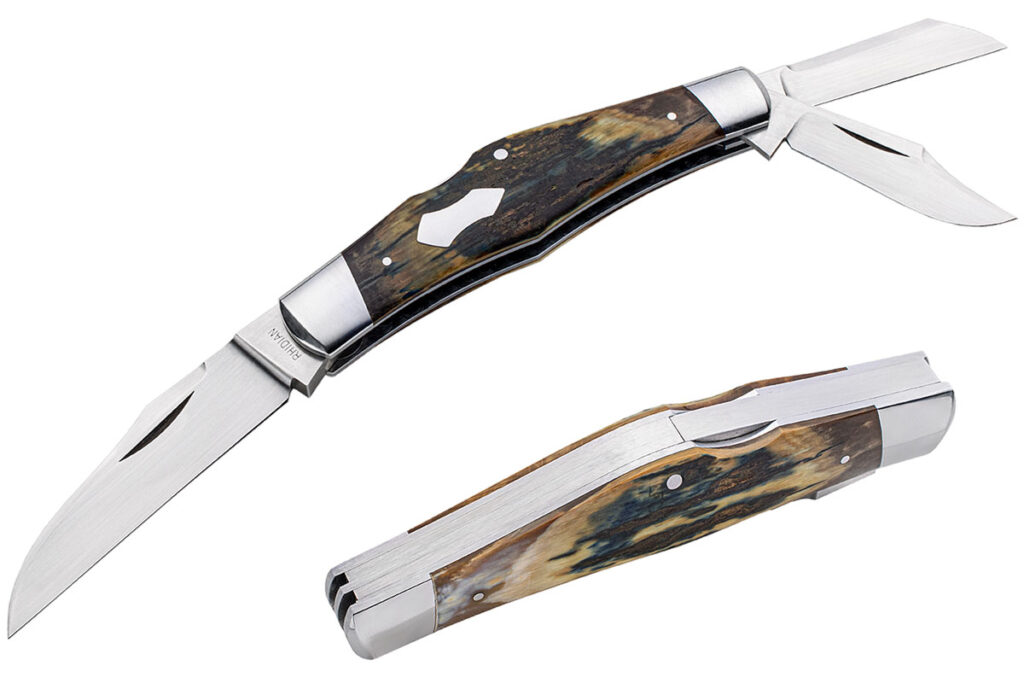
Rhidian Gatrill’s Lockback Rhiddler captured Best Folder in the custom category at last year’s BLADE Show West. The cleverly named lockback whittler features a locking 2 7/8-inch flat-ground wharncliffe and 2-inch hollow-ground slip-joint clip and coping blades of CPM 154 stainless steel. His price for a similar knife: $2,600. (Jocelyn Frasier knife image)

Motivation to make the challenging pattern was easy for Gatrill, who won Best Folder at BLADE Show West 2023 for his lockback whittler cleverly named Lockback Rhiddler. “I like interesting mechanisms and figuring out how to make them work,” he related. “I wanted to challenge myself and see how hard it was to make. Plus, I was attending my first knife show ever, which was the Oregon Knife Collectors Association show in Eugene, Oregon, and I wanted to take something that would possibly win an award. That knife ended up winning Best Folder and Best of Show.”

Looking for examples of lockback whittlers that were striking in appearance and function, Rhidian did some research and recalls, “Like most pocketknife makers, I admire the knives of Tony Bose, Bill Ruple, Ken Erickson and other masters that came before me. I traced photos of their knives and read forum posts that give a few tips, and I asked a few questions from other maker friends that have made lockback whittlers.”

That research led to an opportunity to present a lockback whittler interpretation that resonated with the collector community. “I believe knife collectors like them for their rarity, complexity of mechanism, and interesting function of combining the lockback blade with the slip-joint blades,” Rhidian concluded. “They also look cool with the thick tang on the main blade that steps down thinner and tapers to a point. A locking blade is always a little safer than a slip joint technically, so there’s that for the user. Not many custom makers have made them, and those who do don’t make many!”

Read More

Advertisement

Must Read Articles

Read this before you make a knife

Knifemaking 101 – Read This Before You Make a Knife

  by Wayne Goddard My experience has taught me that there's nothing like digging in and getting started. I've often said the hardest part of the...
how to forge damascus steel

How to Forge Damascus

Advertisement
Advertisement